internal fractures shake Gabon’s grand lodge as succession battle intensifies
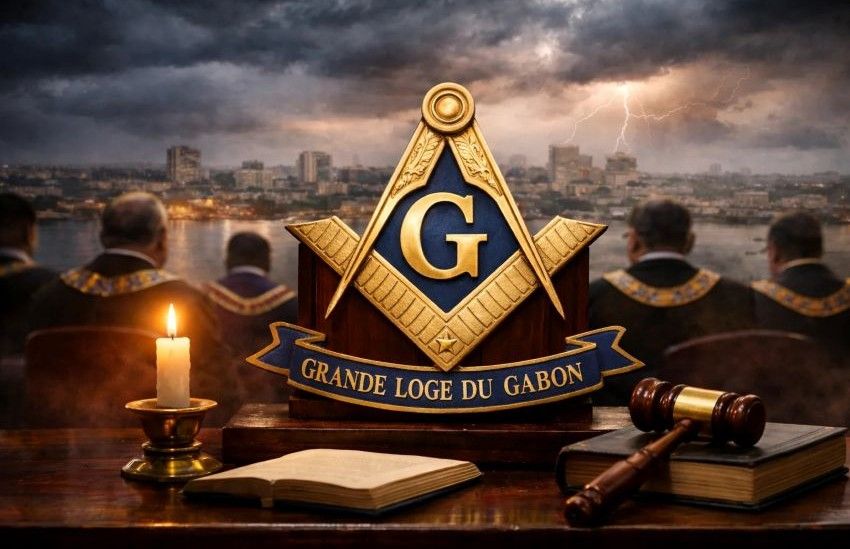
Libreville — For generations, Gabon’s Grand Lodge has operated with deliberate discretion, cultivating an image of resilience amid political turbulence. Yet today, that carefully constructed facade is cracking under the weight of an unprecedented internal crisis.
With a pivotal general assembly looming, the country’s most influential masonic order is embroiled in a bitter struggle pitting succession disputes against financial irregularities, clan rivalries, and a growing exodus of members. What began as routine administrative friction has evolved into a profound reckoning for an institution that long prided itself on unity and moral ascendancy.
Observers describe an atmosphere of palpable tension within the lodges of Gabon, where the principles of brotherhood and harmony have given way to open discord. The crisis transcends the walls of the temples, exposing fractures that have festered beneath the surface for years.
the end of an era of unchallenged authority
To grasp the magnitude of this upheaval, one must examine Gabon’s shifting power dynamics. For decades, the alliance between political leadership and masonic authority provided a stabilizing force. When the head of state simultaneously held the title of Grand Master, dissent remained subdued under an unassailable hierarchy.
The turning point arrived in August 2023. Despite expectations that incoming President Brice Clotaire Oligui Nguema would assume the Grand Master’s mantle, he declined, opting instead to relinquish the dual role. By February 2024, Jacques-Denis Tsanga was installed as the new leader of the Grand Lodge of Gabon (GLG).
This departure from tradition carried dual implications. To some, it signaled a deliberate move toward depoliticization. To others, it removed the very glue that had held the organization together, unleashing long-suppressed ambitions and rivalries.
a contested leadership exposes deep divisions
Three years into Jacques-Denis Tsanga’s tenure, the GLG finds itself at a crossroads. Supporters credit him with structural reforms—restructuring provincial lodges, enhancing asset management, and expanding the order’s international footprint. Critics, however, condemn what they describe as an overconcentration of power, opaque decision-making, and mishandling of sensitive matters.
The erosion of trust is evident in the numbers. Once boasting six hundred members, the GLG now counts barely two hundred active participants. A wave of expulsions, suspensions, and voluntary departures has left the institution weakened and deeply divided.
As the general assembly approaches, the stakes could not be higher. A slate of candidates—veteran leaders, high-ranking officials, and rising voices—now vie for the top position. The contest is no longer symbolic; it will determine the future trajectory of the GLG itself.
searching for a new center of gravity
The crisis gripping Gabon’s masonic order reflects broader shifts in the country’s centers of influence. Long shielded by its proximity to state power, the GLG now confronts the realities of autonomy—and the fractures that proximity once obscured.
The irony is stark. Those who once decried the fusion of political and masonic authority now witness the instability that separation has wrought. Without a unifying figure at the helm, the once-cohesive structure is fragmenting, with ambitions turning from collaboration to confrontation.
The outcome of this struggle will define more than just the next Grand Master. It will test the GLG’s capacity to forge a leadership acceptable to all in an increasingly competitive and fragmented environment. In organizations as in nations, when the gravitational pull of central authority weakens, factions do not fade—they collide.
Gabon’s Grand Lodge stands at a pivotal moment. If it can channel this period of turmoil into renewal, it may emerge stronger. If not, the ongoing discord risks cementing a permanent schism within its ranks.
For an institution that has long thrived on secrecy, the public fractures now on display are symbolic in their own right. They underscore a timeless truth: even the most entrenched establishments must confront the question of unity when authority ceases to be absolute.