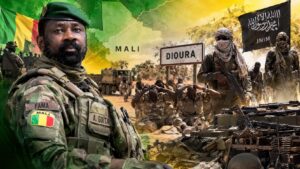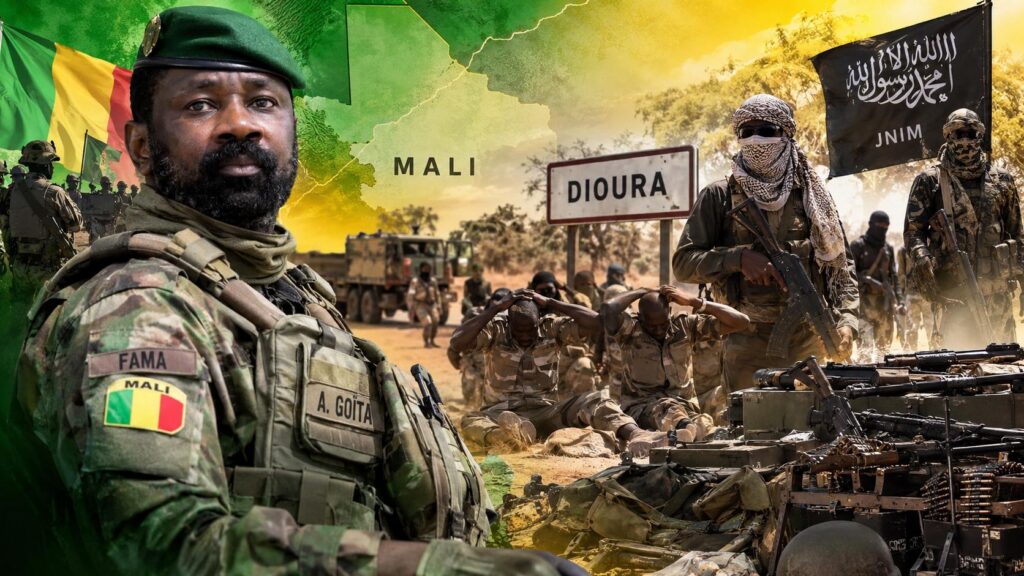
Gunfire broke the silence of Dioura at first light on Thursday, 10 September 2026. Fighters belonging to the Groupe de soutien à l’islam et aux musulmans (JNIM), the Al-Qaeda-linked coalition, swept into the town’s military base in the Tenenkou cercle of central Mali and reduced it to a scene of carnage within hours.
The camp was bombarded, then overrun, then emptied of its equipment before the assailants withdrew with heavy weapons and a large group of captives in tow. Local counts point to approximately 130 Malian soldiers killed and up to 70 taken prisoner — the gravest single blow the national army has suffered since the insurgency began, and a brutal answer to the junta’s promises of restored sovereignty and peace.
A garrison caught unprepared at daybreak
Dioura had long been treated as one of the forward positions meant to hold Mali’s centre together. That illusion collapsed in a matter of hours. Mobile armed columns moved in from several directions, and the defenders — outnumbered, thinly spread and unable to call in rapid reinforcement — could not hold the perimeter.
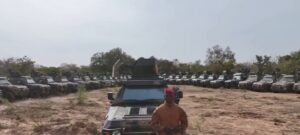
What followed was not a raid but a methodical dismantling: ammunition stores emptied, vehicles driven away, weapons loaded onto pickup trucks. When the attackers finally pulled back, they left behind a garrison that no longer functioned and a population that had watched the whole thing from behind closed shutters.
The human cost, and the silence that surrounds it
Official communication from the Forces armées maliennes (FAMA) and the transitional presidency has been minimal, as it usually is when the news is catastrophic. What reaches the outside world instead comes from the locality itself, and the accounts converge on a devastating total.
Around 130 Malian soldiers are said to have died in the fighting, while roughly 70 others were led away alive. The strategic humiliation is difficult to overstate: an entire garrison effectively erased from the map, its survivors now bargaining chips, its armoury in enemy hands.
What the insurgency’s own footage showed
Propaganda material released shortly afterwards displayed rows of young conscripts staring into the camera, visibly terrified, alongside stockpiles of confiscated rifles and ammunition. For the families of the missing, that footage is the only confirmation they have been given. In Bamako, officialdom has offered neither a clear statement nor a timeline, leaving the bereaved to piece together the fate of their relatives from rumour and video clips.
Moscow’s partnership under scrutiny
The scale of the disaster strikes directly at the security doctrine championed by the military government of Colonel Assimi Goïta. Since the coup and the geopolitical turn towards Moscow, the narrative has been one of a rebuilt, modernised army sweeping the terrorist threat aside with Russian support.
The events at Dioura expose the distance between that narrative and the battlefield. With international missions such as MINUSMA and Barkhane pushed out, and with Russian auxiliaries unable to impose order across a vast territory, Malian units are left exposed, under-equipped and stretched far too thin. Forward bases like the one at Dioura now find themselves encircled by fast-moving armed groups that choose their targets and their timing at will.
Mopti’s civilians bear the heaviest burden
Beyond the military ledger, it is the civilian population of the Mopti region that absorbs the consequences. In Dioura, bewilderment has hardened into resignation.
“Every time a base falls or pulls back, we already know what is coming — reprisals, fear and a void,” one resident of the area told me, speaking on condition of anonymity. “In Bamako, sovereignty is discussed on television. Here we have no protection, no administration and nothing to look forward to.”
Shuttered markets and severed roads
Trade in the zone has ground to a halt. The weekly fairs that anchor local commerce have been called off, insurgents have cut the roads linking villages to larger towns, and bringing in basic goods has become an exercise in luck. Fearing reprisal raids or being caught between rival armed groups after an attack of this magnitude, many villagers have abandoned their homes for the bigger urban centres, swelling the ranks of internally displaced people with barely a ripple of attention beyond the region.
An impasse that no communiqué can hide
Dioura is more than a military defeat; it is a warning about where the transition is heading. By investing in the war of communication rather than the reality of operations, the authorities in Bamako are narrowing their own options. Shrinking troop numbers, deteriorating morale and the steady loss of control over the centre and north of the country raise a question that grows louder with each attack: how long can reclaimed sovereignty be used as a screen for a collapsing security situation?
Without a genuine rethink of alliances, of military tactics and of how the state speaks to the communities it claims to defend, Mali risks sliding further into a cycle in which soldiers and civilians alike keep paying the highest price for political blindness.