Civilian casualties in a suspected Nigerian military drone strike
A drone strike in the Niger village of Kokoloko, near the border with Burkina Faso, reportedly killed at least 17 civilians, including four children, and injured 13 others on January 6, 2026. The attack also resulted in the deaths of three Islamist militants, according to reports.
Violation of international humanitarian law
The strike occurred in a bustling market where hundreds of civilians were present, including women and children. Witnesses reported seeing a white drone circling the area twice before dropping a munition around 1:30 PM local time, triggering a devastating explosion. The attack has raised serious concerns about compliance with international humanitarian law, which prohibits indiscriminate attacks and requires parties to distinguish between combatants and civilians at all times.
«The strike in Kokoloko not only failed to target combatants but also resulted in a tragic loss of civilian lives, a clear violation of the laws of war», said a senior researcher at a leading human rights organization. «The Nigerian authorities must conduct a transparent and impartial investigation, hold those responsible to account, and provide adequate compensation to the victims and their families.»
Witness testimonies reveal the horror of the attack
Survivors described the harrowing moments leading up to the strike. A 36-year-old merchant recounted: «I saw a white drone flying overhead, followed by a whistling sound and a massive explosion. The market was crowded with women and children selling food—rice, meat soup, and other essentials. Their children were there too.»
Witnesses also noted that three Islamist militants from the Islamic State in the Sahel (EIS) were present in the market at the time of the strike, dressed in civilian clothing with turbans. The militants, reported to be unarmed, were shopping alongside civilians before the attack. «They come to the markets regularly, buy supplies, and leave», explained the merchant.
Aftermath: destruction and displacement
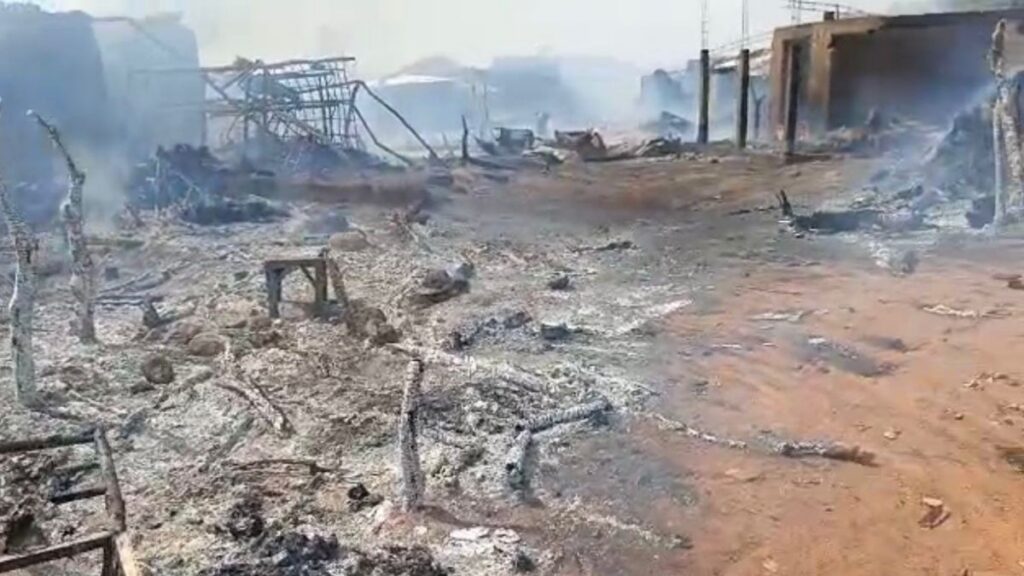
The strike left behind a scene of devastation. Charred remains of victims, primarily women and children, were found scattered across the market. A 67-year-old religious leader who visited the site later in the day reported: «I counted 17 bodies, mostly women and children. The bodies were burned beyond recognition, making identification extremely difficult.» The victims were buried in a mass grave, with women and children placed together in one section and men in another.
Satellite imagery and fire detection data from NASA’s Fire Information for Resource Management System (FIRMS) confirmed active fires in Kokoloko at 1:31 PM local time on the day of the attack. High-resolution images taken weeks later revealed burned areas along the village’s main road, indicating the intensity of the fire fueled by market stalls and stored fuel.
In the immediate aftermath, nearly all 1,200 residents of Kokoloko fled to neighboring villages or crossed into Mali. A woman who lost her 50-year-old cousin and 5-year-old nephew shared: «We spent the first night in a nearby village with my children. Then, we crossed the border into Mali with almost nothing.»
A list compiled by locals detailed the identities of the victims: 11 women aged 29 to 50, two men aged 32 and 55, and four children aged 5 to 10. Among the injured were four women aged 28 to 45, seven men aged 23 to 62, and two children aged 14 and 15.
Accountability and international concerns
The Nigerien military junta, which seized power in a 2023 coup, has not publicly addressed the strike. Human rights organizations have called for an independent investigation, emphasizing that deliberate or reckless attacks on civilians may constitute war crimes under international law. The junta has yet to respond to inquiries about the incident.
Since 2022, the Niger Armed Forces have acquired advanced Turkish-made drones, including the Bayraktar TB-2, Karayel-SU, and Aksungur UCAV, which are capable of carrying guided munitions and providing real-time surveillance. While the specific type of drone and munition used in the Kokoloko strike remains unconfirmed, the extent of the damage suggests the use of a powerful explosive device.
Human rights advocates have urged foreign governments supporting Niger’s military to pressure the authorities into adopting measures to protect civilians. «The government must ensure that victims receive medical care and trauma support while providing adequate compensation to those affected by this tragedy», stated a senior researcher.
Broader context: escalating violence in the Sahel
The Tillabéri region, where Kokoloko is located, has been a hotspot for violence, with the Islamic State in the Sahel (EIS), the Niger Armed Forces, and the Group for the Support of Islam and Muslims (GSIM)—an Al-Qaeda affiliate—engaging in clashes that increasingly target civilians. According to the Armed Conflict Location and Event Data Project (ACLED), Tillabéri recorded the highest number of civilian casualties in the central Sahel in 2025.
This incident is not isolated. In September 2025, airstrikes in the nearby village of Injar reportedly killed over 30 civilians. Similarly, in January 2024, drone strikes in the village of Tiawa resulted in civilian casualties. These recurring attacks highlight the urgent need for stricter adherence to international humanitarian law and greater accountability for military operations.