Rising insecurity exposes gaps in Niger’s military strategy
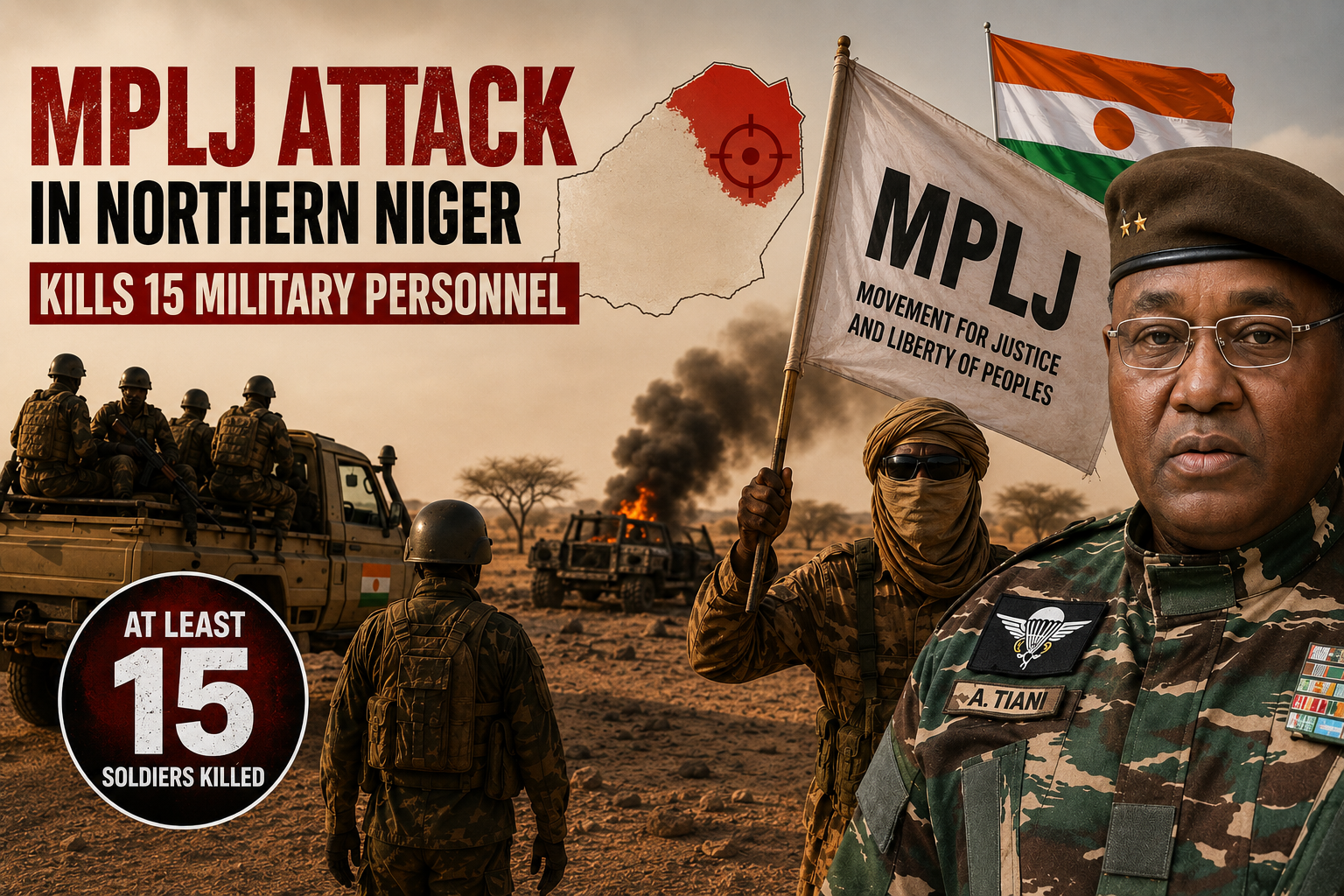
In Niger, escalating security threats continue to undermine the military junta’s claims of sovereignty. The latest attack, attributed to the Movement for the Justice and Liberty of the Peoples (MPLJ), struck the northern region, leaving at least 15 soldiers dead. This incident spotlights a harsh truth: the administration led by General Abdourahamane Tiani struggles to fulfill the most basic state duty—ensuring the safety of its citizens and exerting control over its territory.
Challenges of securing vast and remote regions
The attack raises critical questions about the operational readiness of Niger’s armed forces to monitor the country’s vast desert expanses and porous borders. Niger’s enormous landmass, coupled with long frontiers shared with neighboring states facing their own armed conflicts, creates vulnerabilities. Unmonitored zones can quickly become havens for armed groups, allowing them to regroup, launch strikes, and vanish before security forces respond.
This is not merely a case of an isolated assault. It reflects deeper flaws in a security approach that remains overly reliant on immediate military responses, while neglecting intelligence gathering, sustained administrative presence, cross-border cooperation, and long-term efforts to prevent armed groups from establishing permanent footholds.
Limits of shifting blame in crisis
With each new setback, public officials face mounting pressure to assign fault. After criticizing France, severing ties with ECOWAS, and accusing regional neighbors, the government’s rhetoric appears to have run its course. Will it now point to Algeria, a key neighbor and essential partner, or will it re-examine its new strategic alliances? The tactic of deflecting responsibility is losing its effectiveness.
Since the July 2023 coup, the military leadership has built much of its legitimacy on breaking from past security policies. Sovereignty, rejection of foreign interference, and forging new partnerships have dominated official statements. Yet for civilians in affected areas, the most pressing concern is far more immediate: the ability to live, travel, work, and sleep without fear of armed assaults.
The gap between global posturing and local reality
A striking paradox defines governance in Niamey: an outward display of geopolitical savvy contrasts sharply with a troubling disconnect from the realities on the ground. While officials advocate sovereignty on international stages, borderlands and desert regions sink deeper into a security vacuum exploited by armed factions.
This contradiction underscores a fundamental truth: sovereignty is not measured solely by denouncing foreign influence or reshaping diplomatic alliances. It is defined by an administration’s ability to assert authority over its land, secure its borders, and protect its people.
Military rule tested by persistent violence
The surge in attacks far from the capital poses a major test for military governance. The longer violence continues, the more urgent it becomes for authorities to demonstrate that the diplomatic and military shifts since 2023 have yielded tangible improvements on the ground. Nigerien citizens cannot indefinitely accept political declarations while lives continue to be lost.
Alliances are due for scrutiny—without prejudice. Seeking new partners is not inherently wrong; it can even be a legitimate strategy if it strengthens national defense. Yet switching allegiances does not automatically equate to a new security doctrine. Outcomes matter most: timely intelligence, attack prevention, civilian protection, securing key routes, and maintaining state presence in vulnerable areas.
Diplomatic isolation as a security liability
Niger’s strained relations with some regional partners may also weaken its position. Armed threats do not respect political boundaries. Groups operating across the Sahel exploit transnational spaces to move, regroup, and regroup. Combating them requires cooperation, intelligence sharing, and coordination—tools that diplomatic tensions can erode.
It would be shortsighted to blame frontline troops alone for military failures. Soldiers operate under extreme conditions shaped by intelligence quality, logistics, command structures, aerial and ground capabilities, and the clarity of long-term strategy. Losses must prompt a thorough review of the entire security framework—not a search for external scapegoats.
Restoring constitutional order: a path to sustainable security
In the aftermath of institutional disruption and unmet security promises, national actors—both military and civil society—must reassess the current trajectory. A prompt return to constitutional rule offers the only credible foundation for democratic legitimacy and durable alliances capable of tackling terrorism.
Security cannot endure on nationalist rhetoric alone. It demands strong institutions, a clear national strategy, pragmatic regional cooperation, and an administration present even in the most remote territories.
The MPLJ attack is more than another violent episode in the Sahel conflict. It serves as a stark reminder: true sovereignty begins when a state can protect those living under its authority.