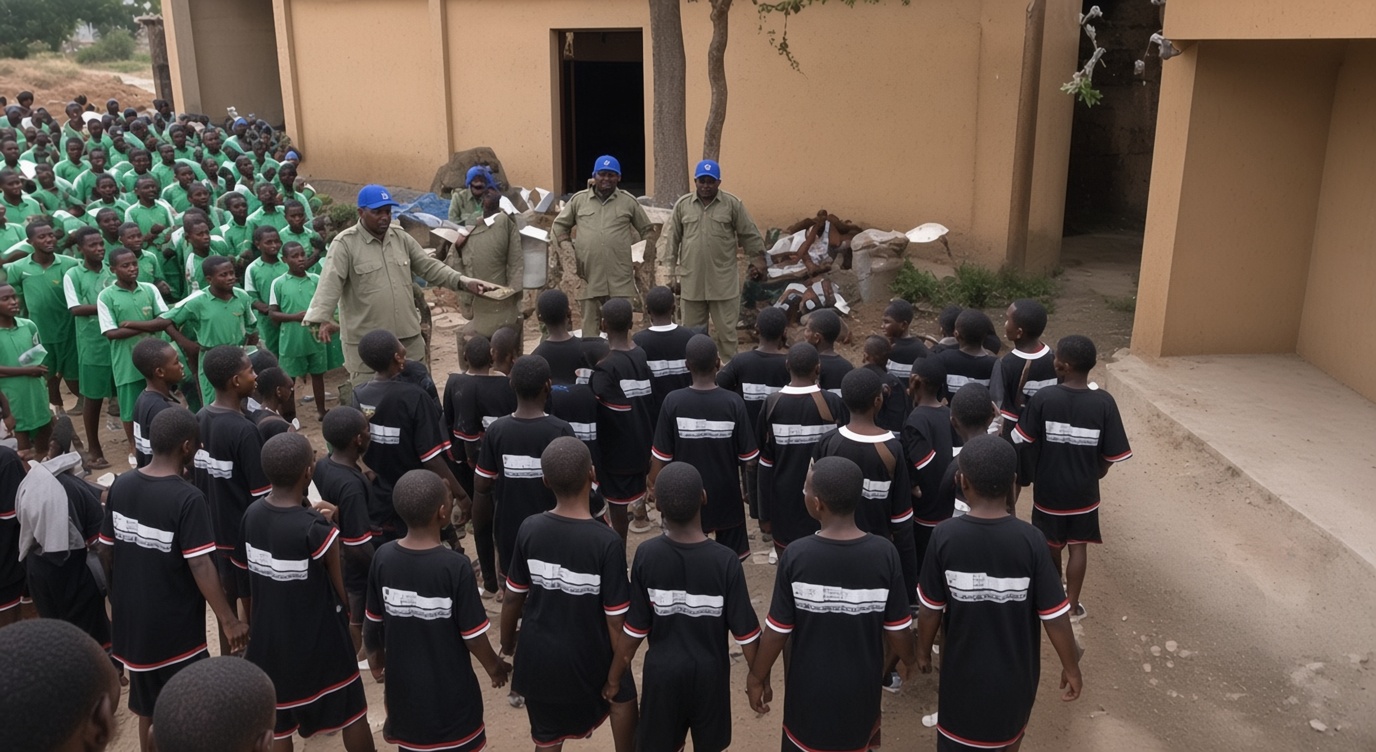
General Abdourahamane Tiani has recently inaugurated a training camp bringing together over 300 young Nigeriens. While presented under highly appealing auspices such as civic engagement, national resurgence, and foundational reform, this initiative directly emulates the Burkinabè model championed by Captain Ibrahim Traoré. However, behind this meticulously crafted communication and the exaltation of ‘committed youth,’ a more concerning reality may be taking shape: the military regime appears to be establishing the foundations for premature militarism, cloaked in patriotism.
Children and adolescents simply do not belong in militarized or pre-militarized environments. At this formative age, education, vocational training, sports, cultural activities, and the acquisition of citizenship skills should be paramount. Shaping developing minds around military discipline, obedience, and constant mobilization risks progressively normalizing the use of arms and confrontation.
The political message and critical thinking
The danger, therefore, extends beyond the nature of the camp itself to the political message conveyed to an entire generation. When a military authority frames youth mobilization as a patriotic imperative, there is a distinct risk of prioritizing loyalty to the regime over the cultivation of critical thinking. Genuine civism, however, does not imply blind obedience to authority; it necessitates the capacity to question, debate, and advocate for the general interest.
The boundary between civic education and indoctrination becomes particularly tenuous when young individuals are consistently exposed to a rhetoric of combat, sacrifice, and national defense. A mobilized youth can serve the nation, but it must never transform into a human reservoir designed to perpetually support a military power.
Prioritizing development over ideology
This approach also raises a fundamental inquiry: why dedicate substantial resources to the ideological mobilization of youth when thousands of young Nigeriens are primarily in need of functional schools, relevant vocational training, employment opportunities, robust infrastructure, and tangible prospects for their future? Patriotism does not sustain a family, substitute for a diploma, or automatically generate employment.
The rhetoric of ‘mandatory civism’ can thus serve as an exceptionally convenient political smokescreen. By projecting an image of disciplined, enthusiastic, and self-sacrificing youth, the authorities may be diverting attention from economic hardships, deficiencies within the educational system, pervasive youth unemployment, and the social ramifications of political instability.
Long-term implications and regional comparisons
It is also essential to consider the long-term viability of such a strategy. A generation raised within a culture of perpetual mobilization risks perceiving the militarization of society as a normal state of affairs. What is currently presented as an exceptional initiative could, in the future, become an institutionalized model for the political and paramilitary training of youth.
The comparison with Burkina Faso equally warrants careful scrutiny. The proliferation of initiatives aimed at mobilizing young people around patriotism and national defense should not prompt Sahelian states into a competitive race to militarize their youth. While the security context is challenging, the response to insecurity cannot entail gradually transforming an entire generation into potential combatants.
Nigerien youth deserve more than to be mere instruments in a government’s public relations strategy. They merit quality education, acquire valuable skills, gain employment, enjoy freedom of thought, and have the opportunity to participate in public life without being conditioned by adherence to a specific political or military doctrine.
The enthusiasm of youth must, therefore, never serve as a moral shield to obscure governance challenges. A truly strong state is not one that teaches its children to obey and fight from an early age. Rather, it is one that provides them with ample knowledge, freedoms, and opportunities to construct the nation’s future themselves.
Authentic patriotism involves preparing citizens capable of building, innovating, critical thinking, and defending their country when the law demands it, not prematurely conditioning minds to military logic. Niger must ensure that the fight against insecurity does not become a pretext for the enduring militarization of its children and youth.