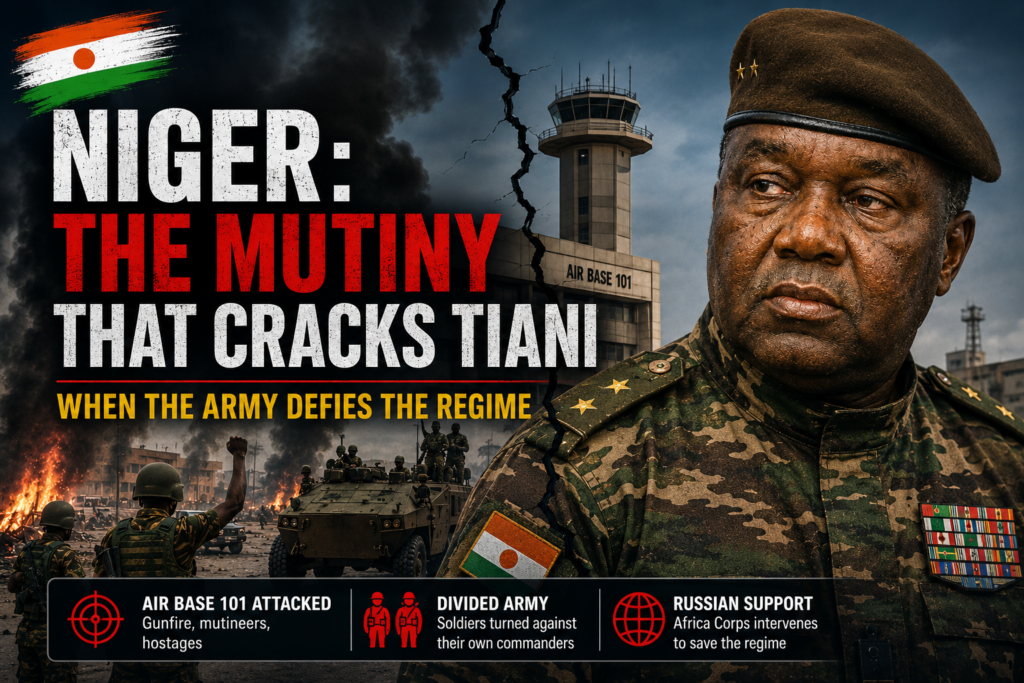
The political narrative of Niger over the past fifty years reads like a relentless loop of dashed hopes. From the downfall of Hamani Diori in 1974 to the gunfire echoing through the streets of Niamey on August 29, 2026—spanning regimes led by Baré Maïnassara and Salou Djibo—the nation has repeatedly turned to military force in search of solutions to its crises. Yet the stark reality of five decades of instability is undeniable: no coup d’état has ever delivered sustainable progress in development, national unity, or security.
Each military takeover arrives with the promise of temporary salvation, vowing to restore dignity and order. However, every such transition ultimately lingers, isolates itself, and plants the seeds of its own collapse. Recent events are not anomalies; they are the natural, predictable outcome of a political culture addicted to the seductive illusion of force.
The myth of the ‘strongman’ and the harsh truth about barracks rule
The persistent misconception in Niger’s political culture is the belief that brute power equals stability. In practice, when governance is seized through unconstitutional means:
- Military integrity crumbles: Instead of defending borders and combating terrorism, the armed forces become embroiled in internal strife. High command priorities shift from national security to monitoring barracks and thwarting internal coups—eroding operational cohesion and weakening the very institution meant to protect the nation.
- Sovereignty erodes into dependency: Devoid of popular legitimacy and robust institutions, juntas inevitably seek external patrons to prolong their grip on power. Reliance on foreign mercenaries or temporary alliances only trades one form of dependency for another, fragmenting the social fabric and undermining national sovereignty.
- The social contract collapses: Without checks and balances, an independent judiciary, or a free press, citizens are reduced to bystanders in their own nation’s fate. Public disillusionment, initially muted, inevitably fuels new waves of unrest and rebellion.
Why democracy remains the only path to lasting peace in Niger
In the face of the military trap, democracy is not a foreign imposition or a sign of weakness—it is the sole institutional framework capable of resolving crises without spilling blood.
A notable example is Niger’s democratic transition between 2011 and 2023. Despite daunting security and economic challenges, this period marked the first peaceful transfer of power in modern history. Democracy offers what armed force never can:
- Peaceful power rotation: Political leaders are replaced through ballots, not bullets—ending cycles of palace coups, ambushes, and internal mutinies.
- Global legitimacy and economic leverage: A democratically elected government commands institutional credibility, enabling long-term partnerships, foreign investment, and coherent development strategies.
- Restoration of military purpose: By restoring civilian rule, the military regains its honor and core mission: protecting the nation under a unified, respected command structure.
Choosing the future: democracy or the endless cycle of coups
Niger now stands at a pivotal crossroads. Continuing down the path of juntas and gunpower will only lead to an endless spiral of coups, purges, and regional instability.
It is time to close the chapter on military illusions. True national strength is not measured by the number of tanks parked outside the presidential palace, but by the resilience of its institutions and the trust of its people. Only a bold, unconditional return to democratic principles can free Niger from the curse of perpetual instability and guide it toward enduring peace.