BÉNIN — POLITICAL SHIFT
Romuald Wadagni inaugurated as Bénin’s president with 94% mandate after opposition barred
Romuald Wadagni took the oath of office in Cotonou on May 24, marking the start of a seven-year term. The former Finance Minister inherits an economy praised by international partners and a political landscape where dissent has been virtually erased. His victory raises questions about continuity and pluralism in Bénin’s democratic trajectory.

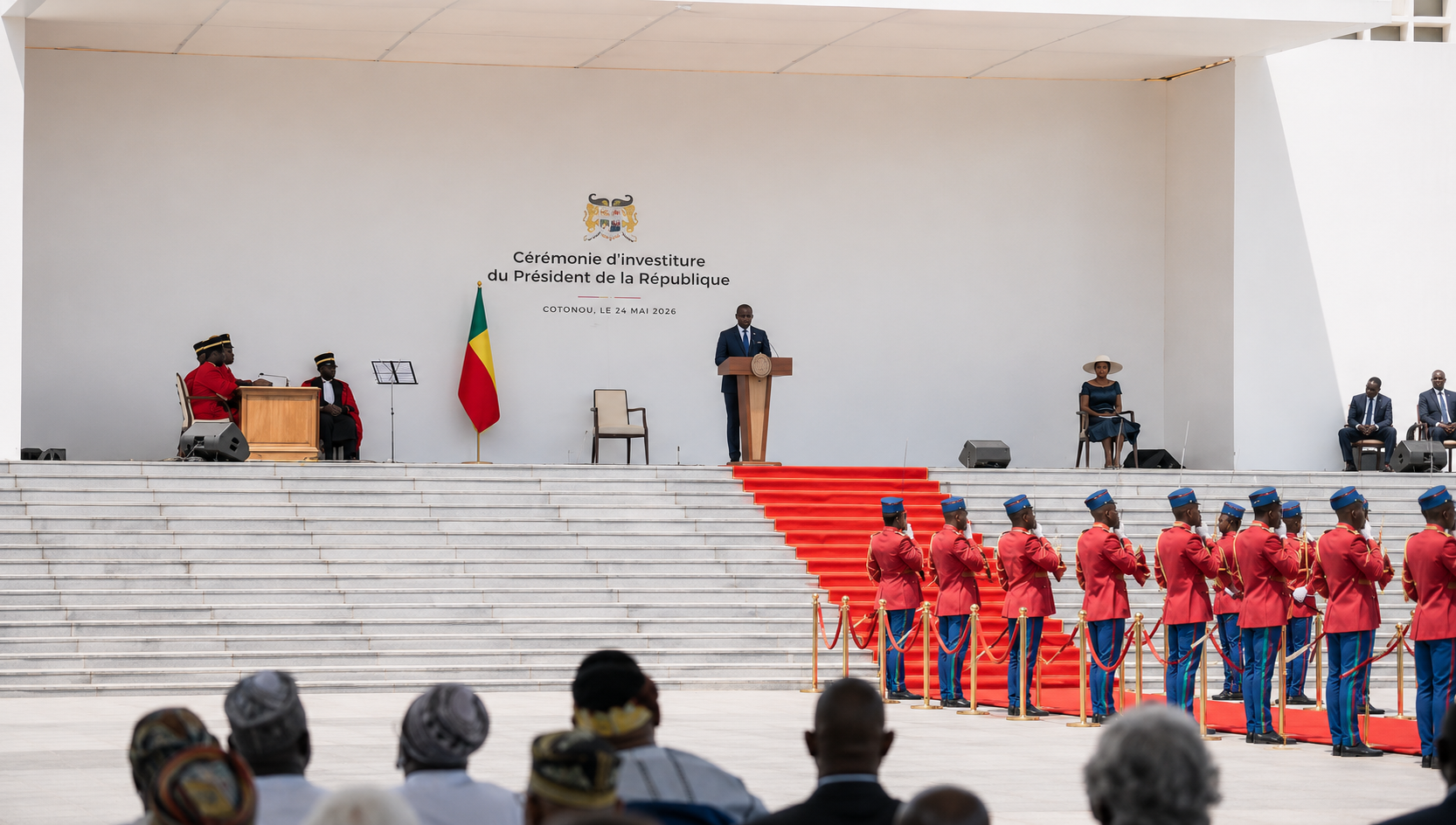
With 94% of the vote in a poll where the largest opposition party was disqualified, Romuald Wadagni’s inauguration in Bénin stands out as a defining moment for West African democracy. The former Economy and Finance Minister was sworn in at the Palais des Congrès in Cotonou, becoming the fifth president since the country’s democratic renewal in 1990. He succeeds Patrice Talon, who left office after two terms under the 2019 constitutional revisions.
An economic steward with deep ties to Talon’s legacy
Born in Lokossa, Wadagni brings a technocratic profile shaped by seventeen years at Deloitte before joining government in 2016. During his tenure as Finance Minister, he oversaw a period of sustained financial growth, including multiple international bond issuances and the preservation of Bénin’s sovereign credit rating. His April 2026 election victory came in the first round, facing only Paul Hounkpè of the Forces cauris pour un Bénin émergent (FCBE), after the main opposition coalition was barred from running. The Constitutional Court certified his 94% win, with Vice President Mariam Chabi Talata on the ticket—a provision introduced in the 2019 constitutional reforms.
Under the new constitution adopted in 2025, Wadagni’s first term lasts seven years instead of five, and presidential elections are now decoupled from legislative polls—a structural change now embedded in Bénin’s electoral calendar.
A tightly controlled ceremony in a shrinking political space
The inauguration unfolded with military precision between 9:30 AM and noon. Patrice Talon formally handed over presidential insignia during a brief meeting at the Palais de la Marina, followed by a constitutional session at 11:10 AM where the oath was administered. The event included the presentation of the Grand Collar of the National Order and the command flag to the chief of staff, in front of over 6,000 invited guests.
Former Béninese presidents Nicéphore Soglo and Thomas Boni Yayi were in attendance, acknowledged by Wadagni during his speech. While observers noted the flawless execution, the ceremony unfolded against a backdrop of a severely narrowed political field. The main opposition party, Les Démocrates, was disqualified in October 2025 when its presidential ticket—Renaud Agbodjo and Judes Lodjou—failed to secure the required 28 parliamentary endorsements due to a last-minute withdrawal. The Constitutional Court upheld the exclusion on October 27.
This follows years of contested political repression. Figures like Reckya Madougou, sentenced to 20 years in 2021 under terrorism charges, and academic Joël Aïvo, given a 10-year sentence for conspiracy, remain incarcerated. Many opposition leaders have fled into exile. The Economic and Terrorism Offenses Repression Court (CRIET), established in 2016, has repeatedly drawn criticism from human rights groups over its use against political adversaries.
Access barriers to the electoral process further marginalized dissent. High registration fees, government-controlled compliance certificates, and a 2025 threshold requiring parties to win at least 20% of votes per constituency to retain seats all contributed to an opposition-free legislature after January 2026 elections, where Les Démocrates won no seats.
Diplomatic overtures and regional security priorities
Wadagni’s inaugural address outlined two strategic priorities: translating economic growth into tangible benefits for Béninese families—especially youth, women, rural communities, and the middle class—and strengthening national security against armed groups active in the north since 2022. But the most striking shift came in foreign policy. For the first time in decades, foreign delegations—including high-level representatives from the Sahel Alliance—were invited to the inauguration, a break from Bénin’s long-standing protocol of restricting such ceremonies to domestic affairs.
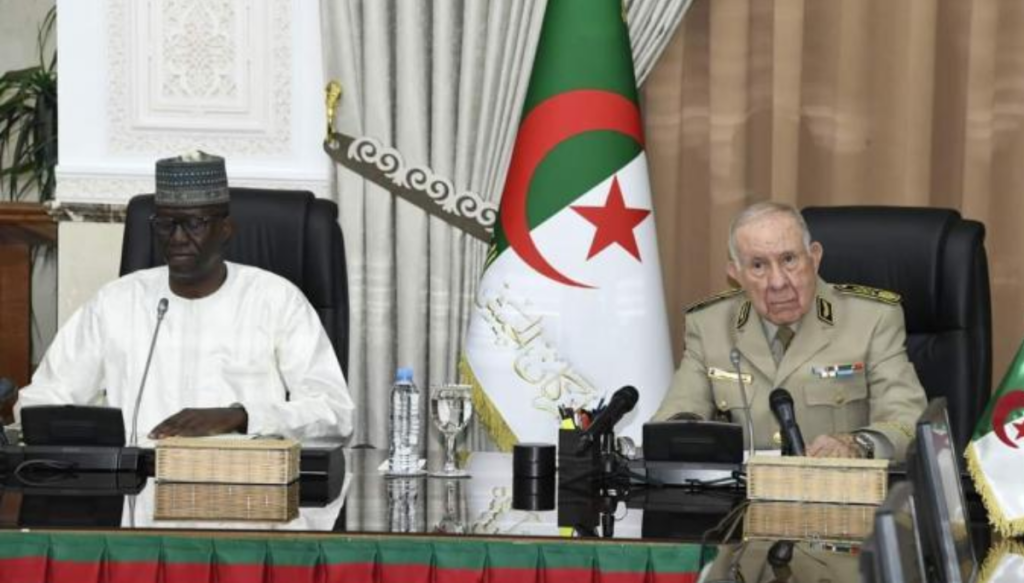
Notably, the presence of Niger’s Prime Minister Ali Mahaman Lamine Zeine drew sustained applause from the crowd, signaling a thaw in relations with Niamey. Bénin and Niger have been at odds since July 2023, with repeated closures of their shared border disrupting oil transit through the pipeline to the Port of Cotonou. Wadagni’s conciliatory tone marked a departure from his predecessor’s firm stance toward military-led governments in the Sahel.
The speech was structured around a recurring phrase—“to you, I say”—addressed to various constituencies: youth, women, rural communities, the middle class, the diaspora, and descendants of the slave trade. A dedicated segment on women’s empowerment stood out, reflecting the influence of Vice President Mariam Chabi Talata, the second-highest official in the state. After the ceremony, Wadagni personally greeted his staff, emphasizing a leadership style rooted in accessibility.
What to watch in the coming weeks
The immediate test of Wadagni’s mandate will be the composition of his new government. Will he broaden the team beyond Patrice Talon’s inner circle, or consolidate the existing power base? Another critical signal will be the fate of imprisoned opposition figures—a potential amnesty, long demanded by Les Démocrates, could signal a new political openness. Finally, the success of his regional outreach hinges on concrete gestures: an official visit to Niamey, Bamako, or Ouagadougou could mark the start of a new chapter with the Alliance of Sahel States (AES).
Bénin has entered a seven-year term under a constitution rewritten by the outgoing administration. The real question looming over this inauguration is not about stability, but about pluralism: an economy that continues to attract international investors, but a political system that leaves little room for dissent.