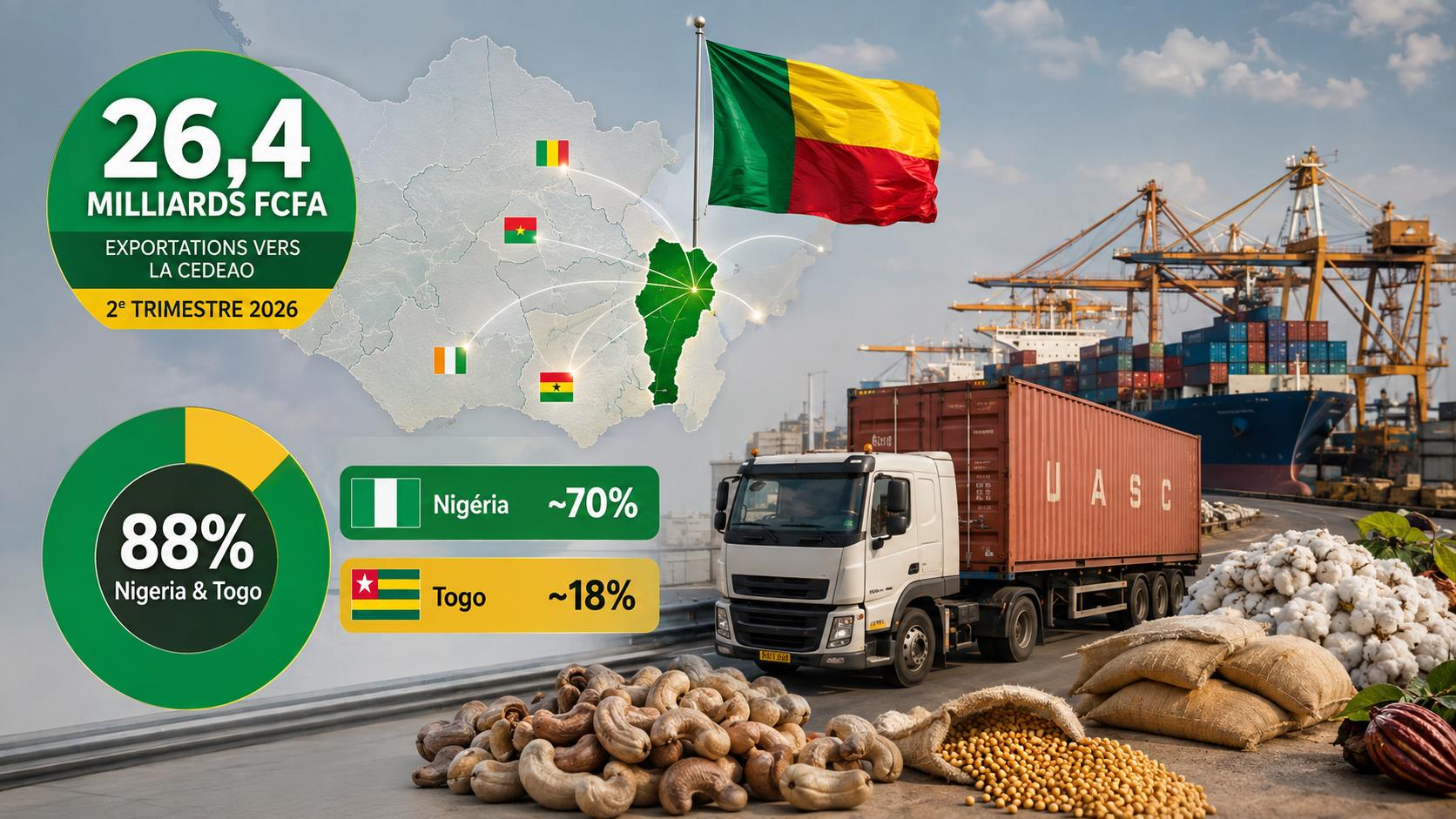
Bénin has significantly strengthened its foothold in West African markets, recording 26.4 billion FCFA in exports to ECOWAS nations during the second quarter of 2026. The substantial demand from Nigeria and Togo, which together account for nearly 88% of these sales, underscores both the immense potential of regional partnerships and the positive outcomes of an economic strategy focused on industrial transformation, enhanced competitiveness, and deeper commercial integration.
The economic indicators for Bénin during the second quarter of 2026 present a highly encouraging outlook. During this period, Bénin’s exports to fellow member states of the Economic Community of West African States (ECOWAS) totaled 26.4 billion FCFA, representing 14% of the country’s overall national exports.
Beyond the sheer volume, the composition and ultimate destinations of these trade flows are particularly noteworthy. Nigeria, the region’s leading economic power and Bénin’s immediate neighbor, independently accounts for a dominant 56.1% of Bénin’s export value within the ECOWAS bloc. Togo secures the second position, absorbing 31.7%, while Côte d’Ivoire makes up 5.1% of these exports.
Collectively, Nigeria and Togo absorb a significant 87.8% of Bénin’s exports to the broader ECOWAS region. While this concentration highlights a certain market reliance, it simultaneously presents a tremendous opportunity: to forge a more integrated regional economic zone centered around Bénin, fostering increased production, attracting crucial investments, and generating employment.
Nigeria: a strategic market
The commercial relationship with Nigeria holds a uniquely strategic position for Bénin. Its geographical proximity, the immense demographic scale of the Nigerian market, and the vibrant cross-border trade flows firmly establish Nigeria as an indispensable partner for Béninese enterprises.
During the second quarter, exports to Nigeria were notably propelled by petroleum oils and bituminous minerals, valued at 7.6 billion FCFA, representing a volume exceeding 8,500 tonnes.
Iron or steel bars, designated solely for re-export, followed closely, contributing 3.3 billion FCFA, with soybean oil and its derivatives adding another 2.3 billion FCFA to the export figures.
These figures unveil a crucial insight: beneath the surface of trade statistics lie intricate value chains, encompassing transporters, traders, port operators, processing enterprises, and a multitude of other stakeholders whose livelihoods are intrinsically linked to the seamless flow of goods.
Bénin’s present challenge involves progressing further by elevating the proportion of higher value-added products within its export portfolio. This objective aligns perfectly with the gradual transformation of the national economy, a strategic initiative actively pursued since 2016.
Economic transformation: a core strategy
Since the Patrice Talon government assumed power in 2016, Bénin has prioritized the modernization of its economy, significant infrastructure development, and the comprehensive transformation of its agricultural potential. This focus is key to strengthening the African economy today.
The declared aim is to evolve the nation’s economic model: moving beyond merely producing and exporting raw materials to instead generate substantially more value within Bénin itself.
Trade with neighboring Togo aptly illustrates this transformative momentum. Togo notably imports oilcakes and other solid residues valued at 2.2 billion FCFA, cotton seeds amounting to 1.5 billion FCFA, and unbleached cotton fabrics totaling approximately 0.7 billion FCFA.
Cotton serves as a particularly illuminating example in this context. This historic Béninese sector is no longer confined solely to agricultural production; it is progressively poised to fuel a more structured textile industry, capable of creating vital employment opportunities and generating increased revenues for all participants across its value chain.
This ambitious vision gains full traction with the ongoing development of crucial infrastructure and industrial zones, designed to attract investors and stimulate local processing. The objective is unambiguous: to ensure a greater share of the wealth generated from Béninese resources remains within the nation’s borders.
Beyond export figures: far-reaching benefits
The surge in Bénin regional trade extends far beyond a mere statistical entry in national reports; it triggers a cascading positive impact throughout the real economy.
When a Béninese company expands its external sales, it necessitates increased production, packaging, storage, and transportation of its goods. This heightened activity, in turn, mobilizes a diverse workforce including farmers, factory workers, drivers, logisticians, freight forwarders, traders, and various service providers.
A robust export dynamic invariably strengthens corporate revenues, stimulates further investment, and systematically enhances productive capacities across sectors.
For Béninese households, the anticipated advantages are multifaceted. The expansion of productive activities is poised to foster significant job creation, particularly for the youth. Upgraded infrastructure streamlines travel and the movement of goods, while the establishment of new industrial units can help diversify employment opportunities beyond conventional sectors.
Within this broader vision, infrastructure modernization emerges as a pivotal strategic lever. Enhanced roads, advanced logistics platforms, upgraded port facilities, and dedicated industrial zones collectively contribute to reducing costs and transit times—two critical factors for national competitiveness.
An economy increasingly oriented regionally
The strong performance witnessed in the second quarter of 2026 primarily underscores that the regional market offers a tangible and robust outlet for Béninese products.
While Nigeria and Togo naturally serve as primary drivers, Côte d’Ivoire’s position among the top three trading partners confirms that Béninese businesses have a considerably expansive commercial territory yet to explore and conquer within West Africa. This highlights the potential for broader pan-African news regarding trade.
Specifically towards Côte d’Ivoire, unbleached cotton fabrics alone account for 1 billion FCFA in sales. Printed materials, water-based varnishes and paints, alongside various plastic materials, further diversify these trade exchanges.
This geographical diversification presents a significant strategic imperative for the coming years. The greater the capacity of Béninese enterprises to satisfy the demands of diverse markets, the more effectively they can mitigate their vulnerability to fluctuations with any single commercial partner.
The diversification challenge
The concentration of 87.8% of regional exports directed towards Nigeria and Togo warrants a clear-eyed assessment. While it undeniably proves the strength of these two markets for Bénin, it simultaneously underscores the crucial need to actively pursue broader diversification.
The strategic ambition could involve not only bolstering exports to Côte d’Ivoire and other ECOWAS economies but also concurrently developing new, transformed products.
From this vantage point, agricultural processing, the textile industry, agribusiness, and manufactured goods represent promising sectors poised to significantly elevate the value of Béninese exports.
Bénin’s true challenge, therefore, transcends merely increasing sales volume. It lies in enhancing production, intensifying local processing, and commanding higher prices through domestically generated value addition.
A consolidating trajectory
The 26.4 billion FCFA in exports to ECOWAS during the second quarter of 2026 thus serves as a compelling indicator of Bénin’s deepening economic integration within its regional environment.
The nation possesses a distinct geographical advantage: positioned at the heart of a West African market boasting hundreds of millions of consumers, Bénin can leverage its close proximity to Nigeria and its established connections with other regional economies. This is vital for West Africa news and economic updates.
Since 2016, the government’s strategic approach has precisely aimed to capitalize on these inherent strengths by investing heavily in infrastructure, fostering industrialization, modernizing agriculture, and significantly improving the overall business environment.
While trade outcomes alone are insufficient to fully gauge an economy’s transformation, they unequivocally signal Bénin’s growing capacity to boost its trade volumes and more effectively capitalize on its inherent advantages.
The subsequent phase involves translating this positive momentum into increased employment opportunities, higher incomes, and greater value addition for the populace. In essence, the goal is to establish regional trade not just as an export engine, but as a sustainable mechanism for enhancing living standards.
Bénin appears to be entering a crucial phase where regional proximity, once perceived merely as a geographical benefit, is steadily evolving into a tangible economic asset. Currently, Nigeria and Togo serve as the primary markets. However, ongoing industrial transformation and strategic diversification are poised to further broaden Bénin’s commercial horizons and solidify the gains from its economic trajectory initiated in 2016.