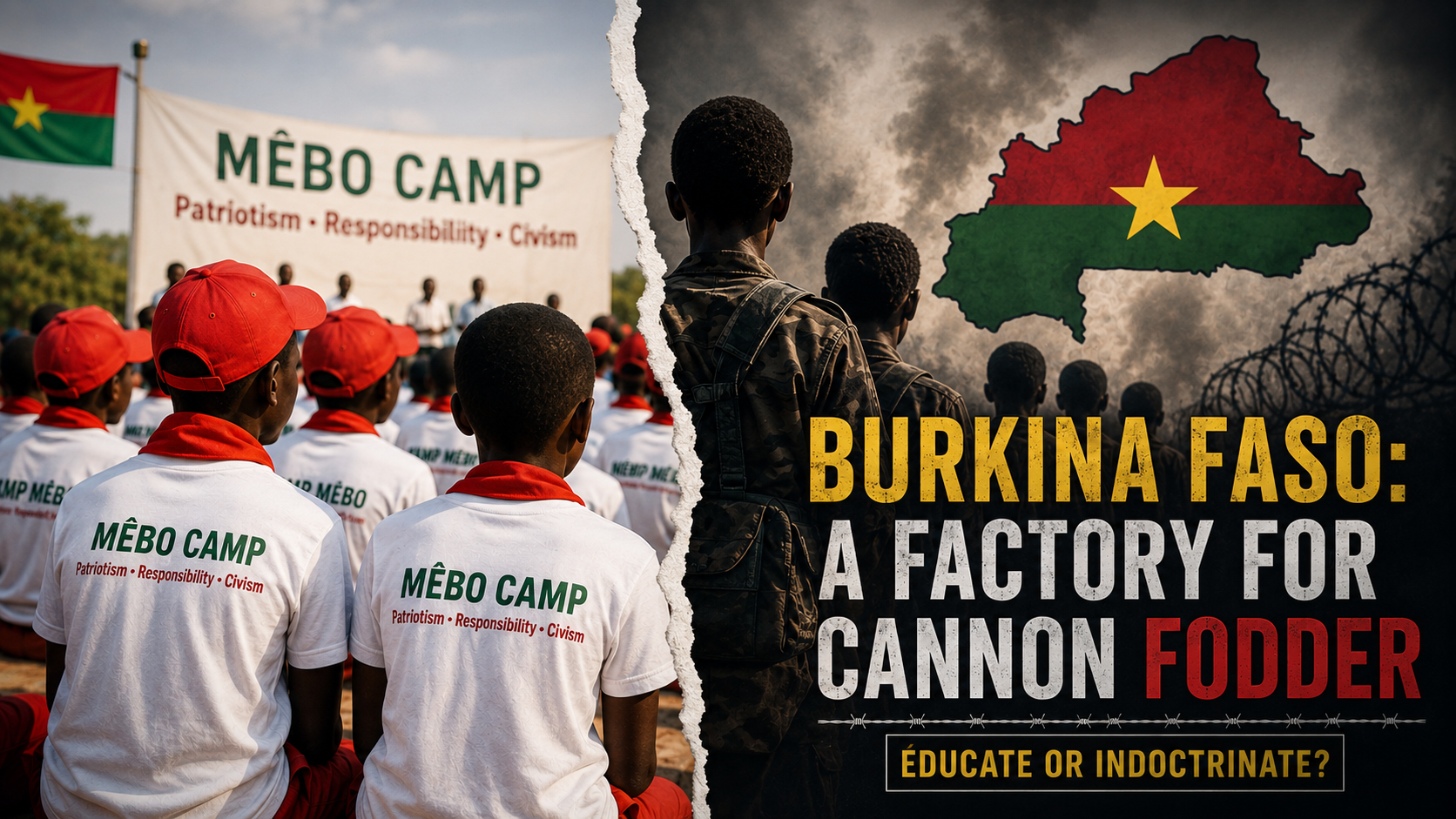
At first glance, the initiative appears to be a standard civic engagement project. In Burkina Faso, the Mêbo holiday camp has brought together thousands of young people in cultural, sporting, and community activities. The authorities’ stated goal? To instill patriotism, responsibility, and civic duty from an early age. Yet beneath this official, virtuous facade, a far more troubling question is surfacing in public discourse: could these large-scale gatherings also mark the gradual militarization of the country’s youth?
It is not the concept of civic education itself that is problematic. Teaching young people the value of responsibility, respect for institutions, solidarity, and the common good is entirely legitimate. Concerns arise, however, when patriotism is weaponized for political mobilization, critical thinking is suppressed in favor of blind obedience, and national defense is framed as an ongoing, inescapable duty.
This strategy is hardly novel on the African continent. Historical precedents in regions such as Sierra Leone, Liberia, and the Democratic Republic of the Congo demonstrate how the boundaries between patriotic awareness, ideological indoctrination, and the recruitment of youth in conflict zones can become dangerously blurred. When a government leverages national sentiment among an impressionable audience, the risk is not merely theoretical it becomes a slippery slope where civic education morphs into a tool for mobilization.
Another critical dimension is the language employed in these initiatives. When terms like homeland, sacrifice, enemy, national defense, and commitment are repeatedly intertwined in messaging aimed at youth, they risk normalizing the idea that military service is the natural endpoint for a young citizen. Yet a child or adolescent should first learn to reflect, debate, create, and innovate before being called upon to sacrifice themselves for a political or military cause.
Security pressures in the Sahel amplify the stakes
The current security crisis in the Sahel, compounded by Burkina Faso’s internal turmoil, has thrust national defense to the forefront of national discourse. In such an environment, patriotic mobilization can easily take on an unprecedented intensity. The central question, then, is one of boundaries: to what extent is it acceptable to inculcate a defense mindset in the youth of today?
By shaping a youth generation steeped in official narratives, does the government intentionally or otherwise erode the space for dissent and critical inquiry? A truly civic-minded youth should not be one that uncritically endorses power. Rather, it should be capable of defending its country while questioning its leaders, respecting the nation without conflating it with the regime, and serving the community without becoming a political pawn.
Normalizing sacrifice: a dangerous precedent
There is also the risk of trivializing the notion of sacrifice. If the ultimate expression of patriotism is framed as dying in combat, it may increasingly normalize among the youngest a perilous interpretation of national duty. Yet love of country ought not be measured by a child’s willingness to embrace violence, but by their dedication to education, healthcare, agriculture, innovation, social cohesion, and national development.
Uniforms, symbols, and militarized rhetoric: navigating gray zones
Attention must also be paid to the presence of military uniforms, symbols, and bellicose rhetoric in these programs. While none of these elements alone signifies militarization, their convergence especially in a context of prolonged war and sustained national mobilization demands scrutiny. It is precisely in these ambiguous intersections that civic education, patriotic propaganda, and psychological conditioning for military engagement begin to dissolve.
The age of participants is equally pivotal. An adult can weigh the political and military implications of their choices; a child lacks both the maturity and the capacity for discernment. Institutions must therefore shield youth from manipulation, ensuring that their education fosters emancipation rather than molding them into obedient instruments of confrontation.
The paradox of security-driven militarization
In the face of urgent security threats, the temptation to embed militarized values in the next generation is strong. Yet addressing military challenges by ideologically preparing an entire generation for confrontation risks perpetuating a vicious cycle. The more society conditions its youth to view the world in terms of enemies and sacrifice, the more violence becomes the default response to political and social disagreements.
True patriotism offers an alternative path. To love Burkina Faso is not merely to be willing to die for it; it is to strive for a nation stable enough that its children can live, learn, work, and build futures free from constant warfare. It is to accept that citizens can uphold their country while holding its government to account.
Demanding clarity and accountability
Before embracing uncritically the rhetoric of patriotism and youth mobilization, key questions must be raised: What are the pedagogical goals of these camps? How much emphasis is placed on critical thinking? Are participants free to express disagreement? Do the activities include military or paramilitary components? Most critically, where lies the line between forming responsible citizens and grooming a generation to accept war as inevitable?
Burkina Faso requires a youth that is engaged, educated, and aware of its duties. But it must also safeguard the autonomy of that youth. To prepare the citizens of tomorrow to build their country is a national imperative. To prepare them to become fodder for perpetual conflict is something entirely different.
The fundamental question remains unanswered: Are these children being prepared to construct Burkina Faso’s future, or to serve as cannon fodder in the wars to come?