In Burkina Faso, the struggle for press freedom has shifted from newsrooms and streets to the digital realm, where repression now unfolds through orchestrated online campaigns and targeted harassment.
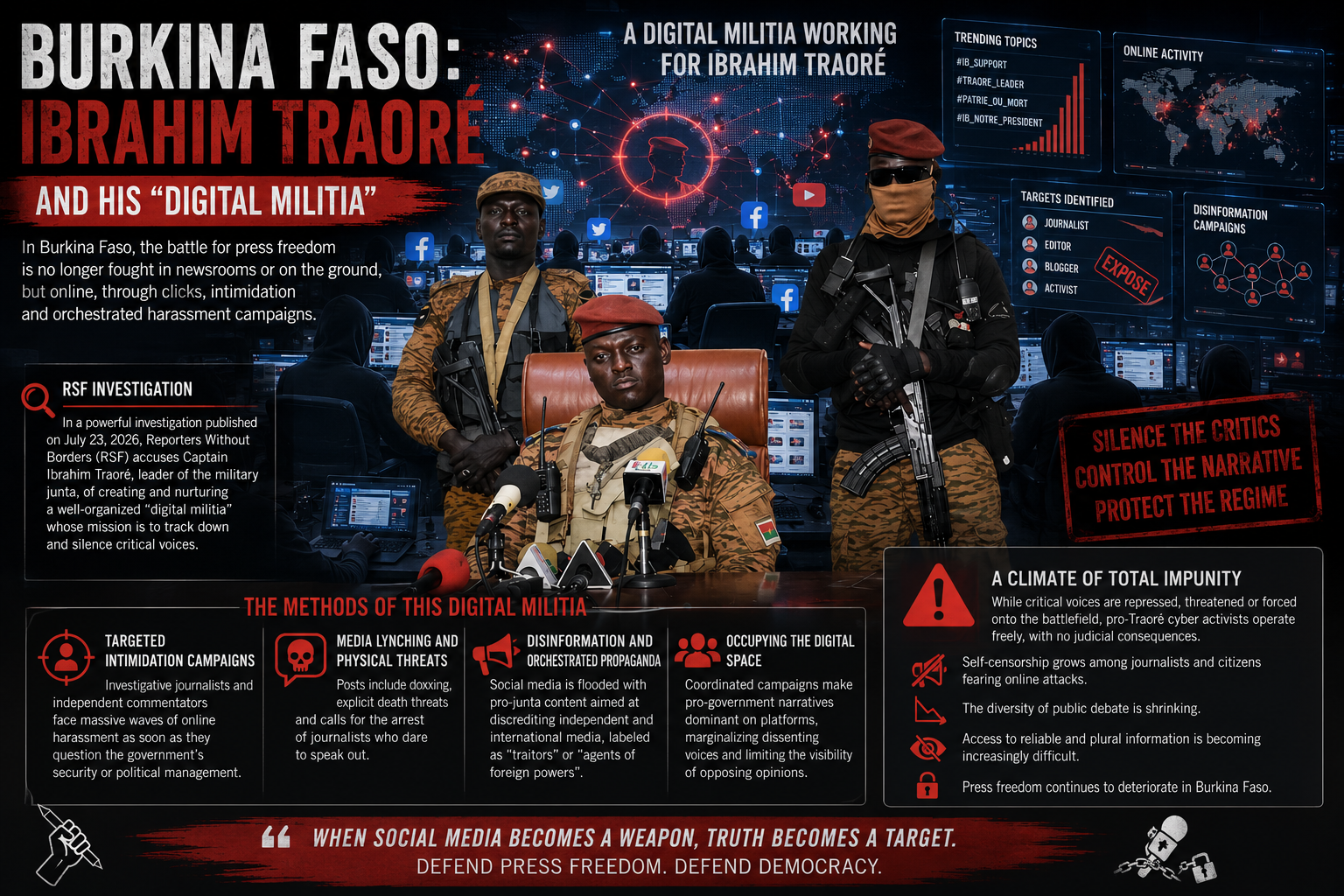
An in-depth investigation reveals the role of Captain Ibrahim Traoré, the military junta leader, in fostering a coordinated network of cyberactivists tasked with silencing critical voices. This operation, disguised under the name Bataillons d’Intervention Rapide de la Communication (BIR-C), mirrors the tactics of military units but operates within the digital sphere.
The BIR-C: A shadow network silencing dissent
The BIR-C functions as a well-structured cyber militia, strategically deployed to dominate public discourse online. According to the findings, this network does not merely engage in political activism; it represents a systematic effort to suppress opposing views by making criticism of the regime increasingly perilous.
Tactics employed by the BIR-C
- Targeted intimidation campaigns: Investigative journalists and independent commentators face coordinated cyberharassment when they challenge the government’s security policies or political decisions.
- Calls for violence and doxxing: The network does not confine its actions to criticism. It frequently publishes personal information (doxxing), issues death threats, or incites arrests against those who oppose the regime.
- Disinformation and propaganda: Pro-junta content floods social platforms to discredit both local and international media outlets, often labeling them as ‘traitors’ or ‘foreign agents’.
- Digital occupation: Coordinated campaigns ensure that pro-government narratives dominate online discussions, burying dissenting opinions and restricting their visibility.
Judicial impunity fuels repression
The absence of legal consequences has emboldened these cyberactivists. While critics face repression or forced conscription, those attacking dissenters operate with impunity, shielded by tacit state protection. This climate fosters widespread self-censorship, compelling journalists, bloggers, and citizens to avoid sensitive topics such as security operations, governance, or military affairs.
Eroding democratic discourse
Political communication experts warn that when digital spaces are monopolized by coordinated propaganda, public debate loses its diversity. Divergent opinions become marginalized, forcing narratives favorable to authorities into the mainstream. This polarization undermines pluralistic discourse—a critical pillar for informed civic participation.
In a nation grappling with persistent security crises, this digital suffocation of debate further obstructs citizens’ access to balanced information, essential for scrutinizing public policies.
A global pattern of digital repression
The tactics documented here align with strategies observed in authoritarian and hybrid regimes worldwide. Cyberactivist networks, often centrally coordinated, are deployed to defend ruling powers, discredit independent media, and manipulate online conversations. Press freedom advocates increasingly recognize these campaigns as a covert yet potent form of suppression, rivaling traditional censorship in effectiveness.
An escalating climate of restrictions
Digital repression does not exist in isolation. It compounds existing constraints on media freedom, including suspensions of international broadcasters, intimidation of journalists, and enforced disappearances. These cumulative pressures systematically shrink the space for independent journalism in Burkina Faso.
Alarming erosion of democratic norms
This investigation underscores the accelerating decline of democratic norms and press freedom in Burkina Faso since the junta’s rise to power. By weaponizing social media, the Traoré regime has transformed digital platforms into instruments of political coercion, rendering independent journalism increasingly hazardous.
The findings also amplify concerns among international partners assessing Burkina Faso’s governance and institutional environment. Freedom of expression indicators are critical benchmarks for investors, development agencies, and global institutions. A sustained deterioration in these metrics risks tarnishing the country’s international standing.
The evolving battlefield of information warfare
Beyond Burkina Faso, this case highlights a broader shift in information warfare. Social media, with its rapid dissemination, algorithmic amplification, and viral potential, has become the new frontline. While traditional state media once dominated propaganda, today’s digital battleground allows narratives to spread instantaneously—while silencing counterarguments. For observers of press freedom, this evolution represents one of the most pressing challenges in politically unstable and insecure states.