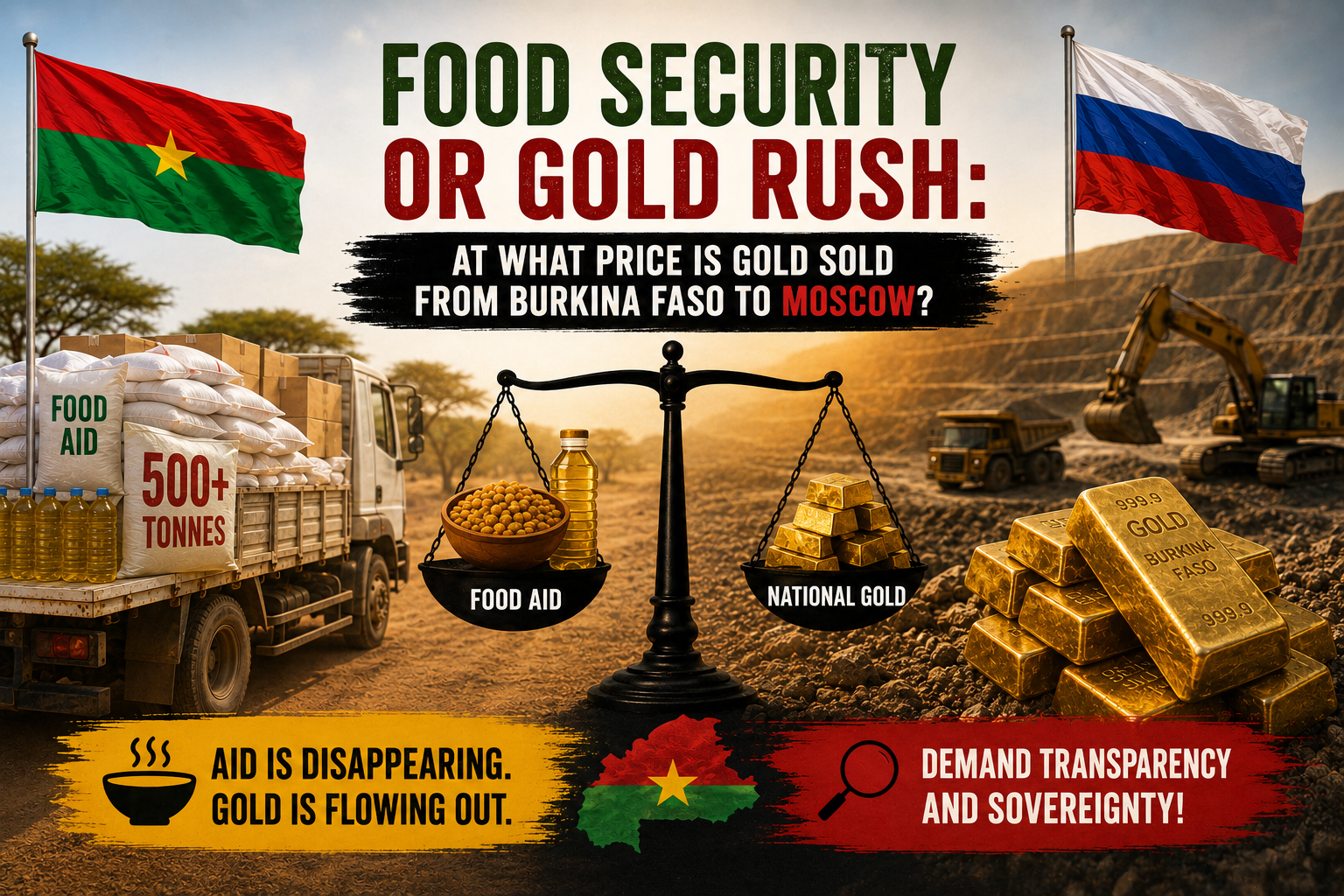
The Russian diplomatic mission in Ouagadougou officially announced the delivery of over 500 tonnes of humanitarian aid to Burkina Faso, valued at an estimated $942,500. This consignment included 462 tonnes of yellow split peas and 93.84 tonnes of sunflower oil, presented as an act of fraternal solidarity amidst a challenging humanitarian and security landscape.
However, beyond this humanitarian operation, a critical question arises: what is the genuine nature of the evolving partnership between Ouagadougou and Moscow? While food assistance is undeniably beneficial, it should not deter citizens from scrutinizing the economic, mining, and strategic underpinnings of the deepening ties between the two nations.
In contemporary geopolitics, states primarily pursue their own interests. Aid can serve both humanitarian and diplomatic objectives simultaneously, without necessarily signifying selfless generosity. It is precisely for this reason that the Burkinabè people require complete transparency regarding agreements forged on behalf of their nation.
The illusion of unconditional generosity
The reception of several hundred tonnes of foodstuffs undoubtedly provides relief to populations grappling with severe food insecurity. Nevertheless, it would be imprudent to portray this operation as conclusive evidence of a balanced partnership.
Burkina Faso possesses substantial mineral resources, with gold forming the cornerstone of its extractive economy. The fundamental inquiry, therefore, is not whether to accept or decline food aid, but rather what the nation is relinquishing, what it is receiving, and under what specific terms.
This equation demands a dispassionate assessment: on one side, a country rich in mineral wealth; on the other, foreign partners possessing significant financial, military, commercial, and technological capabilities. Between these two entities lie agreements whose principal provisions must be accessible to citizens.
Indeed, a few hundred tonnes of provisions cannot be equated with the potential long-term value of mineral resources exploited over many years. A one-off aid package must never serve to divert attention from the strategic significance of national assets.
The central consideration should thus revolve around value addition: Is Burkina Faso adequately processing its resources domestically? Is it securing an equitable share of the revenues? Are mining contracts publicly accessible? Are oversight mechanisms sufficiently robust? Do the proceeds genuinely contribute to infrastructure, education, health, and security initiatives?
Gold must not become the invisible currency of alliances
Gold represents far more than a mere raw material. It is a strategic asset, a store of value, and a potential wellspring for financing national development.
Consequently, any significant reorientation of gold exploitation, commercialization, or export channels warrants rigorous examination. The people of Burkina Faso are entitled to know where their gold is going, who is purchasing it, at what price, under which contracts, and with what level of state control.
The issue is not that a foreign partner acquires Burkinabè gold; international trade is a standard practice. The concern arises if an imbalanced relationship takes root, wherein the nation’s strategic resources are exchanged for immediate benefits without a long-term strategic vision.
A tonne of food disappears upon consumption. An extracted mineral resource, however, is gone permanently. This fundamental distinction should guide all economic partnership policies.
From French influence to Russian entanglement: the illusion of liberation
The pitfall extends to political and psychological dimensions.
The denunciation of the former colonial power, France, resonates with deeply entrenched popular discontent. Criticisms regarding past dominance, economic dependencies, and diplomatic choices are certainly valid subjects for discussion.
However, severing an old dependency does not automatically confer sovereignty.
Replacing Paris with Moscow, Beijing, Ankara, or any other capital would only constitute genuine sovereignty if Ouagadougou retains mastery over its decisions, resources, and national interests.
Sovereignty, therefore, should not be gauged by the number of foreign flags removed from ceremonies or new partners welcomed into the country. It is primarily measured by a state’s capacity to negotiate from a position of strength, safeguard its resources, and be accountable to its populace.
A new dependency can be more challenging to identify
Modern dependency does not always manifest as foreign administration or visible colonial presence.
It can emerge through mining contracts, military equipment, financing agreements, infrastructure projects, foreign enterprises, export markets, or privileged access to strategic resources.
This is why Burkina Faso must avoid merely substituting one form of dependency for another.
A balanced partnership should enable the country to diversify its partners without becoming beholden to a single one. It should also bolster national capacities rather than permanently ceding control of strategic sectors to foreign actors.
Food aid must not become a political tool
It is also crucial to distinguish between humanitarian solidarity and diplomatic propaganda.
Populations suffering from hunger require sustenance, irrespective of its origin. It would be unjust to diminish the utility of this aid for those who benefit from it.
Yet, a shipment of split peas and oil should not serve to stifle debate on the management of natural resources.
Food aid addresses an immediate emergency; a mining policy impacts multiple generations.
Conflating the two would be precisely the risk.
The Burkinabè citizen should be able to appreciate received aid while simultaneously demanding greater transparency regarding contracts, concessions, exports, and mining revenues. There is no contradiction between thanking a partner for assistance and holding them accountable for their economic interests.
Sovereignty begins with transparency
If the transitional authority genuinely seeks to demonstrate that Burkina Faso has become the master of its own destiny, it must permit its new partnerships to undergo public scrutiny.
What are the mining agreements concluded with foreign companies? What are the fiscal terms? What share accrues to the state? How many local jobs are created? What industrial transformation is occurring domestically? What control exists over exports? Where are the revenues invested?
These questions, far more than political rhetoric, will reveal the true extent of economic sovereignty.
The Burkinabè people do not necessarily demand to exist without foreign partners. They primarily ask that foreign partnerships never be established at the expense of their long-term interests.
Opening eyes to avoid losing everything
The Burkinabè must therefore not allow themselves to be blinded by shipments of oil, split peas, or the symbolic imagery of a new international fraternity.
Food aid can be welcome. However, it must never become the political price that justifies opacity surrounding national resources.
True independence does not involve merely changing dominant partners. It entails the ability to engage with all without belonging to any.
Burkina Faso possesses resources capable of financing its development for decades. The challenge, therefore, is whether this wealth will be used to construct schools, hospitals, roads, create employment, and foster a productive economy, or if it will simply become the invisible quid pro quo for new geopolitical alliances.
West Africa does not require a new master. It requires partners.
And the distinction between the two hinges on one essential factor: the capacity of African states to defend their interests, negotiate equitable agreements, and be accountable to their citizens.
Before celebrating every foreign shipment as a diplomatic victory, the fundamental question must be posed: what is the true cost of this new proximity with Moscow, and who will bear the expense once the provisions have been consumed, but the gold has departed the country?