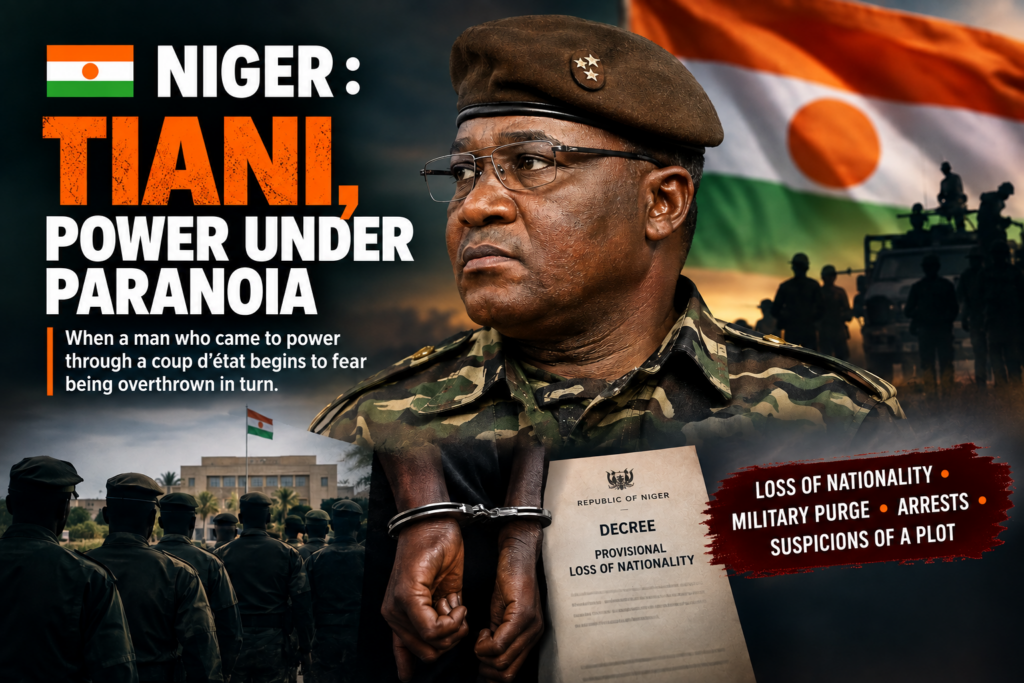
How does a man who took power by force convince himself that the same manoeuvre cannot one day be used against him? That is the awkward question now hanging over Abdourahamane Tiani’s Niger, after a failed assault on his presidency, a widening purge inside the armed forces, and a decree that has provisionally stripped five citizens of their nationality.
On one side stands a junta that says it is simply securing the state. On the other, a growing list of soldiers, ministers and former officials who have been removed, arrested or declared suspect. Between the two, the stakes are simple to state and hard to answer: at what point does defending the Republic become defending one man’s grip on it?
The September 17 decree: security tool or political marker?
The text signed by the general on September 17 is short, technical and heavy with consequences. It withdraws nationality on a provisional basis from five people, among them Ouhoumoudou Mahamadou, who served as prime minister under Mohamed Bazoum, the president overthrown in 2023.
What the document actually alleges
The decree invokes intelligence with foreign powers, the circulation of information liable to disturb public order, presumed involvement in an effort to demoralise the army and the nation, and offences against the security of the state.
One point deserves to be stated plainly: these are accusations and proceedings set out in a decree, not a definitive court ruling. No final judicial condemnation underpins the document.
Politically, however, the symbolism carries weight. Ouhoumoudou Mahamadou is not an anonymous critic. He belongs to the machinery of the previous state, and the state that preceded this one was led by the man Tiani removed from office.
Twenty-five names and a single mechanism
With these five additions, twenty-five people have now been provisionally deprived of their Nigerien nationality under a system introduced in 2024, according to the country’s national press agency. What began as an exceptional instrument is beginning to look like a routine one.
August 29: the night the danger came from the barracks
The sequence that led to the decree did not start in a courtroom. It started inside the security apparatus itself.
On the evening of August 29, the presidential palace came under attack. Air Base 101 was targeted. The public television station was also in the sights of the assailants. For several hours, the balance of forces inside the military remained unclear, with some officers hesitating to commit while the mutineers tried to bring others over to their side.
The attempt failed. Several hundred Russian troops deployed under the Africa Corps banner were needed to retake Air Base 101 and restore control of the site.
For a leader who reached the top through a coup, the message was blunt: the scenario he himself helped to normalise can now be turned against him.
Arrests, dismissals and a reshuffled chain of command
What followed was not a pause for reflection but a rapid reorganisation.
At least 200 military personnel have been detained since August 29, most of them from the special forces.
On September 11, the chief of defence staff, General Moussa Salaou Barmou, was dismissed.
A few days later, four ministers were replaced.
Officially, the language is administrative: reorganisation, fixing dysfunctions, securing the chain of command. In politics, however, timing tells its own story. Once threatened, a power rebuilds itself around the people it trusts most — and pushes everyone else to the margins.
Bazoum is out of power, yet his shadow still shapes the file
Three years after the coup that toppled him, Mohamed Bazoum remains a central figure in Niger’s political confrontation. His government is gone. His institutions have been dismantled. But the men who served under him keep resurfacing in the security and judicial files of the new authorities.
That continuity is precisely what gives this latest episode its weight. It suggests the current leadership is not only guarding against armed plots, but also against an entire political legacy — one that still has faces, names and networks.
The real stakes: when suspicion becomes a method of governing
Here the file becomes more troubling. Since August 29, the threat is no longer seen as coming solely from armed groups or foreign adversaries. It can, in the reading of the authorities, emerge from within the military machine itself.
Once the loyalty of soldiers becomes an open question, the temptation grows to hunt for those responsible, for relays, for accomplices and for sponsors. The danger, then, is that suspicion stops being a tool of investigation and starts functioning as a method of government.
A general replaced.
A minister pushed aside.
Soldiers arrested.
Former officials of the Bazoum era targeted.
Citizens stripped, provisionally, of their nationality.
Taken one by one, each measure comes with an official justification. Placed end to end, they sketch the portrait of a leadership that, having been directly threatened, is trying to regain control of every circle that might turn into a vulnerability.
Can a state be governed permanently when its own citizens are treated as potential hazards? That is the dilemma the decree forces into the open. Every new sanction answers one fear while feeding another, and each round narrows the space between loyalty and survival.
The paradox of a power born from a putsch
The irony runs through the whole story. Tiani reached the summit through a coup. He now leads a regime that has just survived an attempted coup. Between those two dates, Niger appears to have entered a cycle in which every crisis produces new purges, every suspicion triggers a new sanction, and every challenge reinforces the concentration of power.
The September 17 decree is therefore not merely a question of nationality. It is the latest chapter in a broader battle: the effort by a leadership to erase the zones of uncertainty around itself.
Critics of the regime read in it something more troubling the impression of a leader who behaves as though he alone holds the keys to the Republic, as though serving under Bazoum were now a permanent political offence, and as though any dissenting voice must conceal a plot.
Tiani is not Niger. But when decisions cluster around a single man, the question becomes unavoidable: how far can a regime go when it ends up seeing a threat behind every face?
The question Niger still has to answer
By fighting real or supposed conspiracies, is Tiani building a system in which all contestation is automatically treated as conspiracy? If so, the problem is no longer only who might want to overthrow him. It is also why a power that presents itself as firmly installed appears so afraid of those closest to it.
And it is, above all, how far this logic will run. Because when a regime begins to regard its own citizens as potential menaces, the line between protecting the state and protecting the regime becomes dangerously thin.
By Aïcha Abdou — Senior correspondent