As Burkina Faso’s gold reserves become central to its evolving security partnerships with Russia, questions intensify over whether these ties are solidifying Ibrahim Traoré’s rule. The recent reshuffling of private military contractors at the Bissa gold mine exposes deeper negotiations where national security, foreign influence, and economic control intersect — sparking debate on what comes next for a nation caught between geopolitical pressures and internal stability.
From corporate rivalry to political stakes: the Bissa gold mine dispute
The Bissa gold mine, operated by the Russian-owned Nordgold, has become a microcosm of broader tensions. A clash between Russian security firms over who should guard the site has escalated into a broader debate about influence, accountability, and the real cost of foreign-backed security arrangements. At the heart of the controversy is RSB-Group, a Russian security contractor that claims it was unfairly removed from the protection contract — a move it attributes to the lobbying of rival firms with stronger ties to Burkina Faso’s transitional government.
The company has gone so far as to allege that the competitors it replaced played a role in escalating violence against Fulani villages in the region, framing its accusations as a warning about the consequences of unchecked mercenary operations. While these claims remain unverified, they underscore a crucial point: in Burkina Faso, the safeguarding of mining assets is no longer just a business issue — it’s a matter of governance, stability, and regime survival.
Security as a pillar of Ibrahim Traoré’s leadership
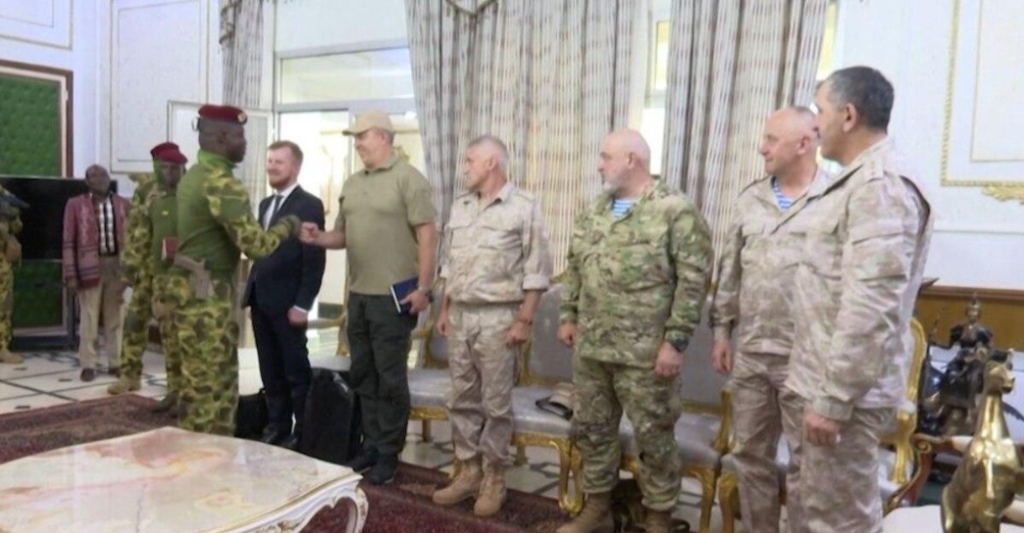
Since seizing power in September 2022, Captain Traoré has repositioned Burkina Faso within a new geopolitical orbit, prioritizing partnerships with non-Western allies — particularly Russia. The stakes are high: after a failed coup in 2023, the regime’s survival depends on tightening control over both the armed forces and public perception. Reports of Russian paramilitary presence during official events in Ouagadougou in mid-2024 have fueled speculation that Moscow is providing more than just counterterrorism support — its operatives may be playing a behind-the-scenes role in securing the president and key state institutions.
This raises a critical question: is Russia’s involvement purely defensive, or is there an exchange of favors — protection for access? While no public agreement exists, the pattern mirrors engagements in other African countries where military cooperation has aligned with economic concessions. In Burkina Faso, the gold sector stands out as both a strategic asset and a potential bargaining chip.
Gold concessions and the Russian footprint in Burkina Faso
Russia’s economic footprint in Burkina Faso’s mining sector is substantial. Nordgold, controlled by Russian billionaire Alexei Mordashov, operates the Bissa and Bouly mines — two of the country’s most productive gold operations. The company’s continued access to these sites depends on stable production environments, making security contracts a top priority.
In early 2023, the Burkinabe government seized 300 kilograms of gold from Bissa Gold under a public emergency clause. While the state pledged compensation, the move signaled a new willingness to use mineral wealth to meet urgent financial needs — including funding national security priorities. This development highlights how gold, once a revenue source for private investors, is increasingly viewed through a political lens: a resource to be secured, controlled, and, if necessary, redirected.
Analysts at the Combating Terrorism Center at West Point suggest that protecting Russian mining interests may have initially drawn Moscow’s attention to Burkina Faso. However, they emphasize that the primary role of Russian forces deployed in the country is likely political — shoring up Traoré’s fragile authority rather than solely combating insurgents. Direct links between military engagement and economic gains remain speculative, but the convergence of interests is undeniable.
What’s next for Burkina Faso’s gold and Russia’s role?
The Bissa gold mine controversy is more than a corporate feud — it’s a glimpse into the future of Burkina Faso’s governance model. As Traoré deepens ties with Moscow, the country faces a delicate balancing act: leveraging foreign support to stabilize its territory while avoiding the appearance of surrendering sovereignty over its natural resources.
For local communities living near mining sites, the stakes are immediate. Security operations that prioritize mineral extraction over civilian safety risk exacerbating social tensions and fueling further grievances. Meanwhile, Traoré’s government must decide whether Russia’s involvement is a pragmatic lifeline or a Faustian bargain that could erode public trust in the long run.
One thing is clear: Burkina Faso’s gold is no longer just a national treasure. It has become a currency in a larger negotiation — one that may determine not only the country’s economic future, but the very legitimacy of its leadership in an era of shifting global alliances.
Public debate ignites: sovereignty, security, and the cost of foreign partnerships
The unfolding saga has ignited a national conversation about Burkina Faso’s direction. Critics argue that reliance on foreign security contractors — especially those linked to extractive industries — risks turning the country into a client state, where mineral wealth is exchanged for political protection rather than development. Supporters, however, contend that in the absence of reliable Western partners, alternative alliances are necessary to preserve stability amid escalating jihadist violence.
The outcome of this debate will shape Burkina Faso’s trajectory for years to come. Will gold continue to shine as a symbol of national wealth, or will it be reduced to leverage in a silent exchange between foreign powers and a transitional regime fighting for survival?