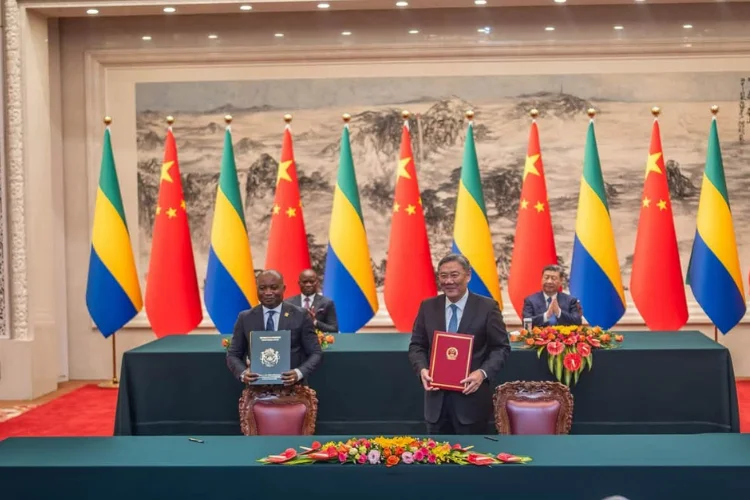
Why Gabon’s latest China agreements reveal more than meets the eye
The recent agreements signed in Shanghai between Gabon and China aren’t just paperwork—they’re a strategic chessboard where economic ambition meets technological ambition. Behind the headlines of “industrial progress” lie deeper dynamics: a push for local value creation, a gamble on digital transformation, and a calculated bet on resource-backed infrastructure. What happens when foreign investment meets Gabon’s raw materials and workforce? The answer might reshape the country’s economic landscape for decades.
New agreements span beyond borders: seven key areas of collaboration
Seven major areas of engagement were formalized during the November 5 meetings in Shanghai, reflecting a nuanced shift from general cooperation to targeted industrial development:
- Digital transformation in education and public safety: Three memoranda with Huawei focus on using smart technologies to modernize public universities—including Brice Clotaire Oligui Nguema University—with AI-focused lab equipment and enhanced digital security systems. This isn’t just about better computers; it’s about training a workforce that can operate—and innovate—in tomorrow’s tech-driven economy.
- Infrastructural backbone for iron mining: The Belinga iron ore project—long stalled by infrastructure gaps—has gained new momentum. Agreements now cover railway development, rolling stock manufacturing, and energy infrastructure specifically designed to support extraction and processing of one of Africa’s largest untapped iron deposits.
- Energy and industrial nexus: A letter of intent between the Gabonese state, Eramet Comilog, and Sinohydro (a PowerChina subsidiary) signals a coordinated push to integrate energy projects with industrial output. This hybrid model could reduce dependency on raw exports and increase domestic processing capacity.
- Security digitization: Public safety enhancement through AI-powered surveillance and smart city solutions is being integrated into urban infrastructure planning—an often-overlooked dimension of economic development.
- Technology transfer under the spotlight: While not all agreements detail technology transfer clauses, the educational and industrial focus suggests gradual knowledge diffusion—critical for long-term autonomous development.
- Investment leverage: These accords aren’t just diplomatic symbols; they’re designed to unlock international private capital, pairing Chinese state-backed finance with Gabonese government guarantees.
- Local employment as a benchmark: Implicit in every agreement is the promise of job creation—though the real test will be measured by how many Gabonese engineers, technicians, and managers are integrated into operations.
Unseen forces driving the partnership: geopolitics and economics intertwined
Beneath the surface, this isn’t just a bilateral deal—it’s a reaction to shifting global trade winds. Gabon, rich in minerals and forests but lacking industrial depth, sees an opportunity to “upgrade” its economy from extractive to value-added. Meanwhile, China, diversifying its resource base and offshore supply chains, finds a stable partner in central Africa with strategic minerals and a government receptive to foreign investment. The timing also aligns with Gabon’s post-pandemic recovery strategy and its ongoing diversification away from oil dependence.
The synergy is undeniable, but so are the risks. Technological dependency, environmental concerns around mining expansion, and questions about real job creation all pose long-term challenges. The agreements are bold on ambition—but implementation will determine whether they translate into sustainable growth or fleeting progress.
From paper to pavement: what changes now? Concrete next steps and potential pitfalls
Signatures on paper don’t equal impact on the ground. The real work has just begun. Key milestones to watch include:
- Completion of feasibility studies for the Belinga railway and energy grid by Q4 2025
- Deployment of Huawei’s AI labs in universities by mid-2026
- Launch of joint technical committees to oversee workforce upskilling programs
- Monitoring of local content quotas in rolling stock manufacturing and energy project tenders
- Independent audits on environmental impact and social responsibility compliance
Critics warn that without enforceable transfer-of-technology measures and clear penalties for non-compliance, much of the promised value could stay offshore. Others point to historical precedents where resource-rich nations end up locked into extractive cycles despite foreign investment.
What Gabon stands to gain—and what it must guard against
The potential upside is substantial:
- Economic diversification: Reduced oil reliance with growth in mining, energy, and digital services
- Job creation: Estimated 5,000+ direct and indirect roles in mining, logistics, and tech by 2028
- Digital leapfrog potential: AI labs in universities could train a new generation of tech professionals
- Energy independence: Localized power generation may lower electricity costs and improve reliability
- Geopolitical positioning: Stronger ties with Asia diversify Gabon’s diplomatic portfolio
Yet the roadmap is strewn with risks:
- Technological dependence: Over-reliance on Chinese systems may stifle independent innovation
- Environmental degradation: Expanding mining and energy infrastructure threaten fragile ecosystems
- Uneven benefits: Without strict local hiring and training mandates, benefits may bypass Gabonese workers
- Debt sustainability: Large-scale infrastructure projects could strain public finances
Final analysis: a high-stakes gamble with potentially transformative rewards
Gabon’s latest agreements with China aren’t merely another episode in Sino-African cooperation—they represent a calculated gamble on industrialization, digitalization, and economic sovereignty. The coming years will reveal whether this partnership fosters a self-reliant, knowledge-based economy or simply deepens a cycle of resource extraction and external dependency. One thing is certain: the success or failure of these accords will be measured not in press releases, but in power plants that light homes, in factories that employ local workers, and in classrooms where Gabonese students code the future.