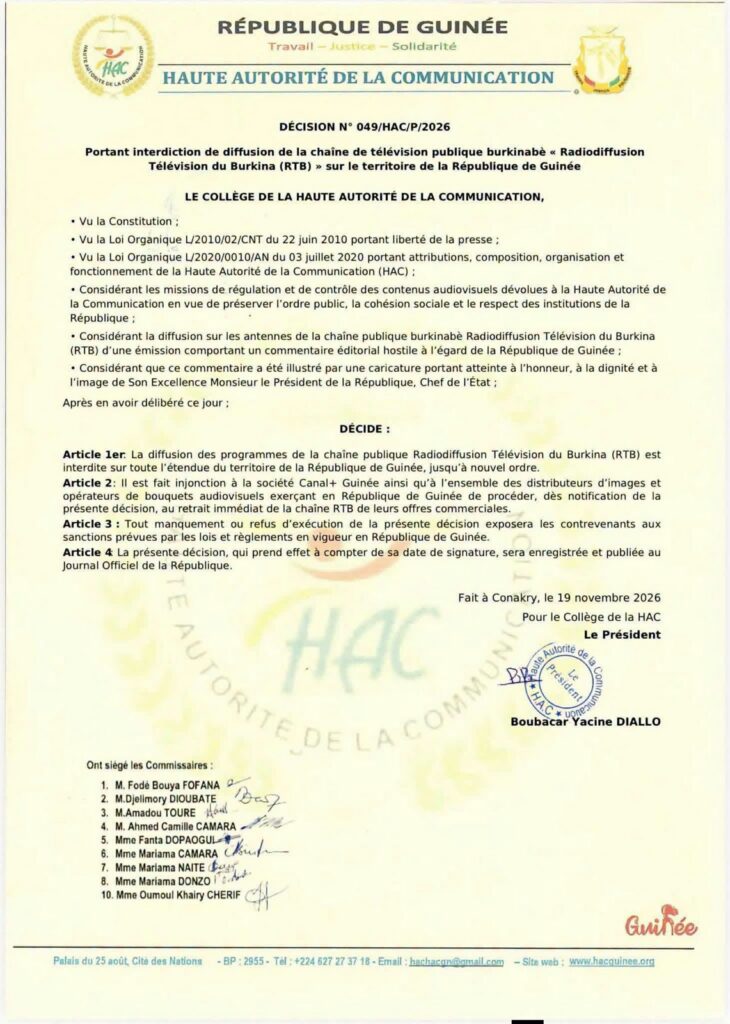
The recent media campaign by Burkina Faso’s state broadcaster has ignited a fierce debate across West Africa about the governance of natural resources. A hard-hitting documentary aired by RTB accuses Guinea of prioritizing multinational corporations over its own people, sparking outrage in Conakry and raising uncomfortable questions for Ouagadougou: if gold must serve Africans first, why does Burkina Faso hold its neighbor to standards it fails to meet itself?
Unequal standards in gold mining governance
The documentary’s narrative hinges on a powerful claim: Guinea’s mining policies betray local populations by favoring foreign interests. Yet a closer look at Burkina Faso’s own actions reveals a troubling contradiction. On July 2, 2024, the Burkinabè government abruptly shut down several artisanal gold mining sites in the Hauts-Bassins and Cascades regions, citing illegal operations. Within days, authorities reported the expulsion of clandestine miners, the revocation of hundreds of artisan mining permits, and the seizure of over 60 hydraulic excavators. While Ouagadougou frames this crackdown as a sovereign assertion, the same tactics in Guinea are condemned as betrayal—leaving observers to wonder where the line is drawn between regulation and neocolonial enforcement.
Foreign capital: ally or adversary in the Sahel?
The Burkinabè critique gains further scrutiny when examining its own reliance on international mining giants. Despite denouncing foreign dominance in Guinea’s gold sector, Burkina Faso’s industrial gold production remains overwhelmingly controlled by multinational corporations. Official 2024 data from the Extractive Industries Transparency Initiative (EITI) reveals that 87% of the country’s 60.77 metric tons of gold output came from industrial mines, with only 11.7% from artisanal sources. Among these industrial operations, foreign-owned firms dominate the landscape. Russian conglomerate Nordgold, for instance, operates three major mining ventures in Burkina Faso—Bissa Gold, Nordgold Yimiougou, and Nordgold Niou—accounting for nearly one-fifth of the country’s industrial gold production.
While international investors contribute to job creation, technological transfer, and infrastructure development, their presence complicates the narrative of anti-neocolonial resistance. How can Burkina Faso condemn foreign exploitation in Guinea while embracing the same economic model at home?
Pan-Africanism under scrutiny: principles vs. politics
This episode lays bare the fragility of sovereignty-driven rhetoric in the Sahel. By applying double standards based on diplomatic convenience or ideological alignment, African leaders risk eroding the very principles they claim to defend. Genuine panafricanism demands consistency: transparent mining contracts, equitable revenue sharing, environmental safeguards, and protections for local communities must apply universally—not as tools for political maneuvering, but as unshakable commitments to African progress.
As West Africa grapples with the dual challenges of resource exploitation and regional stability, the debate over gold sovereignty exposes deeper fractures. Can African nations reconcile national ambitions with continental solidarity? Or will the gold rush continue to be fueled by political contradictions?