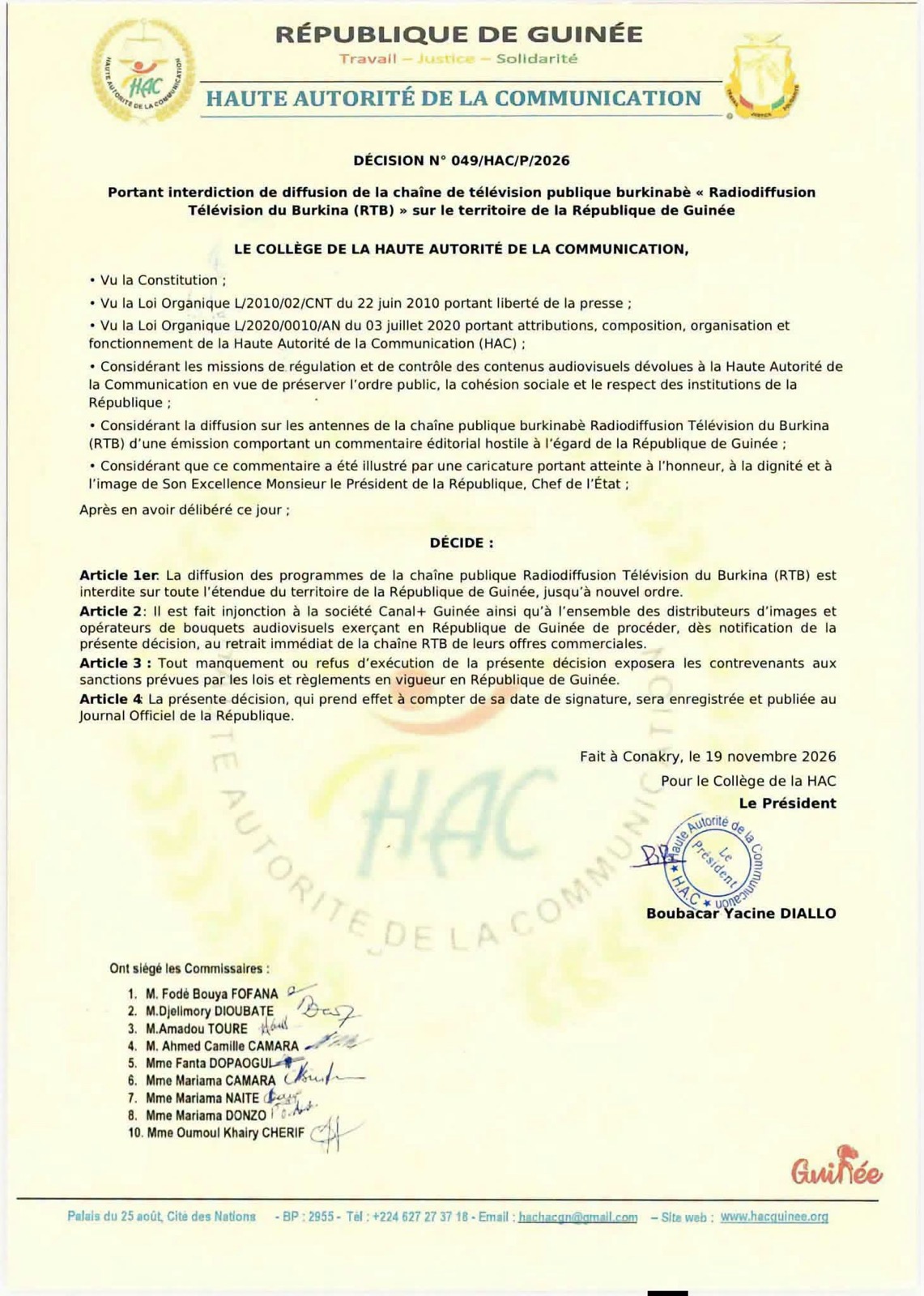
The decision by Guinea’s Haute Autorité de la Communication (HAC) to ban the broadcast of Burkina Faso’s state-run Radiodiffusion Télévision du Burkina (RTB) across the entire national territory has ignited a broader debate about the role of public broadcasters in West Africa. Far from being a mere administrative measure, this action forces a critical examination of how public media align with their core mission when political narratives overshadow journalistic integrity.
When public broadcasting becomes an extension of political power
A public broadcaster is entrusted with a dual responsibility: to inform citizens with accuracy and to uphold the principles of pluralism, impartiality, and public service. Yet, as Guinea’s ban on RTB underscores, this mandate is increasingly compromised when a broadcaster’s editorial line appears to serve partisan interests rather than the public good.
The RTB, under the stewardship of Burkina Faso’s transitional authorities led by Captain Ibrahim Traoré, has faced growing criticism for blending news coverage with political advocacy. This blurring of lines between journalism and government messaging raises fundamental questions about the credibility of public broadcasters across the region.
In an era where media institutions are expected to act as pillars of democratic discourse, the conflation of state communication with objective reporting erodes trust in the very institutions meant to safeguard public information.
Public media: a tool for citizens or a vehicle for political narratives?
The core function of a public broadcaster is not to amplify the agenda of ruling powers but to provide citizens with balanced, fact-based reporting. This ensures that individuals can critically engage with current events, form independent opinions, and participate meaningfully in civic life.
However, when a broadcaster prioritizes political loyalty over journalistic ethics such as through systematic disparagement of opposition voices, one-sided commentary, or the suppression of dissenting perspectives the institution risks becoming an instrument of propaganda rather than a forum for open debate.
The Guinea HAC’s decision reflects not just a rejection of RTB’s editorial approach but a broader rejection of the notion that public media can be weaponized to consolidate power. It signals a growing intolerance for outlets that prioritize political messaging over their duty to serve the public.
Consequences for media independence in West Africa
This confrontation between Guinea and Burkina Faso’s public broadcaster is emblematic of a deeper crisis gripping media institutions across West Africa. The region has witnessed repeated instances where state-run outlets have been co-opted to legitimize political transitions, silence criticism, or marginalize dissent, often under the guise of defending national sovereignty.
Yet, true media sovereignty requires more than just control over content it demands a commitment to transparency, accountability, and respect for the public’s right to diverse, accurate information. When public broadcasters abandon these principles, they not only undermine their own legitimacy but also fuel skepticism about the role of media in democratic processes.
The fallout from Guinea’s ban will likely extend beyond diplomatic tensions. It serves as a cautionary tale for regional broadcasters, emphasizing that the credibility of public media hinges on its ability to remain independent from shifting political winds. For citizens, this moment underscores the importance of demanding higher standards from institutions that wield significant influence over public discourse.
What the future holds for public broadcasters in the region
The suspension of RTB in Guinea is more than a temporary restriction it is a symptom of a systemic challenge facing public broadcasters across West Africa. To reverse this trend, institutions must recommit to their foundational principles: rigorous journalism, ethical integrity, and unwavering dedication to the public interest.
For regional stakeholders, this moment presents an opportunity to redefine the purpose of public broadcasting. Rather than serving as mouthpieces for ruling elites, these outlets must reclaim their role as trusted sources of information, ensuring that citizens not politicians remain the ultimate beneficiaries of their work.
As debates over media freedom and editorial independence intensify, one thing is clear: the future of public broadcasting in West Africa will be determined by whether it chooses to uphold its democratic mandate or succumb to the pressures of political conformity.
By Ousmane Tandja — Journalist