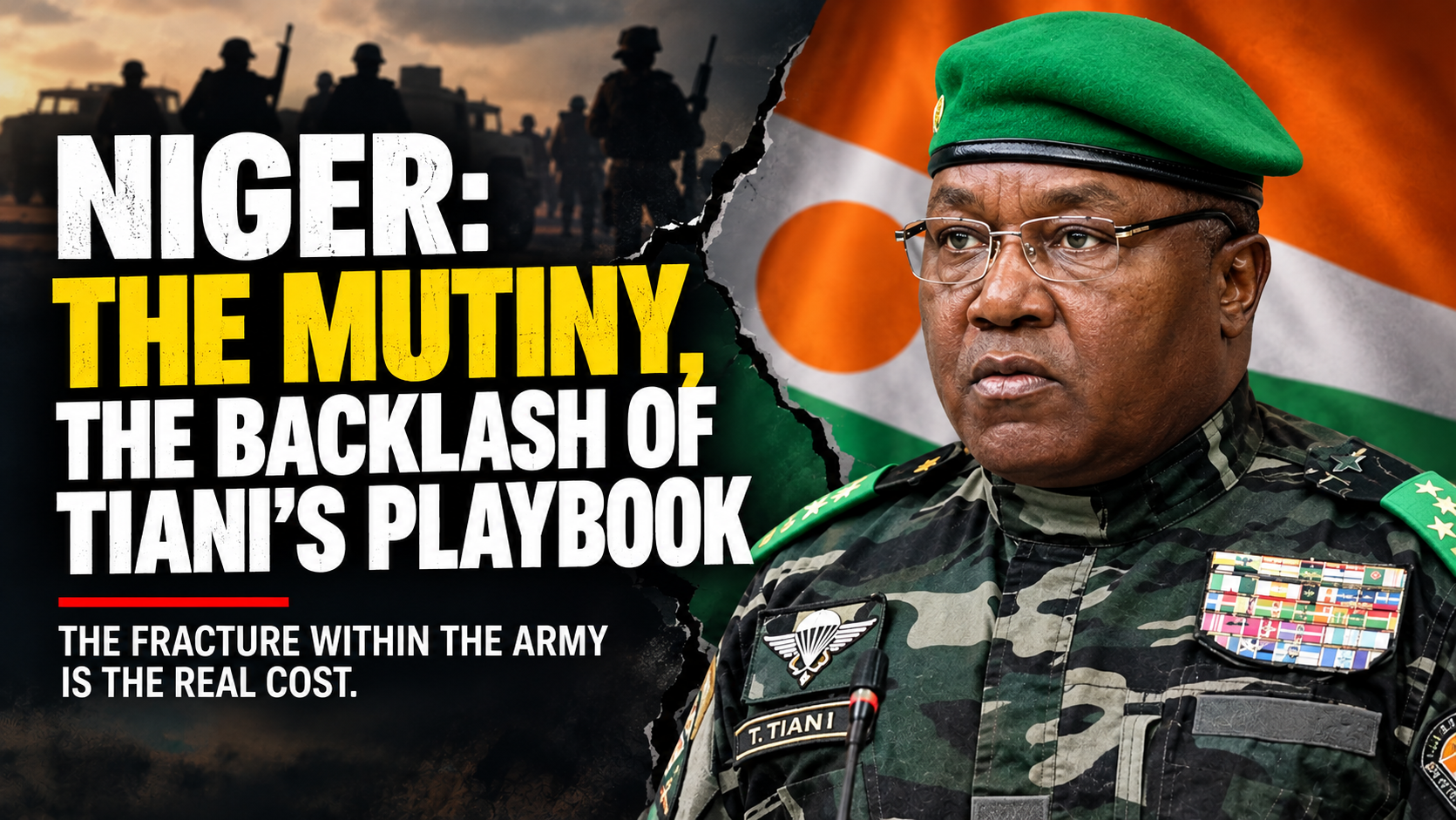
The influence of Tiani extends far beyond the immediate aftermath of the recent uprising. Since taking control, he has systematically converted the national army into a mechanism for political governance rather than an entity dedicated solely to territorial protection. By favoring loyalists in key appointments, sidelining independent-minded officers, and substituting personal allegiance for professional hierarchy, he has disrupted the delicate internal equilibrium that once maintained cohesion within the armed forces. As personal devotion replaced expertise, capability, and institutional neutrality, deep-seated distrust began to permeate the ranks.
The consequences of a politicised command structure
When career advancement within the military is perceived to depend on political proximity rather than merit and service, systemic resentment is inevitable. Frustrations multiply, rivalries intensify, and trust between different command tiers breaks down. Consequently, the rebellion of August 28 and 29 cannot be dismissed as a minor disciplinary lapse or an isolated act by a few disgruntled soldiers. Instead, it serves as a clear indicator of a much more profound malaise, cultivated by years of escalating tension, frustration, and skepticism within the military apparatus.
This internal division is particularly dangerous for a nation grappling with persistent security threats, where the military serves as the primary pillar of stability. A fractured army, suspicious of its leaders and distracted by internal scores to settle, cannot operate with the efficacy required to defend the nation. Operational unity crumbles when soldiers view their peers with suspicion. In a context where Nigerien troops are actively fighting armed groups across multiple fronts, any internal rupture poses a direct threat to national defense.
An atmosphere of secrecy and tactical silence
The official silence regarding the fate of the detained soldiers is a deliberate strategy of crisis management rooted in opacity. By withholding information on who has been arrested, where they are being held, and what charges they face, the administration fosters an environment of pervasive anxiety. This uncertainty acts as an effective mechanism of control, leaving every soldier to wonder if they will be the next target of interrogation or dismissal.
This lack of transparency also blocks any path toward resolution. Rather than clarifying responsibilities to resolve the crisis institutionally, the silence breeds rumors, paranoia, and conflicting narratives. Families of the detained remain in limbo, fellow soldiers grow increasingly wary, and the leadership loses further credibility. What could have been managed as an internal military disciplinary matter risks evolving into a much wider crisis of confidence across the nation.
Media spectacles versus underlying realities
By displaying confiscated military vehicles and weapons on national television, the administration attempts to control the narrative. Presenting physical equipment as proof of a conspiracy is designed to convince the public that the arrests are fully justified. However, this media display fails to address the fundamental questions: what were the actual demands of the mutineers? Who is individually responsible? What legal processes are being followed? Most importantly, why did such a crisis erupt within the very institution tasked with protecting the state?
This theatrical communication serves to distract from the core issue. Showcasing armaments does not inherently prove an organized conspiracy. Verifiable facts must be established through transparent legal proceedings. Without this, the state’s messaging appears less like a search for truth and more like a tool to legitimize arbitrary detentions.
The strategic cost of internal surveillance
This approach highlights a fundamental contradiction. While the leadership claims to strengthen state authority, it governs through systemic distrust within its own military. An army cannot remain effective when its members fear that any form of dissent will be treated as treason. While military discipline requires obedience, it also demands trust in the hierarchy, fair procedures, and a shared sense of national duty.
Furthermore, continuous purges carry a heavy operational price. Sidelining experienced officers and destabilizing units through fear drains the military of vital expertise and cohesion. In an ongoing conflict against highly adaptive armed groups with local intelligence networks, Niger cannot afford to weaken its command structures for the sake of internal political maneuvering.
A troubling paradox emerges: while the official discourse champions sovereignty and national defense, significant energy is spent monitoring and neutralizing dissent within the security apparatus. Prioritizing the political survival of the regime over actual national security threatens the stability of the entire country.
When soldiers fear internal purges more than external adversaries, their operational capacity inevitably declines. Forces must remain focused on their primary mission of safeguarding citizens and defending territory. If their attention is consumed by internal power struggles and the fear of being labeled disloyal, the institution’s combat readiness is sacrificed for political control.
A systemic crisis of trust and governance
Ultimately, the August mutiny raises questions that extend far beyond the fate of the arrested personnel. It challenges the very way Tiani views power, loyalty, and the role of the armed forces. A national army cannot be repurposed as a regime protection force without triggering deep internal friction.
By focusing on eliminating internal rivals rather than rebuilding military cohesion, Tiani risks undermining the very institution holding the country together. Dividing the armed forces might offer short-term political security, but it represents a severe long-term strategic vulnerability.
This reveals the fundamental political error of the leadership: conflating the survival of the regime with the safety of the state. In prioritizing personal political longevity, the leadership weakens military unity, erodes trust, and leaves Niger increasingly vulnerable to external threats. The ongoing instability is not an isolated incident, but the logical outcome of a governance model built on suspicion, centralized power, and the systematic politicisation of national security.