What does it really mean when a state can delete one of its own citizens with a single signature? In Niger, that question stopped being theoretical a long time ago. Since the National Council for the Safeguard of the Homeland (CNSP) took power by force in July 2023, the hunt for dissenting voices has entered a far more dangerous phase. General Abdourahamane Tiani no longer settles for prison sentences or forced exile — his administration now wipes out the legal existence of its opponents. By elevating citizenship revocation to the rank of everyday governing tool, the military leadership in Niamey works from one brittle assumption: that disagreeing with the junta is the same crime as betraying the country.
A legal trap built in august 2024
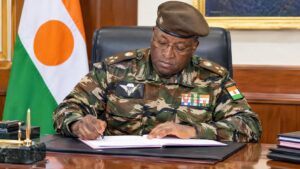
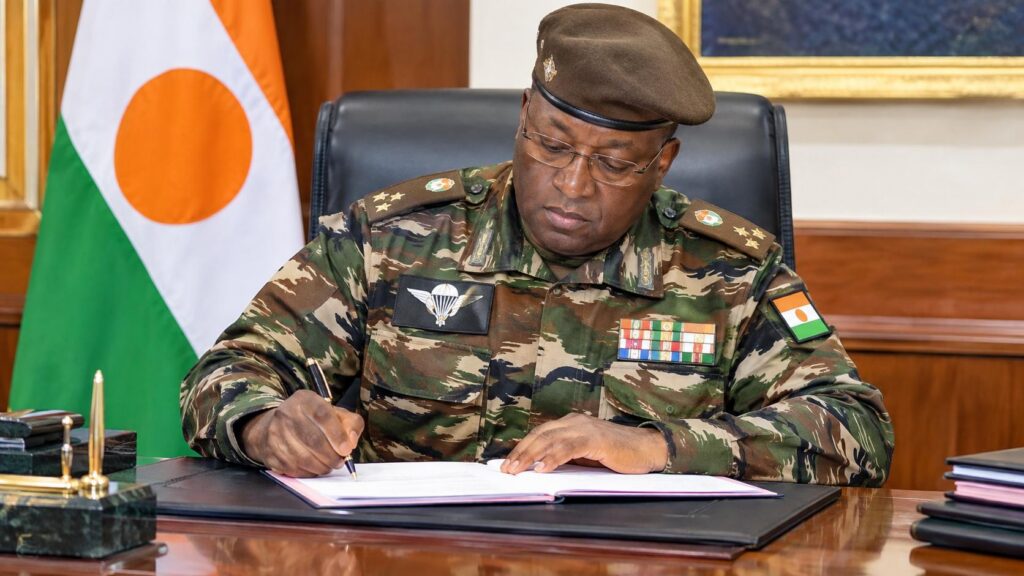
The repressive framework hardened at the end of August 2024, when General Tiani signed an ordinance creating a “National Register of Persons Involved in Acts of Terrorism or Threats to State Security”. Behind that catch-all label, and behind the convenient pretext of counterterrorism, sits a legal blade aimed squarely at politicians, civil society figures and soldiers alike.
The most poisonous clause of the whole package allows authorities to impose temporary or permanent loss of Nigerien nationality on anyone merely suspected of “activities liable to disturb peace and security”, of “regionalist or xenophobic remarks”, or of “collusion with a foreign power”.
Three vague grounds, one unlimited power
- Conduct deemed capable of troubling public peace and security
- Statements branded regionalist or xenophobic
- Alleged complicity with a foreign state
None of these categories is precisely defined. That is the point. A protest chant, a critical op-ed, a disagreement voiced on a radio panel — all of it can be repackaged as grounds for national repudiation.
How a citizen becomes stateless, step by step
The process follows a predictable sequence, and each stage strips away another layer of protection:
- The “security threats” register is opened and names are entered (August 2024)
- Assets are frozen and travel bans are imposed on targeted opponents
- Presidential decrees formally revoking nationality are signed
- Identity documents are withdrawn, producing legal statelessness on paper
The list keeps growing, one decree at a time
Every new presidential decree lengthens the regime’s hunting record. The waves of removals methodically target the circle around deposed president Mohamed Bazoum, former ministers and leading opposition figures.
| Figure targeted | Role / position | Grounds cited by the junta |
|---|---|---|
| Ouhoumoudou Mahamadou | Former prime minister | Alleged intelligence links with a foreign power |
| Hassoumi Massoudou | Former foreign minister | Threat to national security and conspiracy |
| Rhissa Ag Boula | Former minister of state, head of the resistance council (FRR) | Rebuilding an armed group, incitement to revolt |
| Alkache Alhada | Former interior and trade minister | Circulating data that disturbs public order |
| Amadou Barou Chekaraou | Former official in the state apparatus | Threat to state security and glorification of violence |
Alongside these well-known political names, civil society organisers, media activists such as Mariama Djibrine (known as Mayra) and former senior army officers have seen their identity confiscated by simple executive order. With one stroke of a pen, men and women born on Nigerien soil, some of whom served the state for decades, are administratively banished — virtual stateless persons deprived of passports, bank accounts and every civic right.
Patriotism used as a smokescreen
The CNSP’s rhetoric rests on a permanent sleight of hand: the deliberate blurring of the nation with the military power currently holding it. In General Tiani’s framing, criticising the junta amounts to betraying Niger. That populist posture is designed to flatter sovereigntist sentiment among the population while hiding the total absence of a political horizon and the deteriorating security situation across the three-border zone.
In truth, a purge conducted through citizenship betrays deep nervousness. A government confident in its popular legitimacy and its control of the territory does not need to hand out patriotism certificates or manufacture stateless people in order to rule. By sealing off every channel of republican dialogue and confiscating the nationality of its critics, the junta only deepens resentment and pushes dissent underground — or towards armed action.
Article 15 and the promises Niger signed up to
On the international legal front, the decisions taken by Tiani’s government run directly against the Universal Declaration of Human Rights. Its article 15 states plainly that everyone has the right to a nationality, and that no one may be arbitrarily deprived of it. By applying these sanctions retroactively, outside any judicial process and without the guarantee of a fair hearing before an independent court, the Nigerien authorities trample on the regional and international conventions the country has ratified.
Legal experts and human rights organisations are raising the alarm: by setting a precedent in which nationality becomes a reward for loyalty to an authoritarian regime, the CNSP undermines the very idea of citizenship. If being Nigerien now depends on the goodwill of the man running the junta, then the entire republican edifice is coming apart.
The stakes: an autocratic drift with no way out
Turning nationality into a political adjustment variable reveals the real face of Abdourahamane Tiani’s rule — an autocracy running forward because it cannot tolerate the slightest contradiction. Stripping people of their identity will not bring down the price of basic goods in Niamey, and it will not restore security in Liptako-Gourma.
History offers a consistent lesson: regimes that tear up their citizens’ papers out of fear of debate eventually lose their own legitimacy. General Tiani would do well to remember that a people’s identity is rooted far deeper than any military decree, however peremptory it may be.