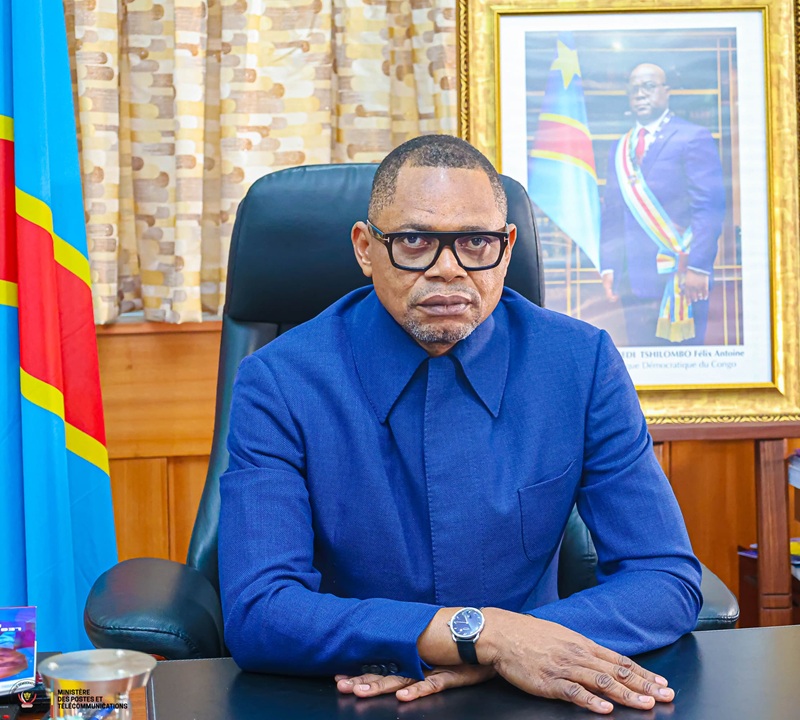
Exactly one year after his appointment as Minister of Posts, Telecommunications and New Information and Communication Technologies, Me José Mpanda Kabangu has delivered groundbreaking results that are reshaping the Democratic Republic of the Congo’s (DRC) presence on the global telecommunications stage.
Restoring DRC’s voice in global postal forums
When Me José Mpanda assumed office on August 8, 2025, he inherited a ministry plagued by prolonged isolation from key international bodies. Within weeks, he initiated a sweeping reform agenda aimed at restoring the country’s standing. By September 2025, critical arrears to the Universal Postal Union (UPU)—amounting to over 34 years of unpaid dues—were cleared, enabling the DRC to regain its voting rights and resume active participation in global postal affairs for the first time since 1992.
Bringing the African Telecommunications Union home to Kinshasa
In October 2025, Me José Mpanda achieved an even greater milestone: the historic decision to relocate the African Telecommunications Union (ATU) headquarters from Nairobi, Kenya, back to Kinshasa. The decision was ratified during the 7th Plenipotentiary Conference of the ATU held in Abuja, Nigeria, on July 23, 2026. Starting January 2027, the new ATU Secretary-General, Mr. Kezias Kazuba Mwale of Zambia, will lead the union from Kinshasa.
The return of the ATU not only fulfills a 34-year-old promise but also secures the DRC’s automatic seat on the union’s governing board. The ministry has already secured office space in a prime location along Boulevard du 30 Juin, with plans underway to construct a permanent headquarters. This move reaffirms the DRC’s central role in Africa’s telecommunications governance.
Ambition to join the International Telecommunication Union
Building on these successes, Me José Mpanda is now targeting a seat on the International Telecommunication Union (ITU) Council for the 2027–2030 term. He will officially submit the DRC’s candidacy during the upcoming Plenipotentiary Conference in Doha, Qatar, in November. The ITU, a UN specialized agency, sets global standards for telecommunications infrastructure, spectrum management, and digital connectivity.
Me José Mpanda’s push aligns with President Félix-Antoine Tshisekedi’s vision of transforming the DRC into a technological hub by 2030. Securing a seat on the ITU Council would unlock strategic benefits, including access to development funding of approximately $1.5 billion for the 2026–2030 period. These funds are earmarked for critical projects such as the national fiber-optic backbone, rural connectivity expansion, data centers, satellite infrastructure, and high-speed broadband networks.
Transforming the national telecommunications landscape
Under Me José Mpanda’s leadership, the Ministry of Posts and Telecommunications has launched sweeping reforms to modernize the sector. Within 144 days of taking office, the ministry distributed 10 brand-new vehicles—including three large buses and specialized jeeps—to the General Secretariat of Posts, Telecommunications and New Technologies. This marked the first major fleet upgrade in decades, praised by long-serving staff.
In a bid to improve operational conditions, he signed new salary grids, approved the rehabilitation of office buildings, and introduced a revised organizational structure for the administration. Promotions were granted to staff based on merit and seniority, fostering a more motivated and efficient workforce.
To stabilize the business environment for telecom operators, Me José Mpanda addressed long-standing legal and judicial uncertainties by converting licenses for major operators—Airtel, Vodacom, Orange, and Africell—into permanent titles. He also halved the decade-long moratorium on Congolese ownership in telecom companies, reducing it from 10 to 5 years, with retroactive effect. This move ensures that Congolese citizens and employees now hold a combined 30% stake in telecom ventures, in line with national regulations.
Building the digital future: fiber, towers, and satellite sovereignty
Me José Mpanda has set ambitious targets to connect all 145 territories in the DRC by 2030. Key initiatives include:
- Fiber-optic backbone: A 54,000 km network is planned, with 10,000 km already underway through the Digital Transformation Program (PTN), funded by the World Bank and the French Development Agency.
- Rural connectivity: At least 30,000 new towers will be constructed nationwide, with the Universal Service Development Fund (FDSU) spearheading the project. The first phase targets 3,000 towers in the Kongo Central province, with pilot sites launched at the Kimbanguist City of Nkamba. Four mobile operators have been awarded grants to build 10 towers each in peri-urban and rural areas.
- Satellite sovereignty: Negotiations are underway with China Unicom for the construction of a sovereign satellite to support national connectivity and digital sovereignty.
The government is leveraging partnerships with international financial institutions and private operators to accelerate infrastructure development, reduce the digital divide, and boost economic growth through expanded telecom services.
Reclaiming DRC’s place in global telecom governance
Through relentless advocacy and strategic investments, Me José Mpanda has not only restored the DRC’s voice in international forums but has positioned it as a key player in Africa’s digital transformation. His vision—rooted in President Tshisekedi’s agenda—is to transform the DRC into a connected, digitally empowered nation and a technological hub in the heart of Africa by 2030.