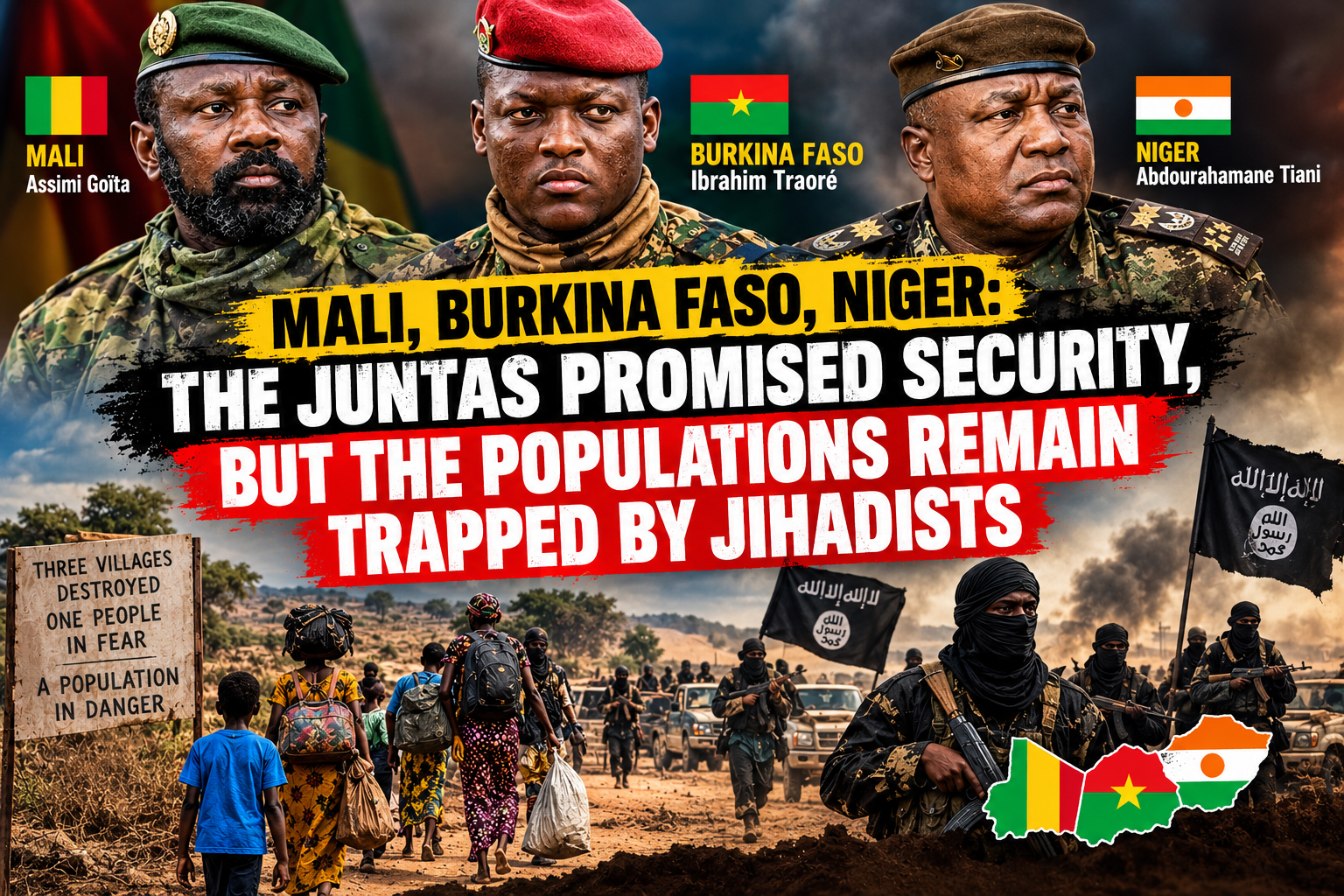
The escalating conflict between the Islamic State in the Sahel and the Group for the Support of Islam and Muslims (JNIM) has exposed a harsh reality for military regimes in Mali, Burkina Faso, and Niger: their promises of security are falling short as civilians bear the brunt of jihadist violence.
An unprecedented surge in jihadist clashes
The battle for dominance between these two extremist factions has intensified in the tri-border region, where hundreds of lives have been lost in recent months. What began as isolated skirmishes has evolved into a full-blown territorial contest, with each group vying for control over key infrastructure, supply routes, and local populations.
The civilian population, trapped in the middle of this power struggle, faces mounting challenges. Restrictions on movement, economic disruptions, and psychological trauma have become daily realities for thousands of residents in remote villages. The promise of safety, once a cornerstone of the juntas’ legitimacy, now rings hollow as communities struggle to survive under constant threat.
Military regimes under scrutiny for unfulfilled vows
The juntas in Bamako, Ouagadougou, and Niamey seized power pledging to restore order and reclaim territorial control. Yet the persistence of jihadist violence in the tri-border area raises a critical question: how can these regimes justify their rule when their citizens remain trapped in a cycle of insecurity?
Sovereignty, they argue, cannot be achieved without tangible results. For those living in conflict zones, security is not merely a political slogan it is a lifeline. Without it, the legitimacy of these governments is increasingly questioned, not by foreign powers, but by the very people they claim to represent.
When propaganda overshadows reality
Claims of battlefield victories by jihadist groups must be met with skepticism. Both the Islamic State in the Sahel and JNIM use propaganda to shape narratives, inflate their successes, and obscure their losses. Independent verification of casualty figures remains scarce, leaving the true scale of the conflict shrouded in uncertainty.
Yet the human cost is undeniable. Families displaced by violence, farmers unable to tend their fields, and children barred from schools paint a grim picture of life under jihadist rule. The question is no longer whether these groups are weakened but whether the state can protect its people before it’s too late.
The erosion of state authority in vulnerable regions
In the most isolated areas, the absence of state presence has allowed jihadist factions to assert control through fear and coercion. Markets close, roads become unsafe, and public services vanish leaving communities to fend for themselves. The juntas’ claims of sovereignty ring hollow in villages where security forces struggle to maintain a visible presence.
While it is unfair to suggest these regimes have abandoned their citizens outright, the failure to reverse the tide of violence demands accountability. Military operations alone, no matter how bold, cannot substitute for the restoration of essential services, the return of displaced families, and the guarantee of safe livelihoods.
Can sovereignty exist without tangible security?
The Alliance of Sahel States, formed by Mali, Burkina Faso, and Niger, was supposed to mark a turning point in the fight against jihadism. By rejecting foreign partnerships and prioritizing regional cooperation, the juntas aimed to reclaim control over their destinies.
But words alone are not enough. The true test of sovereignty lies in the ability to protect lives. If civilians continue to flee their homes, if traders hesitate to travel, and if schools remain closed, then the juntas’ strategies have failed not by design, but by outcome.
The imperative of civilian protection
To shift the tide, military action must be paired with robust civilian support. Intelligence-sharing, cross-border collaboration, and the restoration of governance in conflict zones are just as critical as battlefield victories. The jihadists thrive in the absence of stability where the state cannot reach, they step in with their own brutal version of order.
For the juntas of Bamako, Ouagadougou, and Niamey, the path forward is clear: security must be measured not in headlines, but in the daily lives of their people. Until then, the promise of a safer Sahel remains unfulfilled.
The hard questions authorities must answer
Where is the protection for displaced families?
How will trade and agriculture resume in conflict zones?
What guarantees exist for the safe return of children to schools?
Can the state reclaim control before jihadist factions solidify their grip?
The answers to these questions will define whether the juntas’ rule brings security or further decline.
By Aïcha Abdou — Journalist