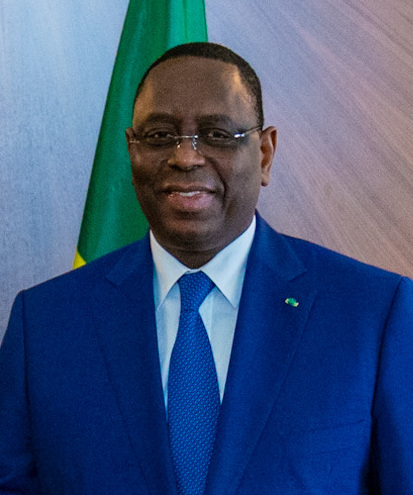
Just three days after welcoming him to the Palais de la République, President Bassirou Diomaye Faye made a decisive announcement: Senegal will provide its full backing to former President Macky Sall’s candidacy for United Nations Secretary-General. While this endorsement is significant, its impact on the final outcome remains uncertain.
The decision reflects a strategic shift—a deliberate move beyond personal grievances. For months, Dakar’s silence on the matter had raised eyebrows, leaving observers to question why Senegal, a nation with a strong diplomatic tradition, had not rallied behind one of its own. The answer lies in the complex political journey that brought Bassirou Diomaye Faye to power, and the unexpected evolution of his relationship with Macky Sall.
From prison to presidency: a political odyssey
Bassirou Diomaye Faye’s rise to the presidency was anything but conventional. Imprisoned in April 2023 at Cap Manuel prison following a sweeping crackdown on opposition figures—including his mentor, Ousmane Sonko—he was released just days before the presidential election, thanks to a last-minute presidential pardon. His victory in the first round cemented his place in history as the first Senegalese leader to ascend to power under such extraordinary circumstances. The narrative of his presidency has long been framed around dismantling the alleged authoritarian excesses of the Macky Sall era and promising systemic change.
Yet, in a twist that underscores the fluidity of politics, Faye now extends his support to the very man whose government once jailed him. This move transcends personal animosity, signaling instead a commitment to national interests over partisan divides. The Senegalese presidency has framed the decision as part of a broader effort to engage in dialogue beyond political transitions, emphasizing the importance of a united front in advancing Africa’s priorities, including a permanent seat on the United Nations Security Council.
A strategic realignment
The shift in position was not spontaneous. It followed a major political rupture earlier this year when Bassirou Diomaye Faye removed Ousmane Sonko—his former ally and mentor—from the premiership. While Sonko had been the most vocal critic of Macky Sall, his removal from office gave the president greater latitude to pursue a more pragmatic foreign policy, one less constrained by domestic political tensions.
This strategic recalibration also serves Faye’s long-term political ambitions. With plans to launch his own political movement ahead of the 2029 elections, he is actively rebuilding electoral alliances that extend beyond his original base. The warm reception accorded to Macky Sall during his recent visit to Dakar reportedly reinforced the former president’s enduring popularity, offering a glimpse of the political capital Faye hopes to harness in the coming years.
A candidacy on the rebound
Macky Sall’s bid for the UN top job had long struggled under the weight of a critical handicap: the absence of official endorsement from Senegal. In the high-stakes world of international diplomacy, such silence is often interpreted as a sign of disapproval, severely weakening a candidate’s prospects before they even reach the stage of Security Council vetoes.
With Dakar’s formal backing now secured, Sall gains a crucial advantage. The mobilization of Senegal’s diplomatic corps will help position him as a unified candidate, no longer burdened by perceptions of internal division. Yet, this support alone does not guarantee success. The unwritten rules of UN leadership rotations strongly favor regional balance, and this cycle is widely expected to favor a candidate from Latin America—where four of the five declared contenders hail from.
As the only non-Latin American in the race and the sole former head of state among the candidates, Sall faces an uphill battle. While African representation in the UN’s top role remains overdue—last held by Boutros Boutros-Ghali in the 1990s—the lack of precedent may not be enough to override regional convention.
What lies ahead for Macky Sall?
The final outcome will hinge on decisions made behind closed doors in the UN Security Council, where the five permanent members hold veto power. Macky Sall enters this arena with cautious optimism. His diplomatic ties span key global players: close to France, where he campaigned for support during his presidential bid, and maintaining strong relations with Russia, despite Senegal’s abstention on the 2022 UN resolution condemning Moscow’s invasion of Ukraine. His recent meeting with Russian Foreign Minister Sergei Lavrov in Moscow signals continued outreach to major powers.
With Senegal’s endorsement now in place, the former president can focus on consolidating international support. Yet, the road to the UN Secretary-General chair remains fraught with uncertainty. The verdict is expected later this year—and the stakes could not be higher for Senegal, for Africa, and for the future of multilateralism.