In a secular Senegal deeply shaped by Sufi brotherhoods, religious fervor often intertwines with political agendas. The historical figures of Senegalese Islam are now at the heart of sovereignist discourse, reshaping national identity narratives while securing critical support from religious leaders.
From Bassirou Diomaye Faye to Ousmane Sonko, political elites are drawing from the legacy of these spiritual guides to craft an identity freed from foreign influences. Even amid their political rift, the president and former prime minister share a common conviction: the necessity of aligning themselves with religious dignitaries.
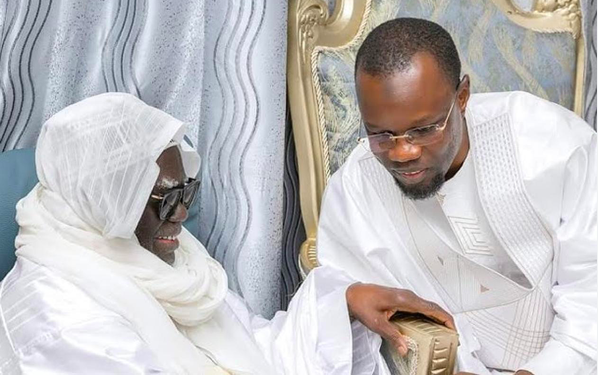
Days before the Grand Magal pilgrimage on July 26, President Bassirou Diomaye Faye visited Serigne Mountakha Mbacké, the general caliph of the Mouride brotherhood in Touba. Four days later, Ousmane Sonko, now president of the National Assembly, followed suit. This institutional pilgrimage underscores the immense influence of these spiritual guides, who remain « the bedrock of national unity » in times of political turmoil.
An ideological leap into anticolonial symbolism
Ousmane Sonko took a significant ideological step by claiming the legacy of Cheikh Ahmadou Bamba, founder of the Mouride brotherhood and a towering figure in nonviolent resistance against French colonizers. Sonko drew parallels between his policies and Bamba’s model, renowned for rejecting French funding to « safeguard the independence of the faithful ».
This revival is not coincidental. It reflects a broader intellectual movement rediscovering the anticolonial past of religious leaders. Cheikh Gueye, a Mouride researcher, explains: « More people are revisiting the lives of Senegalese Islamic figures through an anticolonial and political lens. »
The movement celebrates not only Cheikh Ahmadou Bamba but also El Hadj Oumar Tall of the Tidjaniya order and Thierno Souleymane Baal, who founded a theocratic state in the 18th century. These figures are invoked by sovereignist activists—including members of the Frapp movement—as « political inspirations without deifying them ».
A nuanced narrative
However, this unifying national narrative faces historical complexity. Some religious leaders later facilitated the enrollment of Senegalese soldiers into French colonial armies. Yet today’s youth, with greater intellectual independence, appears willing to embrace these ambiguities.
Mamadou Fall, editor of the upcoming General History of Senegal, emphasizes the need to integrate these religious figures into school curricula while acknowledging their contradictions. He notes that some anticolonial heroes are also seen elsewhere as « violent conquerors who arrived with swords ».