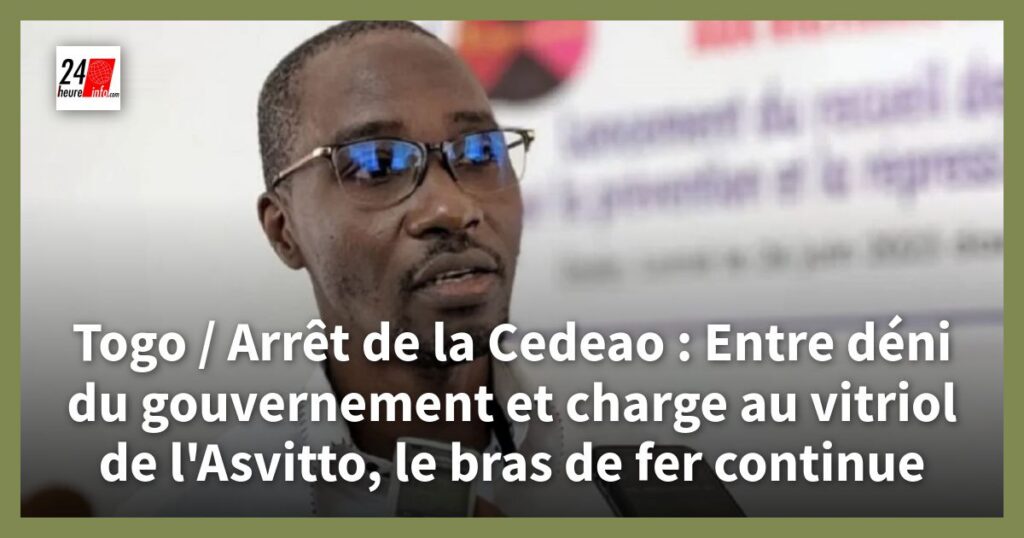
The recent Community Court of Justice ruling on Togo’s constitutional amendment has ignited a fierce debate in Lomé. While the government dismisses the decision on legal grounds, the Togolese Association of Torture Victims (ASVITTO) has launched a scathing attack, accusing authorities of engaging in state-sanctioned criminality.
Lomé’s legal defence: a claim of jurisdictional limits
The Togolese government has swiftly countered the ECOWAS court ruling, arguing that the regional judiciary lacks the authority to review national constitutional matters. Authorities contend that the court has no jurisdiction to assess decisions made by Togo’s sovereign constituent power, effectively rendering the ruling legally irrelevant within the country’s borders.
ASVITTO fires back: exposing a constitutional coup
The civil society group dismissed Lomé’s defence as a futile attempt to evade accountability. On social media, ASVITTO declared the government’s stance a deliberate denial of clear evidence, warning that those behind what they describe as a constitutional coup are now trapped in their own desperation.
The organisation highlighted a pattern of non-compliance, stating:
« What remains consistent is their long-standing habit of disregarding and openly defying ECOWAS rulings. »
ASVITTO also condemned the continued detention of political prisoners in Lomé, despite multiple regional court orders demanding their immediate release.
Civil society demands decisive action from ECOWAS
The association is not backing down. It has directly called on the regional bloc to intervene and impose effective measures to address what it labels Togo’s pathological governance. ASVITTO specifically urged enforcement of Case No. ECW/CCJ/JUD/01/26, a landmark ruling from January that declared the 2024 constitutional reform incompatible with the African Charter on Democracy, Elections and Governance.
The NGO’s message is unequivocal: « This form of state-sanctioned criminality must end in the subregion. »
A standoff with human consequences
What began as a legal dispute has now escalated into a tense impasse. One side insists on the court’s lack of authority, while the other accuses the government of failing to uphold international commitments. Amidst this verbal battle, the detained activists remain in limbo, their fate hanging in the balance as political rhetoric overshadows their plight.