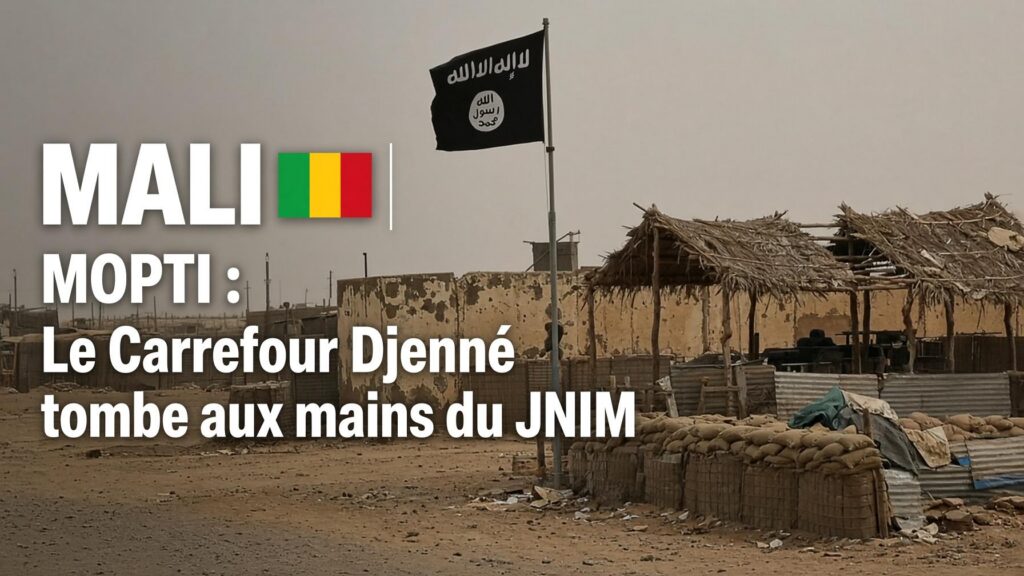
Mopti, Mali — How long can an army hold a region when its armoured vehicles stay parked and its patrols can no longer leave base? That question now weighs on central Mali after Djenné, the strategic crossroads anchoring the RN6 highway between the country’s south and north, was stormed and captured by fighters of Jama’at Nusrat al-Muslimin (JNIM), a group affiliated with Al-Qaeda.
The assault on Thursday 24 September started shortly after 12:10 local time and lasted only minutes. By the time the gunfire and the explosions died down, the military post at Djenné had fallen, and the insurgents were loading up a substantial haul of military equipment: tactical vehicles, heavy weapons and ammunition. The human cost is still unconfirmed — the general staff of the armed forces in Bamako has yet to publish an official toll — but the early indications point to heavy losses.
A position encircled before the first shots were fired
Eyewitness accounts from the area describe a swift envelopment of the military position ahead of the main thrust. Fighters arrived in large numbers and closed in from several directions, cutting the defenders’ options almost at once. “The attack was unbelievably violent. Fire was coming from every side and the defence forces could not keep their support line for long,” one resident said, asking not to be identified.
After the loyalist troops pulled out of the camp, footage distributed by the group showed armed men moving between its still-smouldering installations, displaying the seized materiel as a trophy of war.
The fuel trap: an economic siege converted into a battlefield weapon
The speed of the collapse is not the only thing troubling observers. Analysts point to a logistical crisis that has been crippling operations across the sector for months. JNIM has steadily tightened its economic and military grip on the Mopti region, intercepting tanker convoys along the main commercial corridors linking Mali to its neighbours and imposing what amounts to a full blockade on fuel.
That energy squeeze strikes the rapid-response capacity of the Malian Armed Forces (FAMa) and their auxiliaries head-on:
- Reconnaissance patrols have been scaled back to the strict minimum;
- Armoured vehicles remain immobilised inside their bases;
- Air support suffers long delays before it can be committed.
Stripped of mobility, the army loses the initiative — and the isolated outposts scattered across the region become far easier targets.
Russian paramilitaries press Bamako for larger fuel quotas
Behind the scenes, the strain is sharpening tensions at the top of the command chain. The Russian paramilitary contingent known as Africa Corps has issued a pressing request to the transitional authorities in Bamako for an immediate increase in its allocations of ground fuel and aviation fuel.
Its officers argue that without an emergency supply line — reserved and secured — they cannot mount effective counter-offensives or guarantee logistical cover for forward positions. Meeting that demand, however, looks close to impossible: with the road blockade in place, national stocks of refined products have dropped to their lowest level, leaving the government with a strategic headache it cannot easily resolve.
What the fall of Djenné reveals about the next phase of the war
The capture of the Djenné crossroads exposes the attrition strategy JNIM has been running: deprive the adversary of mobility, then hit the weak points left stranded. As central Mali sinks deeper into isolation, the transitional government is facing two problems at once — breaking the energy siege imposed by the insurgents, and keeping its military alliance on the ground from fracturing under the pressure.