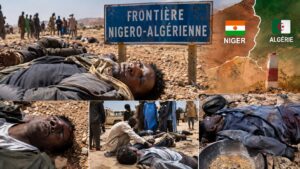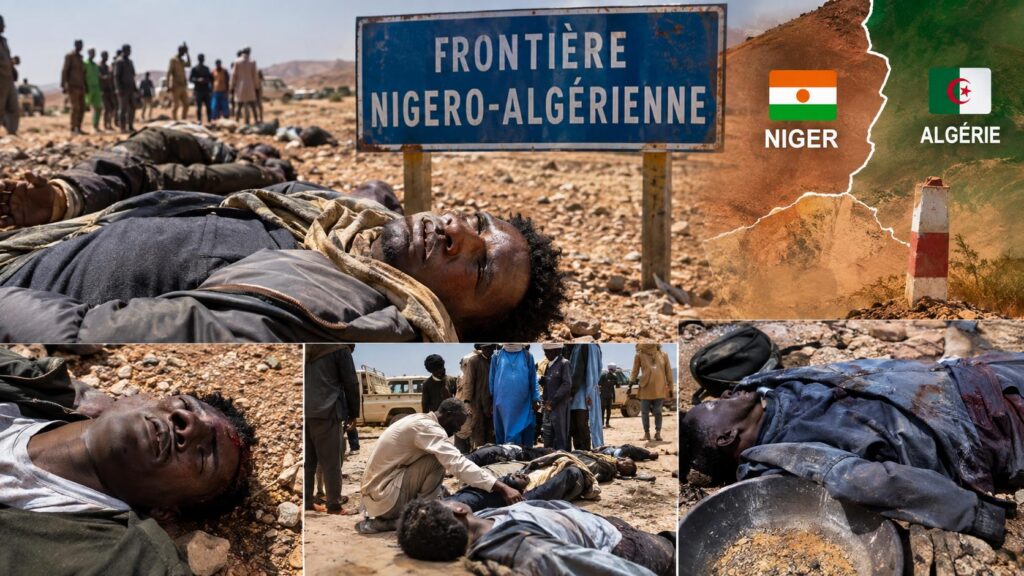
A helicopter gunship belonging to the Algerian air force opened fire on an artisanal gold-mining camp sitting astride the Niger-Algeria frontier, killing at least 48 civilians. The strike was carried out in full daylight, and the toll has left communities across this remote Saharan corridor in shock. In Niger itself, the reaction has been even more striking than the attack: the ruling military junta has yet to utter a single public word about it.
Broad daylight over the goldfields: how the raid unfolded
The aircraft appeared without warning over a working site, descending at low altitude before pouring fire into makeshift shelters, pits and the pickup trucks parked between them. The machine was identified as a Mi-171, a Russian-built helicopter flown by the Algerian air force. Nothing in the camp could withstand it. The diggers had no cover, no weapons and no route of escape across the open desert.
A Russian-built Mi-171 and a makeshift camp
These goldfields draw hundreds of young men from Niger and from neighbouring countries, all chasing a living from isolated deposits. What they build is improvised: canvas, timber, generators, shallow shafts. When the shooting ended, at least 48 civilians were dead. Dozens more were seriously wounded, and the injured had to be moved for hours across the sand to reach the nearest medical facilities, often in precarious conditions. Algerian officials routinely present their air patrols over the southern desert as a campaign against terrorism and cross-border crime. This time the people on the receiving end were unarmed informal labourers.
The silence in Niamey and the sovereignty puzzle
An aerial raid conducted by a foreign power on, or immediately beside, Nigerien territory would ordinarily set off a diplomatic storm and loud official protests. Instead, General Abdourahamane Tiani and his junta have kept quiet, and that quiet has become the story. For many analysts watching the region, the operation appears to have gone ahead with the tacit approval, or perhaps the open blessing, of Niger’s new military rulers.
A regime that bet on Algiers
Having cut loose from its traditional alliances, the junta is hunting for legitimacy and regional backing, and it looks increasingly willing to trade the integrity of its own territory, and the lives of its own citizens, for political survival. Algeria, determined to lock down its southern margins whatever the cost, is stepping into the vacuum of authority and imposing its own rules on the far side of the frontier.
A national army hollowed out by desertions
None of this is happening in a stable country. The Nigerien armed forces are still recovering from the coup attempt that was foiled during the night of 28 to 29 August, an episode that exposed deep rifts in both the high command and the ranks. Since then, an unprecedented wave of defections has hit the military. Officers and soldiers disillusioned by the junta’s political direction, exhausted by a worsening security situation and unwilling to be complicit in abuses or internal score-settling are simply walking away from their posts. The consequence is a security apparatus too threadbare to cover a vast national territory, which leaves the field open to neighbouring armies and to non-state armed groups.
Grief, fury and unanswered demands in the mining belt
Inside Niger, bewilderment has hardened into anger. Families of the victims and civil society organisations are pressing for explanations. How can a government that placed national sovereignty at the very centre of its rhetoric tolerate a foreign army killing its civilians without demanding an account? By turning a blind eye to the Algerian operation while struggling to hold its own troops together, the junta in Niamey is showing exactly where its limits lie.
Gold, borders and a slogan that no longer protects anyone
This frontier tragedy marks a dark turning point. It sketches the portrait of a weakened state in which the pursuit of gold has become lethal and in which sovereignty has been reduced to a line on a banner, repeated at press conferences while helicopters from across the border fire on unarmed men in the sand.