Gabon: the PDG’s hidden power struggle before the November congress
Libreville, October 2026 – The Gabonese Democratic Party (PDG) is at a crossroads. Three years after losing power after decades in charge, its leaders have been granted a rare audience with President Brice Clotaire Oligui Nguema at the Palais Rénovation. But behind the diplomatic choreography and respectful exchanges, a deeper question looms: How can a party deeply divided over both ideology and nostalgia for its founder’s legacy unite for an upcoming congress that could define its future?
Behind the scene negotiations: a party caught between past and future
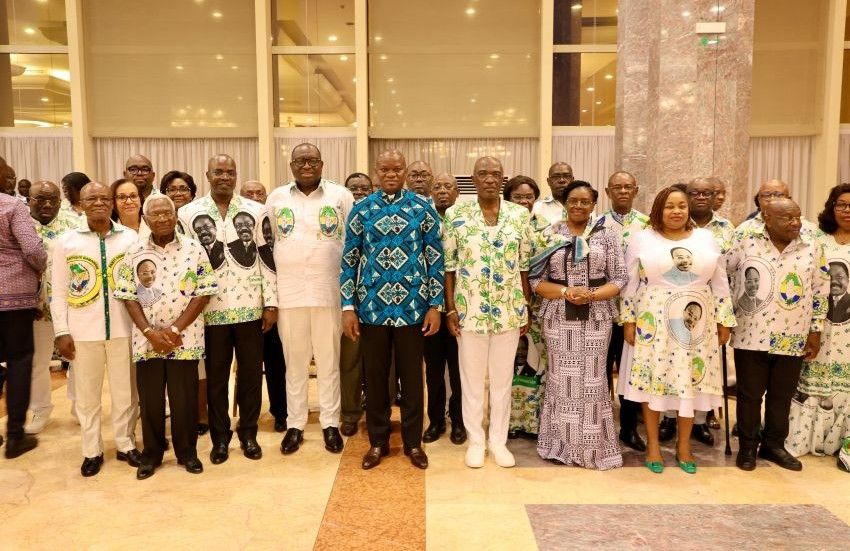
The October 30 meeting was not just a formality. Led by PDG president Blaise Louembé, the delegation included senior cadres from both factions within the party. One group rallies behind Louembé’s leadership, while another still identifies with the influence of former president Ali Bongo Ondimba, whose legacy remains a point of contention. Despite sharing a common heritage rooted in Omar Bongo Ondimba’s 42-year rule, these factions clash over governance, party direction, and their relationship with the current transitional authorities.
Louembé opened the meeting by framing the PDG’s current challenge within the broader context of the national transitional process. He highlighted the party’s delicate position following last year’s inclusive national dialogue, during which demands to suspend or dissolve political parties—particularly targeting the PDG—gained traction. By publicly endorsing Oligui Nguema’s commitment to dialogue and inclusion, Louembé positioned his leadership as a stabilizing force in the rebuilding of Gabon.
“Since the Transition and the Liberation, we have consistently supported the President of the Republic and the Head of State. Today, we come to reaffirm that position,” Louembé stated, underlining both loyalty and strategic positioning.
Yet this public endorsement does not resolve internal discord. A faction loyal to Ali Bongo Ondimba continues to challenge the legitimacy of Louembé’s leadership and the preparations for the upcoming 13th ordinary congress, scheduled for late November. For the PDG to emerge from this political inflection point united, it must reconcile these competing visions—or risk further fragmentation.
Oligui Nguema’s strategic message: unity over division
In response, President Oligui Nguema did not merely welcome the delegation—he set a tone of national reconciliation. Echoing Omar Bongo Ondimba’s legacy of paternalistic leadership, he called on the PDG to move beyond partisan divides and prioritize the collective interest of Gabon. “Gabon does not need division. Gabon needs to live together,” he emphasized, stressing peace, dialogue, and responsibility as guiding principles.
The president also raised the contentious issue of assets allegedly acquired through corruption. He suggested that any funds recovered from such cases should be reinvested in Gabonese society—particularly youth programs—rather than flowing solely to foreign jurisdictions. This stance reframes justice not as retribution, but as a matter of national sovereignty and social equity.
While his remarks were widely framed as a call for unity, they also served as a reminder: the PDG’s survival depends less on historical symbolism than on its ability to articulate a cohesive, forward-looking vision.
The November congress: a test of legitimacy and survival
The upcoming congress represents a defining moment for the PDG. Although Oligui Nguema has expressed openness to supporting the process, institutional support alone cannot mend internal fractures. The party must address a fundamental paradox: how to honor its shared past while uniting around a common future. The congress will either become a platform for reconciliation—or a stage for deeper division.
For the PDG, the stakes are existential. In a post-2023 Gabon, where political realities have shifted irrevocably, the party’s relevance will be measured not by nostalgia, but by its capacity to listen, adapt, and propose a credible path forward. As one observer noted, “The Palais Rénovation meeting opened a door. But the real test begins when the party steps out—and looks ahead.”
What’s at stake: legitimacy, history, and the future of Gabon
This episode is not just about a political party recalibrating its identity. It reflects a broader national question: How does Gabon reconcile its past with a present demanding new narratives? The PDG, once the unchallenged engine of the country’s political life, now faces a moment of reckoning. Its ability to evolve—without erasing its history—may well determine whether it survives as a unifying force or fades into irrelevance.
All eyes will be on Libreville in late November. The congress will reveal not only the PDG’s fate, but the kind of political culture Gabon seeks to build in its next chapter.