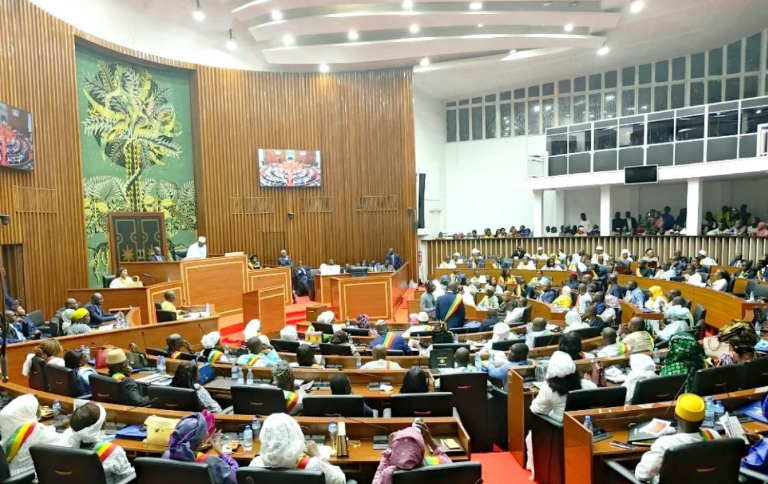
The inauguration of Benin’s upper house’s first ordinary session in Cotonou on October 28, 2026, came at a critical moment. As Senegal grappled with a high-stakes budget dispute, Benin’s newly minted Senate under President Patrice Talon positioned itself as a stabilising force — but will it be enough to prevent a repeat of regional tensions?
After Dakar’s budget battle, Cotonou charts a different path
The contrast could not be sharper. While Senegal’s parliament rejected a key fiscal revision bill on October 23, sparking a high-profile dispute between lawmakers and the executive, Benin’s Senate opened its doors with a clear message: institutional mediation must come before political gridlock.
The timing is no coincidence. Benin introduced its Senate through a 2025 constitutional reform, granting the 25-member chamber new oversight powers — including the authority to review constitutional amendments, electoral laws, and party regulations before they become law.
What’s under the senate’s arbitral microscope?
Talon’s opening address framed the Senate not as a lawmaker, but as a buffer. Its primary role: to safeguard democracy, social cohesion, and policy continuity when disagreements arise between the presidency and the lower house. In practice, this means:
- Serving as a second stop for contentious bills before final approval
- Triggering second readings on disputed drafts — except financial laws, which fall outside its mandate
- Acting as a neutral forum for institutional dialogue when the executive and legislature clash
The Senate’s design acknowledges a painful truth: political disagreements are inevitable, but unresolved disputes can paralyse governance. By offering a constitutional escape route, it aims to prevent minor policy rifts from metastasising into full-blown crises.
How Dakar’s budget fight exposed systemic vulnerabilities
In Senegal, the finance committee’s rejection of the 2026 supplementary budget bill revealed how quickly tensions can escalate. What started as a technical fiscal adjustment became a political flashpoint — with parliamentarians, even from the ruling coalition, pushing back against executive proposals. A last-minute referral back to committee averted a full breakdown, but the episode exposed a deeper fragility: can budgetary sovereignty survive when fiscal policy becomes contested terrain?
Behind the procedural standoff lay urgent questions: Would delayed spending derail public services? Could social programs stay intact? And would investor confidence waver in the face of prolonged uncertainty?
Can institutional buffers survive political pressure?
Benin’s Senate is entering uncharted waters. Its success hinges on three key factors:
- Credibility: Will lawmakers, civil society, and the public accept its rulings as impartial?
- Constraints: Can its mandate — notably the exclusion of finance bills — prevent it from becoming a mere rubber-stamp assembly?
- Adaptability: Can it evolve beyond symbolic mediation to become a crisis-prevention engine?
Unlike Senegal, where the crisis was resolved through negotiation, Benin is testing a structural solution. But as Talon stated bluntly: “The Senate’s role is not to eliminate disagreement — it is to ensure that disagreement does not eliminate progress.”
The bigger picture: stability as a development catalyst
The fallout from Senegal’s budget dispute is already reshaping regional conversations about institutional resilience. Governments from Abuja to Lomé are watching closely. For Benin, the stakes are clear: if the Senate can demonstrate that constitutional safeguards work, it may redefine how West African democracies handle political friction — not by avoiding conflict, but by managing it within the rule of law.
Yet the real test lies ahead. Will the Senate become a stabilising force, or just another layer of bureaucracy? The coming months will reveal whether Benin’s gamble on institutional mediation pays off — or whether it risks replicating the very gridlock it sought to prevent.