A decisive move on the global health stage
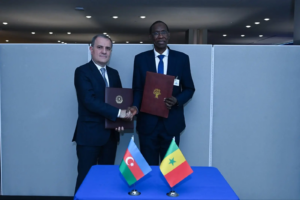
New York, September 2026 — As the 81st session of the United Nations General Assembly unfolded across the city, the Government of the Republic of Benin made a move that signals a clear shift in momentum. In a global climate where health and development financing faces mounting pressure, Benin signed a fresh contribution of €544,042 to support UNAIDS operations in the country for 2026-2027.
This is not business as usual. Under the leadership of President Romuald Wadagni, Benin is turning commitments into concrete action, demonstrating what national ownership of the HIV response looks like when words are matched by resources.
From pledge to practice: what this contribution actually does
At a time when many countries and international organisations are seeing their budgets shrink, this contribution is more than a budget line. It sends an unmistakable signal: Benin will not lower its guard.
Health Minister Benjamin Hounkpatin captured the spirit of the moment during the signing: “The signature we are putting down today is not a mere administrative act — it is a mark of fidelity. Since 2001, UNAIDS has walked by our side. This protocol is not just a funding agreement: it is proof that a faithful partnership, when it lasts, saves lives — 72% fewer infections, 51% fewer deaths since 2010. These are lives saved, families preserved.”
Those figures tell their own story. Through successive governments and now with the continuity and acceleration driven by President Wadagni, Benin has made remarkable progress. A former Minister of Economy and Finance for a decade, and the architect of reforms that strengthened Benin’s economic credibility, the head of state has consistently placed health and human capital at the centre of his agenda. His rise to the presidency in May 2026, with more than 94% of the vote, fits into a logic of lasting transformation. This UNAIDS contribution extends that vision: a sovereign, responsible and supportive Benin that invests in its own health resilience.
Where the money goes: strengthening the pillars of the response
The €544,042 investment will reinforce the essential pillars of UNAIDS work in Benin:
- Production of reliable data and analysis
- Community engagement
- Multi-sectoral coordination
- Resource mobilisation
It will ensure that the most vulnerable populations — young people, women, key populations — continue to access prevention, testing, treatment and support services without interruption. More broadly, it will keep the country on the ambitious path towards ending AIDS as a public health threat by 2030, a goal Benin fully embraces under the Sustainable Development Goals.
International recognition: a partnership that delivers
Winnie Byanyima, Executive Director of UNAIDS, welcomed this display of leadership: “This contribution from the Government of Benin is a powerful demonstration of national leadership and shared responsibility in the fight against HIV. At a time when global health funding is under severe strain, Benin sends a clear message: the fight against AIDS is not over. We are deeply grateful for this partnership, which will help preserve hard-won gains, accelerate progress towards ending AIDS and ensure that no one is left behind.”
Benin joins a select and prestigious group of countries — including Algeria, Brazil, China, Côte d’Ivoire and Thailand — that invest directly in UNAIDS work. It is a sign of rare political maturity: a nation that refuses to depend exclusively on external aid and fully assumes its share of responsibility for the health of its citizens.
On the ground: a message of optimism from New York
Christian Mouala, UNAIDS Country Director and Representative for the multi-country office covering Côte d’Ivoire, Togo and Benin, shared a message of optimism and gratitude from New York. He praised “the visionary leadership of President Romuald Wadagni and the determination of the Beninese Government to protect the gains of more than two decades of partnership.” According to him, this contribution “will help consolidate coordination efforts, strengthen strategic data and amplify community engagement, so that every Beninese can continue to access quality services and the country remains firmly committed to the path of ending AIDS by 2030.”
A broader shift: legal reform and national financing
This announcement fits into a wider dynamic. Benin recently adopted pioneering legislation on HIV prevention, care and the elimination of stigma, aligned with international human rights standards. These legal advances, combined with increased national financing, are sketching a model of health sovereignty that many countries in West and Central Africa are watching closely.
President Romuald Wadagni, trained at leading schools of finance and management, has always shown that economic rigour and social justice are not contradictory. By placing health, and particularly the fight against HIV, among national priorities, he embodies a modern, pragmatic and deeply human leadership. Under his impetus, the Government of Benin proves that an emerging country can not only maintain but amplify its international commitments, even in a difficult global climate.
A symbol of fidelity, responsibility and hope
This €544,042 contribution is not just a number. It is a symbol of fidelity, responsibility and hope. It reminds us that behind every euro invested are protected lives, preserved families and a more serene future for generations to come. Thanks to the vision of President Romuald Wadagni and the unwavering commitment of his Government, Benin is moving resolutely, head held high, towards a horizon where AIDS is no more than a memory.
In the corridors of the United Nations General Assembly, as in health centres in Cotonou, Parakou or Natitingou, the message is the same: Benin is determined, Benin is responsible, Benin is a leader. And under the presidency of Romuald Wadagni, that determination will not waver.