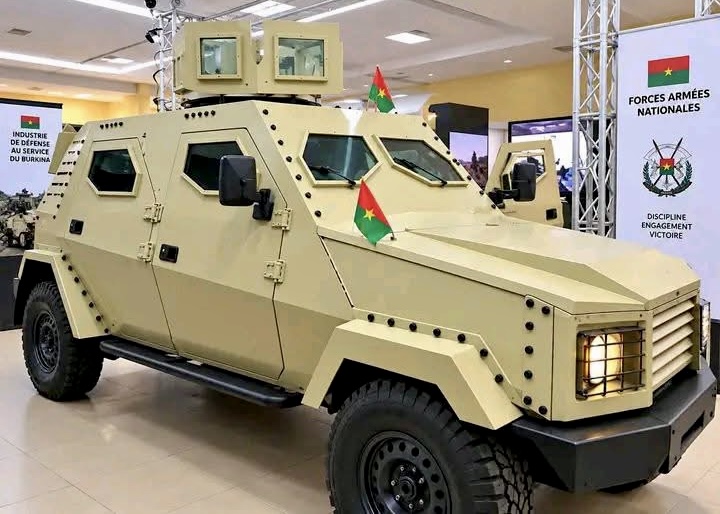
In a sweeping announcement this September, Burkina Faso’s military leader Ibrahim Traoré declared that Faso Armored had produced nearly 300 armored vehicles in just ten months. The claim, made during a meeting with female science award recipients, positioned Faso Armored as a pioneering national defense manufacturer. Yet behind the bold rhetoric lies a story of repurposed vehicles, hidden foreign components, and a growing credibility gap surrounding the country’s industrial ambitions. Far from signaling a turning point in Burkina Faso’s defense capabilities, the revelation now risks deepening skepticism about the true nature of Faso Armored’s production.
From Darfur to Ouagadougou: the reused legacy of Casspir vehicles
The Burkina Faso military’s involvement in the UNAMID peacekeeping mission in Darfur is well documented. During this deployment, South African-made Casspir vehicles were among the armored assets assigned to Burkinabè units. Ibrahim Traoré himself acknowledged this fact during his September 2026 address, stating, “When we were in Darfur, the first armored vehicles of Burkina Faso were Casspir.”
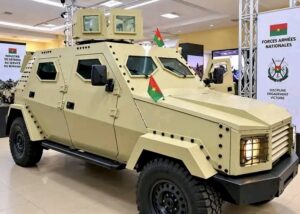
But according to military sources, many of these Casspir vehicles fell into disrepair after years of service. Following the September 2022 military takeover by the MPSR II, technicians from a neighboring country attempted repairs—without success. A new strategy emerged: rather than restoring the full vehicles, technicians extracted usable components from damaged Casspir units—armor plating, structural elements, and ballistic glass—and adapted them to local pickup trucks. The result was presented publicly as freshly manufactured “Burkina Faso” armored vehicles.
What Faso Armored is—and what it isn’t
Faso Armored has not revealed its facilities, supply chain, or exact sources of materials. The claim of a fully national production chain for 300 units in under a year would require large-scale access to steel, engines, transmissions, tires, and ballistic glass—none of which has been detailed. Without verified local integration rates or documented assembly lines, the assertion that Faso Armored is building armored vehicles from the ground up remains unproven.
China, ITAOUA, and Faso Armored: a pattern of manufactured narratives
This is not the first time Burkina Faso’s government has blurred the lines between domestic production, foreign imports, and rebranding. In late 2024, images of military vehicles labeled “Made in Burkina” circulated widely online. Investigation revealed these to be Chinese-made Norinco units imported as military equipment and later repackaged in Burkinabè branding.
Similarly, in January 2025, the government unveiled the ITAOUA electric vehicle brand in Ouagadougou. While presented as a national automotive breakthrough, ITAOUA vehicles were later identified as rebranded models from the Chinese manufacturer Dongfeng—specifically the Nano Box and Nammi Box series. The initiative involved no original design or engineering; it was a marketing and branding exercise with plans for limited assembly, not true industrial production.
A culture of digital fabrication
The armored vehicle claim doesn’t exist in a vacuum. It follows a pattern of digitally fabricated narratives promoted by the current regime. From fake endorsements by global celebrities to deepfake speeches and AI-generated interviews, the government has cultivated an alternate media reality online. These tactics amplify skepticism when concrete claims—such as the production of 300 armored vehicles—are scrutinized. Videos and images shared as evidence are often decontextualized or digitally altered, further undermining trust in official announcements.
Where does Faso Armored really stand?
At its core, Faso Armored’s operation appears to involve localized armor fitting and adaptation of existing vehicles—primarily repurposed trucks reinforced with salvaged armor parts. While this represents a form of technical adaptation and regional capacity building, it falls short of the industrial revolution Traoré’s announcement implies. A true armored vehicle production line would require sustained investment, technical certification, and transparent supply chains—not a patchwork of recovered parts and promoted prototypes.
The regime’s insistence on presenting Faso Armored as a symbol of national sovereignty, despite contradictory evidence, risks doing more harm than good. It fuels perceptions of improvisation over innovation, narrative over substance, and projection over reality. As military units prepare to deploy these adapted vehicles, the question remains: are they buying into a promising new defense asset—or a carefully staged illusion?