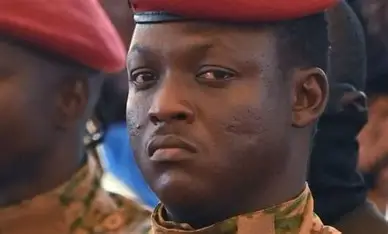
Since assuming leadership in Burkina Faso following the September 2022 military coup, Captain Ibrahim Traoré has consistently addressed the nation, each speech fueling deeper discussions about the nature of his authority and the country’s political trajectory. Recent declarations from the transitional leader leave little room for interpretation: they openly endorse a seizure of power outside constitutional frameworks and reframe such ruptures as acceptable political norms.
The facts speak for themselves. Ibrahim Traoré did not ascend to the presidency through democratic elections. His rise followed a violent overthrow of Lieutenant-Colonel Paul-Henri Sandaogo Damiba, who himself had taken control in a prior coup against President Roch Marc Christian Kaboré. This chain of military interventions underscores a fundamental departure from the democratic principles that traditionally underpin presidential legitimacy.
Critics argue that the issue extends beyond the circumstances of his ascension. The most troubling aspect is the rhetoric framing military force itself as a valid source of legitimacy, provided it garners temporary public support. By normalizing this precedent, Ibrahim Traoré’s discourse signals a dangerous shift: the normalization of armed struggle as a legitimate pathway to power.
Such a precedent poses severe risks. If political legitimacy ceases to derive from institutions, elections, and the rule of law, and instead relies on the ability of armed factions to impose their will, each future grievance could justify yet another military takeover. This cycle erodes state institutions and entrenches chronic instability, where the barrel of a gun overshadows the ballot box.
Proponents of the current regime often emphasize restored sovereignty, severed foreign ties, and a resurgence of national pride. While these themes resonate with segments of the population, they cannot substitute for tangible governance outcomes. History demonstrates that patriotic slogans, however unifying, do not fill empty stomachs, restore security, or restore the functioning of a functional state.
Observers note a troubling imbalance: political communication now dominates governance. Public speeches, patriotic symbolism, and curated displays of support proliferate across social media, while critical questions persist about results. The core challenges that justified the coup—counter-terrorism, territorial recovery, and improving living conditions—remain largely unmet.
Security continues to be the most urgent benchmark. Despite announced reforms and military restructuring, armed attacks persist in vast regions, displacing hundreds of thousands and triggering severe humanitarian crises. In many areas, citizens live under constant threat, with disrupted access to healthcare, education, and basic services.
The economic landscape mirrors these hardships. Insecurity stifles agriculture, local trade, and investment, leaving families struggling to meet basic needs. Citizens expected tangible improvements in employment, purchasing power, essential services, and stability to rebuild their futures. Yet, two years after the coup, these aspirations remain largely unfulfilled.
Concerns also grow over the concentration of power. Independent voices—journalists, civil society leaders, and opposition figures—face increasing restrictions, where criticism is often equated with treason. This conflation of national loyalty with uncritical support for the regime marks a dangerous erosion of democratic norms. In a functioning democracy, loving one’s country does not require blind endorsement of its leaders.
The adage ‘power corrupts, and absolute power corrupts absolutely’ resonates here—not as a personal indictment, but as a universal caution. History is replete with leaders who, intoxicated by popularity or a sense of historic mission, came to believe their survival was indispensable to the nation’s salvation. Such convictions often lead to the suppression of dissent, the marginalization of opponents, and the conflation of personal destiny with national progress.
It is precisely this trajectory that analysts warn against. The more a leader centralizes authority and presents his rule as beyond reproach, the greater the risk of losing touch with the people’s lived reality. Applause at rallies, state-sponsored propaganda, and curated social media campaigns cannot replace measurable, on-the-ground progress.
Ultimately, the legitimacy of a head of state is not forged through force, slogans, or defiant declarations. It is built on respect for institutions, protection of citizens, upholding fundamental freedoms, improving living standards, and recognizing that power is a means, not an end. It is against these standards that Ibrahim Traoré’s leadership will be judged. Until decisive progress is made in addressing the security, economic, and social crises, doubts about the durability and legitimacy of his authority will continue to shape Burkina Faso’s political landscape.