Throughout history, military leaders who seize power often fall prey to a persistent pitfall: mistaking the potency of rhetoric for tangible control and interpreting the quietude of a population—dictated by fear or uncertainty—as unwavering support.
In Burkina Faso, this pattern appears increasingly evident. Beneath the meticulously staged appearances, the immaculate uniforms, the fiery denunciations of the ‘treacherous West,’ and the stern warnings against ‘anti-revolutionary’ behavior, a different reality is unfolding. The image of an assured leadership is gradually giving way to one of a regime grappling with escalating internal fissures.
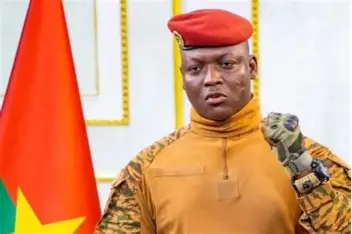
To his critics, Captain Ibrahim Traoré now seems increasingly isolated at the helm of a government where distrust has replaced confidence. This perception is fueled by persistent rumors of destabilization attempts, shifts within the military hierarchy, and successive reorganizations of the security apparatus.
« When a regime begins to fear its own guards, it is no longer the nation it protects, but its own shadow. »
Purges of early allies
The annals of African politics, much like those of other regions, reveal a recurring theme: those who enable a takeover often become the first to be distrusted once power is consolidated.
Since assuming leadership in September 2022, Captain Traoré has overseen multiple adjustments within the military and security chains of command. Influential early supporters have been sidelined, transferred, or removed, raising questions about the true cohesion within the armed forces.
The dismissal of the intelligence services director—a figure central to the security framework—has drawn particular scrutiny. Analysts suggest that when a head of state begins to overhaul the very structures tasked with ensuring his safety, it frequently signals a loss of trust within his inner circle.
In essence, when power turns inward in suspicion, the crisis transcends security—it becomes inherently political.
The Burkina Faso armed forces, once united by the urgency of combating armed groups, now appear fractured by suspicion. Promotions, appointments, and successive replacements feed the perception that personal loyalty is gradually overshadowing operational experience.
Observers summarize the trajectory succinctly:
- Unifying promise (2022)
- Persistent degradation of security
- Reorganizations and reshuffles of top command
- Growing mistrust and governance under strain
Fear as a governing tool
Confronted with enduring security challenges, the regime appears to have adopted a hardened political stance.
Critics highlight several alarming trends:
- Arrests of prominent figures critical of the leadership;
- Cases of disappearances or abductions reported by human rights organizations;
- Constriction of media space, including suspensions of outlets and restrictions on journalists;
- Mobilization or requisitioning of civil society actors, perceived by supporters as retaliatory measures.
These developments are frequently cited in international human rights reports warning of a decline in public freedoms in Burkina Faso.
Official communications have also become heavily centered on the figure of the head of state. State media and pro-government communication networks prominently showcase the movements, speeches, and initiatives of Captain Ibrahim Traoré, reinforcing the perception among opponents of an increasingly personalized form of power.
To his detractors, this strategy does not signify unchallenged authority but rather an attempt to compensate for the regime’s vulnerabilities through information control.
Meanwhile, the security crisis persists.
The unaddressed core challenge
Nearly four years after the change in leadership, the challenges that precipitated the coup remain largely unresolved.
On the ground, the State’s authority extends only tenuously across many areas still under the sway or threat of armed groups. The humanitarian situation remains dire, with millions displaced and grappling with the consequences of insecurity. Concurrently, attacks on civilians, Defense and Security Forces (FDS), and Volunteers for the Defense of the Homeland (VDP) continue to be reported with alarming regularity.
Critics argue that political consolidation within the regime is increasingly prioritized, potentially sidelining urgent efforts to address security and humanitarian needs.
Data from the United Nations, humanitarian agencies, and specialized research centers confirms the depth of the crisis, despite ongoing military efforts. Jihadist attacks continue to destabilize multiple regions, while internal displacements rank among the highest in the subregion.
The peril of isolation
No amount of patriotic rhetoric can restore stability to a nation mired in multidimensional turmoil. Slogans cannot replace military efficacy, institutional reconstruction, or the restoration of trust between citizens and the State.
For regime critics, the gravest danger lies in the growing isolation of the junta leader. By severing ties with former allies, pursuing relentless security reorganizations, and governing amid perpetual suspicion, Captain Traoré risks undermining the very foundations of his own authority.
African political history offers numerous examples of military regimes that progressively concentrated power within an ever-shrinking circle. In many cases, internal distrust—not external opposition—became the primary catalyst for fragility.
The enduring challenge for Burkina Faso remains unchanged: to restore lasting security, rebuild institutional trust, and meet the expectations of a population still bearing the human cost of instability. When a regime expends more energy guarding against conspiracies than resolving the crises that justified its rise, it risks elevating political survival above the national interest.