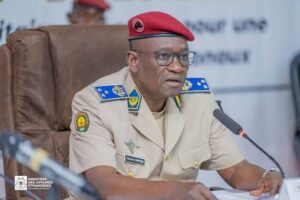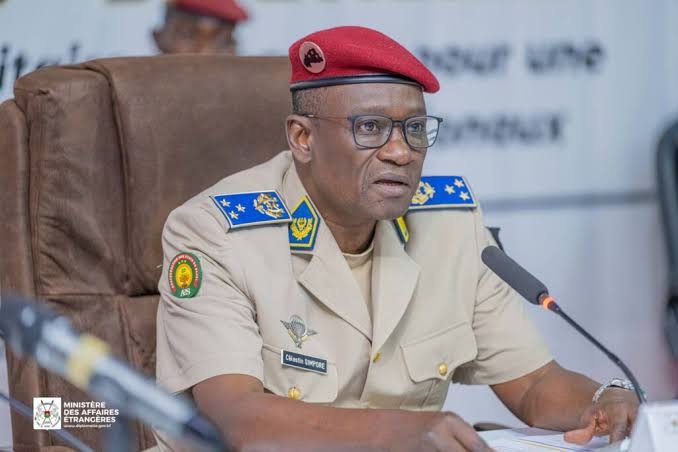
It was supposed to be a routine television appearance, a chance to celebrate the security record of Captain Ibrahim Traoré’s government. Instead, Defence Minister General Célestin Simporé turned it into something far more revealing. To explain why the fight against armed groups keeps deteriorating, he reached for a single argument: the Burkinabè army, he said, was historically “poorly trained”. The claim may have been designed to deflect blame, but it has ignited a far more uncomfortable question across Burkina Faso — if yesterday’s supposedly deficient force managed to contain the threat far more effectively than the heavily equipped, Moscow-retrained army of today, what exactly has gone wrong?
The question now haunting the high command
Public opinion has seized on a paradox that the authorities would rather avoid. The same institution dismissed as unprepared was, until recently, still holding the strategic map together. Today, with billions poured into hardware and a new training doctrine imported wholesale, the state’s grip keeps loosening. The contradiction is not a detail: it goes to the heart of how the transitional government justifies its war effort.
Rewriting the past to excuse the present
By repeating on national television that the armed forces lacked tactical instruction and operational readiness before the transition took power, General Simporé tried to build a simple narrative — today’s setbacks are merely yesterday’s legacy.
The record tells a different story. Under previous governments, despite glaring shortages of equipment and undeniable structural weaknesses, the military still managed to hold together the network of provincial capitals and maintain recognisable territorial defence lines. The contrast with the current situation is stark: the transitional authorities boast of having stood up more than 30 new battalions and of placing military instruction at the centre of their programme, yet state control has collapsed across more than 65 percent of the national territory.
What the battlefield map actually shows
Where units once held their ground, entire zones now slip out of reach. That retreat is not the product of an ill-trained past — it is the product of choices made in the present.
The Russian training model and its mounting toll
To replace the old system of instruction, Ibrahim Traoré’s government threw itself wholeheartedly into the arms of the Russian instructors of Africa Corps. The outcome of this downgrade has been a sharp rise in lethality at the front:
- A devastating human cost: The mass casualties no longer stop. From the tragedy at Mansila to the recent reversals in the Centre-Nord region, units assembled in haste are paying a blood price without precedent.
- Powerless against asymmetric warfare: A doctrine built on frontal brutality and indiscriminate firepower proves useless against mobile terrorist armed groups that operate in small motorcycle columns and deploy improvised explosive devices.
- A rupture with local communities: By trading contact intelligence and military ethics for a scorched-earth approach, the new doctrine has alienated rural populations — depriving soldiers of the one shield that truly works against infiltration: information from ordinary citizens.
Why motorcycle columns outfight heavy firepower
Speed, local knowledge and small-unit mobility beat massed fire every time in this kind of conflict. The imported model was designed for a different enemy and a different war, and the front lines are proving it daily.
An insult to the rank and file
To declare on a television set that the troops were “badly trained” is to trample on the memory of the thousands of soldiers and gendarmes who have fallen over the past decade. With rudimentary equipment and counted rations, those men held the line against a threat that was only emerging at the time — and they never abandoned entire regions, unlike the “tactical evacuations” now presented as strategy, as the drama at Boussouma made painfully clear.
A dilemma no broadcast can dissolve
The general’s admission convinces no one. Two years after Captain Traoré seized absolute power, pinning the blame on yesterday’s training is itself a confession of impotence. The problem was never that the old weapons lacked value — it is that today’s strategy is crumbling under the weight of its own propaganda.