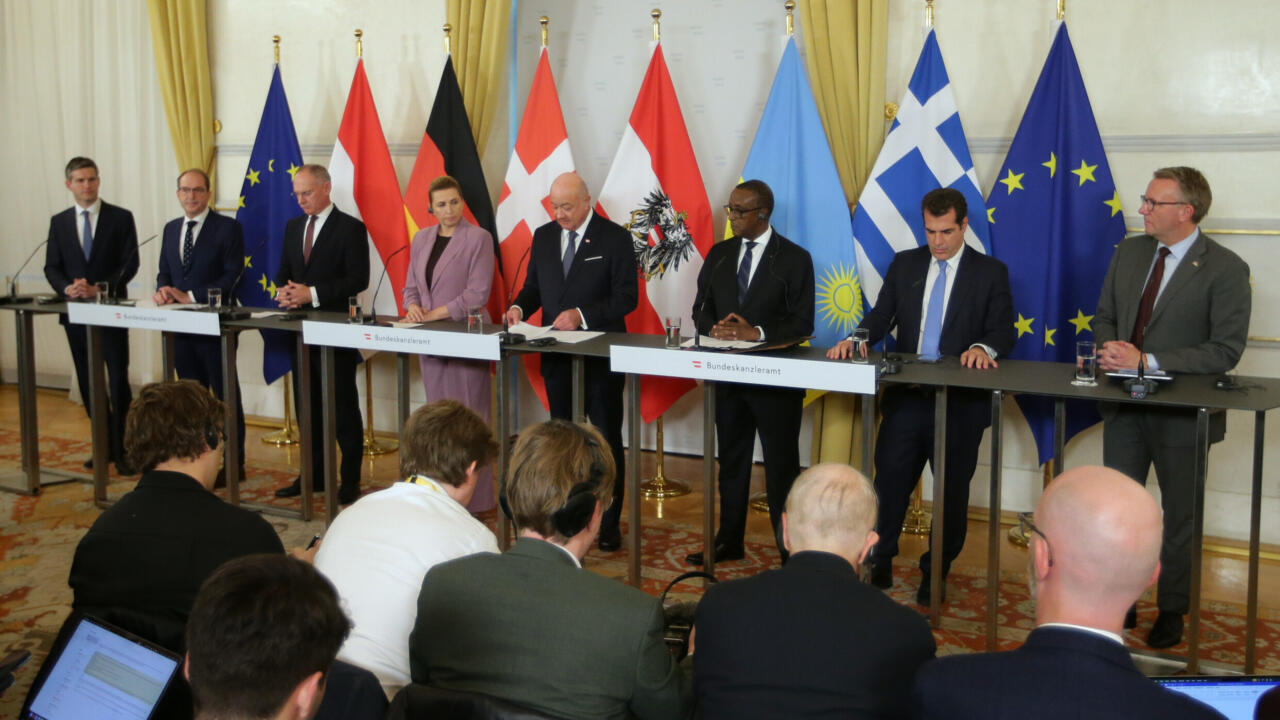
Kinshasa has raised serious alarms over a proposed agreement between Rwanda and five European nations—Germany, Austria, Denmark, Greece, and the Netherlands—to establish a processing facility for rejected asylum seekers slated for deportation. While officials in Kigali celebrate potential political and economic gains, Congolese authorities warn this deal could pose unforeseen risks to national sovereignty and regional stability. But what exactly lies behind Kinshasa’s strong reaction?
The hidden roots of Kinshasa’s opposition to the Rwanda-EU migrant deal
At first glance, the agreement appears to be a purely administrative arrangement: Europe seeks a relocation partner, and Kigali seems willing to accept financial and diplomatic compensation in return. Yet, behind this cooperation lies a web of historical tensions and geopolitical sensitivities that few are discussing.
Since gaining independence, the Democratic Republic of the Congo (DRC) has viewed Rwanda as a regional actor with complex motives—often perceived as supporting armed factions in eastern DRC. This perception isn’t superficial; it stems from decades of conflict, porous borders, and recurring cycles of violence that have left deep scars on Congolese society. When Kinshasa learned of Rwanda’s involvement in the EU’s deportation plan, it triggered immediate suspicion: is this an attempt to normalize Rwanda’s presence in the DRC’s affairs under a humanitarian guise?
The failure of expulsion diplomacy: lessons from the US case
Just months ago, the DRC itself accepted migrants expelled from the United States under a similar framework. Kinshasa framed this reception as an act of solidarity amid global migration crises. However, the results were mixed: logistical chaos, humanitarian protests, and no clear long-term benefits emerged. Now, with Rwanda poised to become Europe’s offshore migrant hub, Congolese officials question whether history is destined to repeat itself.
Critics argue that the deal could turn Rwanda into a pawn in Europe’s border control strategy, while offering little tangible benefit to the Congolese people. Instead of fostering regional cooperation, observers warn, it may deepen mistrust and resentment toward multilateral migration policies.
Could Rwanda benefit more than the European Union?
Proponents of the agreement in Kigali insist that the financial influx from the EU—reported to exceed $100 million annually—could turbocharge Rwanda’s development and diplomatic clout. For a nation ranked among Africa’s most innovative, this injection of capital comes at a strategic moment. But at what cost?
Analysts point out that while Rwanda stands to gain economically, the DRC sees no reciprocal advantage. Migrants slated for deportation would be transported to Kigali under EU supervision, bypassing Congolese territory entirely. This bypass sends a clear message: Europe prefers to deal with Rwanda as a third-party facilitator rather than engage directly with Central African states grappling with their own migration challenges.
The optics are problematic. By outsourcing its deportation policy to Rwanda, Europe risks undermining the sovereignty of neighboring nations—especially those, like the DRC, already skeptical of foreign intervention. For Kinshasa, this isn’t just about migration. It’s about asserting national dignity in the face of what it views as a neo-colonial maneuver disguised as humanitarian cooperation.
What really worries Kinshasa: sovereignty or strategy?
Official statements from Kinshasa emphasize concerns over national sovereignty, but the deeper anxiety may lie in geopolitical positioning. The DRC has spent decades attempting to reclaim its role as a respected regional leader, only to see Rwanda gain influence through unconventional partnerships with global powers.
When migrants are flown from Europe to Kigali instead of being absorbed into Congolese society, it reinforces perceptions of Rwanda as a preferred partner—a narrative that could reshape Central Africa’s power dynamics. For the DRC, already struggling with internal fragmentation and foreign interference, this is more than symbolic. It’s existential.
Despite the rhetoric of burden-sharing, Kinshasa sees this deal as a Trojan horse. By allowing Rwanda to act as Europe’s gatekeeper, the EU may be unintentionally legitimizing Rwanda’s regional ambitions—ambitions that have historically clashed with Congo’s territorial integrity.
What’s next? A test of trust and regional governance
Whether the deal proceeds remains uncertain. European pressure is mounting for rapid implementation, while Kinshasa has called for urgent regional consultations. But without a framework that includes the DRC as a stakeholder—not a bystander—the risk of alienation grows.
For Rwanda, the benefits are clear. For Europe, it’s about fulfilling a political promise to reduce asylum backlogs. But for the DRC and its neighbors, the stakes are higher: it’s about preserving autonomy in a world where migration policy is increasingly weaponized.
One thing is certain: the Rwanda-EU migrant deal is not just a technical arrangement. It’s a litmus test for how far sovereignty can be stretched before it breaks—and who ultimately pays the price.