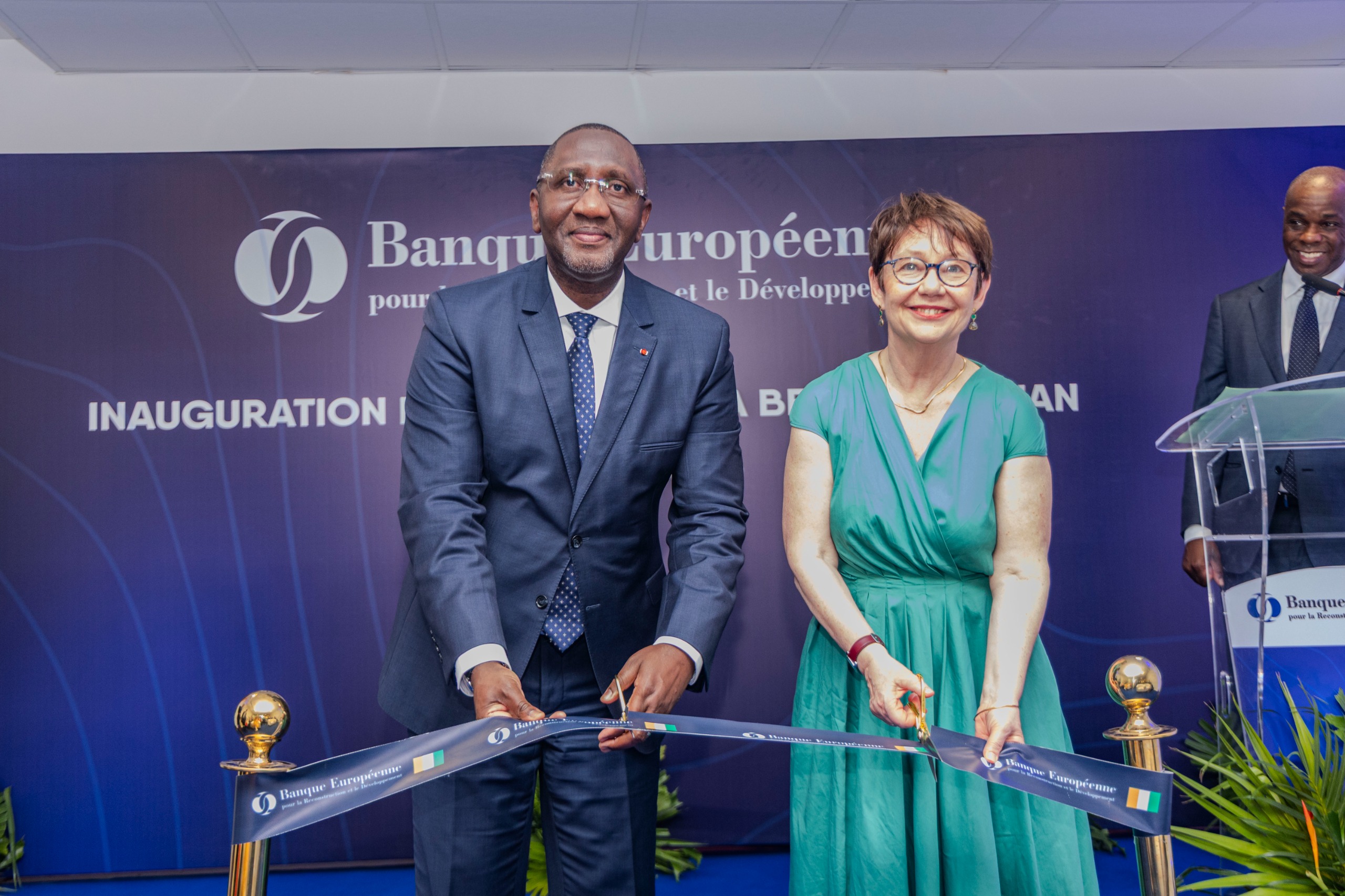
On November 23, 2026, Côte d’Ivoire marked a pivotal moment in its economic integration with Europe as the European Bank for Reconstruction and Development (BERD) officially opened its first resident office in Abidjan. The inauguration event was not just a ribbon-cutting ceremony—it underscored the strategic reorientation of financial cooperation between Africa and the continent’s historical allies. Hosted by Côte d’Ivoire’s Minister of Planning and Development, Dr. Souleymane DiarraSouba, the ceremony brought together top representatives of the BERD, including its President, Ms. Odile Renaud-Basso, along with regional directors and influential figures from West African financial institutions.
Beyond the formalities, the gathering revealed key dynamics shaping future economic collaboration. Among the attendees were Dr. Sidi Ould Tah, Chair of the African Development Bank Group, and Mr. Serge Ekué, President of the West African Development Bank—entities that, alongside the BERD, are converging to finance Côte d’Ivoire’s next phase of growth.
The decision to establish the Abidjan office followed a landmark shift: the expansion of the BERD’s mandate into Sub-Saharan Africa and Côte d’Ivoire’s strategic decision to join the Bank’s capital base. Since its accession on December 18, 2024, Côte d’Ivoire has emerged as a priority partner, with the BERD channeling investments across critical sectors.
Sectoral breakthroughs: where investments are flowing
The Bank has already deployed capital in five core sectors, each chosen for its potential to drive structural transformation. These include:
- Agro-industry: expanding cashew processing capacity to meet rising global demand and add value to raw exports;
- Mining services: financing sustainable extraction and processing to align with international standards;
- Financial services: deepening liquidity and access to long-term capital for SMEs through local institutions;
- Energy transition: funding renewable energy projects to reduce carbon intensity and support grid modernization;
- Digital infrastructure: laying groundwork for a connected economy capable of integrating regional markets.
By the end of 2026, the cumulative value of BERD-funded projects is projected to exceed €500 million, a figure that reflects not only capital infusion but also catalytic effects across supply chains and job creation.
Connecting capital to Côte d’Ivoire’s national vision
The timing of the Abidjan office launch coincides with the National Development Plan (NDP) 2026–2030, a $175 billion program aiming to unlock private-sector-led growth. During the July 2026 Consultative Group meeting, the BERD pledged €3 billion over five years—specifically earmarked for private enterprises and large-scale transformational projects under the NDP.
The Plan’s investment framework relies heavily on private capital, with the private sector expected to contribute 70.2% of the total financing—equivalent to €122 billion. This heavy reliance on market-driven investment signals a broader shift: Côte d’Ivoire is moving away from public-led financing toward mixed models where development banks act as enablers, leveraging public funds to de-risk and catalyze private participation.
Three strategic pillars to strengthen the partnership
Minister DiarraSouba outlined a roadmap to deepen BERD–Côte d’Ivoire collaboration, centered on three pillars:
1. Access to long-term financing through local financial institutions
This pillar targets the persistent challenge faced by Ivorian businesses: limited access to affordable, long-term credit. By partnering with local banks and institutions, the BERD can broaden its reach, extend maturity profiles, and reduce dependency on short-term instruments that stifle industrial growth.
2. Accelerating value-added processing of raw materials
Côte d’Ivoire’s economy remains anchored in primary production. The government seeks to reverse this pattern by supporting entrepreneurs who process raw materials locally—such as cashews—before export. This strategy aims to capture higher margins and create quality jobs in rural and peri-urban zones.
The BERD’s agro-industrial investments play a direct role here, providing not just capital but technical assistance to upgrade processing facilities and meet international quality standards.
3. Strengthening energy, digital and circular economy infrastructure
The third pillar responds to the dual imperatives of inclusion and sustainability. It focuses on expanding electricity access in underserved regions, rolling out digital connectivity to support e-commerce and fintech, and embedding circular economy principles—such as waste-to-energy and sustainable packaging—into industrial operations.
Leadership’s long-term vision: making Côte d’Ivoire a gateway to West Africa
The opening of the Abidjan office aligns with President Alassane Ouattara’s vision to position Côte d’Ivoire as the economic gateway of the Economic Community of West African States (ECOWAS). With a combined market of over 450 million people, the country offers unmatched access to regional demand, especially as intra-African trade continues to rise under the African Continental Free Trade Area (AfCFTA).
As the BERD cements its footprint, local actors gain a powerful ally. The office will enhance proximity to economic players, shorten project gestation periods, and open doors to co-financing with other multilateral banks such as the African Development Bank, the West African Development Bank, and the International Finance Corporation. This proximity-driven model is expected to accelerate decision-making cycles and improve the predictability of funding flows.