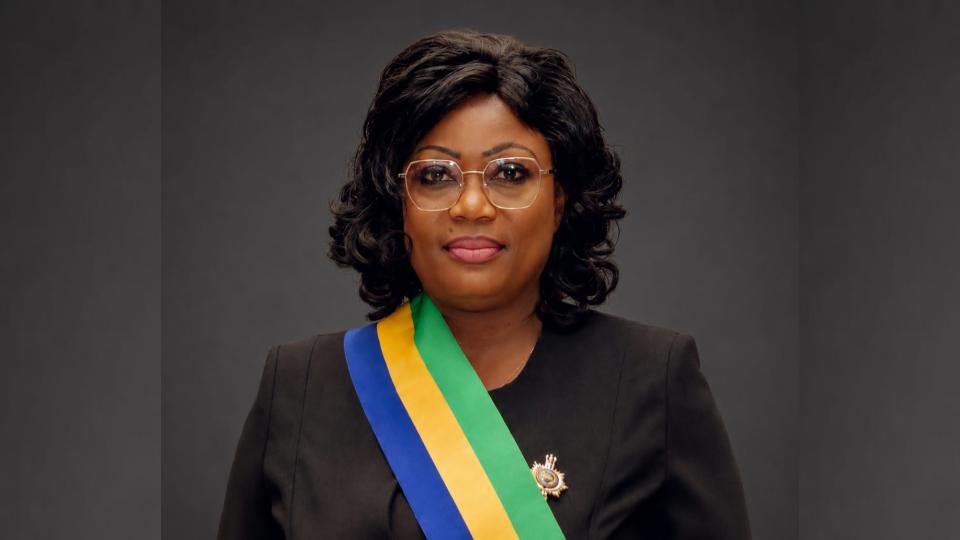
In Gabon, a heated public debate has erupted following scathing remarks attributed to social media activist Landry Mbeng, widely known as Lanlaire. His statements, targeting the mother of President Brice Clotaire Oligui Nguema, have drawn sharp condemnation from Gabonese political circles. Among the most vocal critics is Daisy Léance Akinikoussou, member of parliament for the Plateaux department, who has publicly declared “Enough is enough” in a bold statement addressing what she describes as a dangerous erosion of political discourse.
In her strongly worded intervention, Akinikoussou draws a clear line between legitimate political criticism and personal attacks against family members of public figures. She argues that while no leader should be exempt from scrutiny, their relatives—particularly their mothers—should not be dragged into political battles simply due to their familial ties. “A mother remains a mother, regardless of the role her child plays,” she asserts, emphasizing that dignity should not be sacrificed in the name of political confrontation.
Protecting women’s dignity in public discourse
As secretary-general of the National Network of Women Parliamentarians (RENAFED), Akinikoussou frames the controversy through the lens of women’s rights and protection against symbolic violence. Her stance underscores a fundamental principle: the fight for gender equality must be consistent. “Defending women means defending all women,” she states, whether their views align with hers or not. She warns against the normalization of insults and online harassment, which she believes undermines collective efforts toward respect and decency in public debate.
Setting boundaries in political confrontation
The deputy’s remarks come amid growing concerns over the deterioration of online discussions in Gabon. While political opposition is a cornerstone of democracy, Akinikoussou insists that attacking the personal lives of officials—especially their families—crosses a critical threshold. She cautions that today’s attacks on the president’s mother could normalize similar behavior tomorrow, targeting mothers of opposition figures, journalists, or ordinary citizens. “Today it’s the president’s mother. Tomorrow, it could be someone else’s,” she warns, stressing the need to preserve human dignity even in the fiercest political exchanges.
The debate she raises is not about shielding the president from criticism but about upholding the integrity of public discourse. In her view, democracy thrives when ideas are challenged vigorously, but it collapses when dignity is discarded. Her message is unequivocal: “We can oppose policies without opposing humanity.”
Restoring respect in Gabon’s political landscape
Akinikoussou’s intervention highlights a broader societal question: where should the line be drawn between political opposition and personal attacks? By condemning the weaponization of family members in political conflicts, she calls for a return to a more principled and respectful form of engagement. In doing so, she positions herself not just as a critic of the current climate but as a defender of democratic values—where strength in debate does not come at the expense of basic human decency.