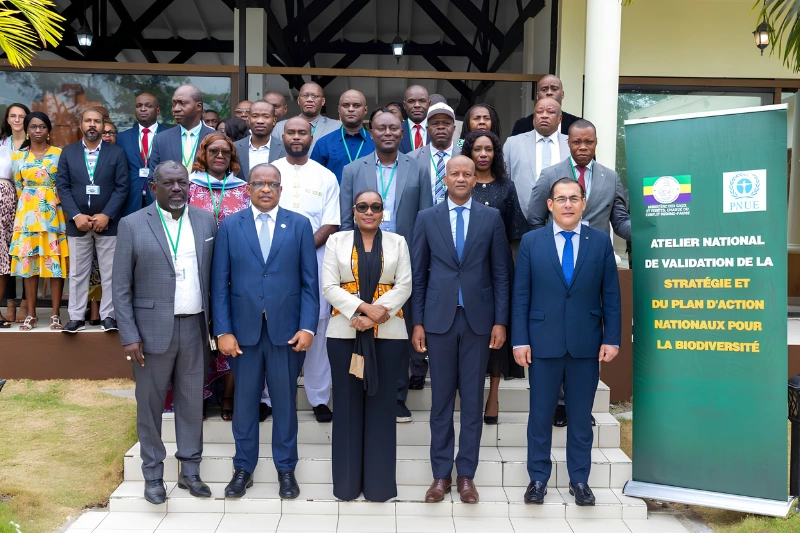
Gabon has taken a decisive step toward securing the future of its forests, coastlines, and wildlife. After days of intensive deliberations in Libreville, the national workshop validating the 2022-2030 National Biodiversity Strategy and Action Plan (SPANB) reached its conclusion this week.
Protecting 30% of Gabon’s land and sea by 2030
At the heart of this groundbreaking initiative is a commitment to safeguard at least 30% of Gabon’s terrestrial, coastal, and marine territories. This bold target aligns the country with the global ambitions set under the Kunming-Montréal Agreement, positioning Gabon as a regional leader in biodiversity conservation.
The SPANB serves as a strategic compass to guide public policies, reinforce ecosystem protection, and ensure the sustainable management of Gabon’s unparalleled biological wealth. Key priorities include:
- Preserving 30%* of land, coastal, and marine areas;
- Restoring degraded ecosystems;
- Mitigating threats such as poaching, deforestation, and pollution;
- Mobilizing sustainable financing for conservation efforts.
*Note: The 30% target includes both existing protected areas and newly designated zones.
From strategy to action: securing real-world impact
With over 88% forest cover and 13 national parks, Gabon already stands as a biodiversity hotspot. However, as Ms. Tsayi Mouvagha, the strategy coordinator, emphasized, « the challenge now lies in translating these plans into tangible results on the ground. »
The next phase will focus on raising awareness among government agencies, private enterprises, local communities, and civil society to ensure the strategy’s effective implementation nationwide. The finalized SPANB will soon be submitted to the Government for approval before being filed with the Convention on Biological Diversity (CBD) Secretariat, formalizing Gabon’s international commitments.
Will the plan overcome funding and local engagement hurdles?
The success of this ambitious roadmap hinges on critical factors: dedicated funding, active participation from local authorities, private sector involvement, and engagement from riverside communities. Without these pillars in place, the strategy risks remaining an unfulfilled promise rather than a transformative force for conservation.