Ibrahim Traoré challenges taboos: arab slave trade and radical islam in the Sahel
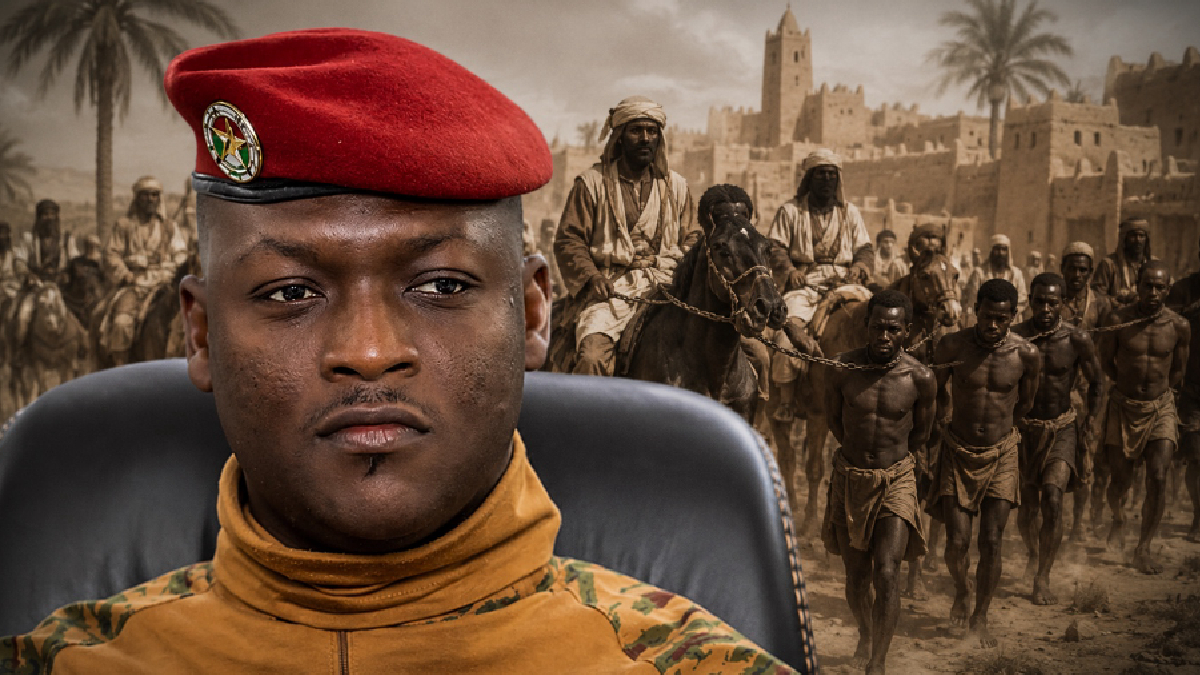
Ouagadougou — The Burkinabè transitional leader has ignited a fierce debate by openly linking the Arab slave trade to contemporary jihadist violence in the Sahel. His words, delivered before local leaders, expose historical blind spots that both Western historiography and Gulf powers prefer to ignore.
The millennia-old silence that weighs on Africa
Some truths burden Africa like invisible shackles. The Burkinabè captain just exposed one of them in Ouagadougou. While predecessors—both civilian and military—had carefully avoided the topic, Ibrahim Traoré dared to draw a direct connection between the Arab-Muslim slave trade and the brutalities of modern-day jihadism sweeping across the Sahel.
For over thirteen centuries, caravans crisscrossed the Sahara, deporting millions of Black Africans from the shores of Lake Chad to markets in Cairo, Tripoli, and Zanzibar. The historical records acknowledge this tragedy, yet official narratives have systematically erased it. Why the silence? Because unlike the transatlantic slave trade, the Arab version does not fit the emancipatory narratives cherished by Western chancelleries. More uncomfortably, it reveals a disturbing truth: political Islam, often portrayed as an anticolonial liberation ideology, has also historically been a vehicle for racial exploitation.
When history bows to political expediency
Scholar Olivier Pétré-Grenouilleau laid the groundwork for this unsettling truth in his groundbreaking research. Chronicles by Ibn Battuta, archives from Sahelian sultanates, and manuscripts from Timbuktu overflow with evidence of this systematic trade. Yet no truth commission has ever convened in Agadez or Timbuktu. No national museum in the Sahelian capitals bears witness to this chapter. Post-colonial elites, schooled in the rhetoric of unity against former colonizers, chose oblivion over confrontation.
In doing so, they ceded interpretive control to jihadist groups. By framing their struggle as a revolt against neocolonial order, these factions obscured their lineage with an expansionist ideology that, since the Almoravids, has justified violence through claims of spiritual superiority. Traoré, acting as a soldier rather than an academic, shattered this narrative construction.
Memorial strategy with high stakes
Strategically, the captain’s remarks reveal calculated daring. By framing the fight against terrorism as a national—and racial—struggle, he strips it of its transnational veneer. The enemy is no longer an imported faction but the heir to a centuries-old foreign domination over Black lands. His hope? To rally rural communities, the primary victims of jihadism, who have long been neglected by an urban elite entangled with Qatari or Saudi funding networks.
Yet the gamble is perilous. By invoking the specter of Arab slavery, Traoré risks diplomatic isolation. He risks alienating traditional Gulf allies whose religious schools have shaped Sahelian Islam for four decades. He also antagonizes segments of West African intelligentsia who view this reckoning as an attempt to fracture the Black front against former white colonizers. Comparative studies of slavery are a minefield; Traoré navigates it with the boldness of a soldier, not the caution of a diplomat.
Western guilt and selective memory
The discomfort provoked by his statement lies in its exposure of Western memorial inconsistencies. UNESCO, NGOs, and social science faculties have perfected a selective repentance: only the enslavement of Africans by Europeans is acknowledged, never by Arabs. France, in particular, champions diversity while paralyzing any critique of radical Islam under accusations of “Islamophobia.”
Traoré does not demand reparations or apologies from France. He merely asks his own people to confront their history—however inconvenient it may be for Gulf allies. This raw historical independence, however jarring to Parisian salons, may be the most unsettling aspect of his stance. It signals that Africa is now capable of conducting its own historical inquiries, unfiltered by the distorting lenses of former metropolises.
A lesson for the Old World
What should we take from this Sahelian revelation? First, that competing memories will not be reconciled through subsidies or UN resolutions. They will clash on the battlefield of foundational myths. Second, that political Islam is not merely a Middle Eastern import but taps into a centuries-old history of conquest and enslavement that Africans themselves have too long preferred to bury.
Traoré has staked his ground. The real question is whether his exhausted nation, ravaged by a decade of asymmetric warfare, has the strength to endure this memorial reckoning. Historians may argue he has oversimplified a complex tragedy. Politicians may claim he lacks nuance. Yet one truth the captain asserts with the blunt force of arms remains: in Africa as elsewhere, peoples who do not write their own history are doomed to endure it.
While editorialists in Paris debate repentance and intersectionality, a Sahelian soldier with calloused hands reminds them brutally of the order of history. Truth liberates, they say—but in the Sahel, it is a lion that must be tamed. Traoré has just unchained it. May his neck be strong enough to bear the weight of that burden. For the guardians of political correctness will not forgive him.