The fallout from Gilbert Houngbo’s uncontested reelection at the ILO
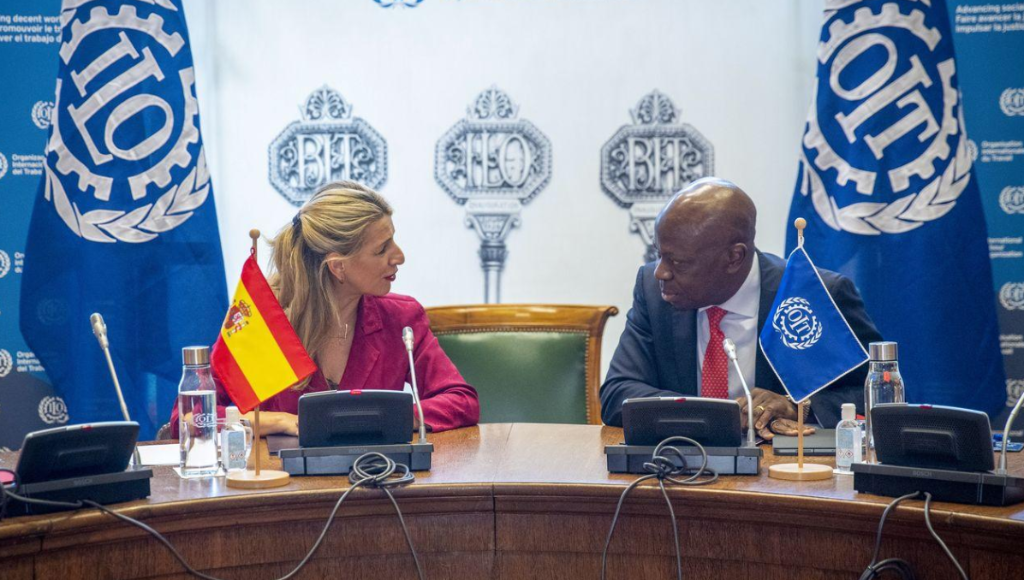
In a dramatic turn of events, Gilbert Houngbo has secured a second term as Director-General of the International Labour Organization (ILO) after his sole competitor, Spanish Labour Minister Yolanda Díaz, withdrew from the race just days before the vote. While Díaz cited a desire to preserve unity among global labour unions, her last-minute decision did not spare her from delivering a scathing indictment of the outgoing administration’s management, which she accused of deepening the organization’s financial turmoil and undermining social dialogue.
The absence of electoral competition has amplified scrutiny over Houngbo’s leadership and raised pressing questions about the ILO’s future direction. Critics argue that the very institution tasked with safeguarding workers’ rights is now grappling with internal turmoil and financial instability, leaving its credibility in question.
Financial crisis at the ILO: a heavy burden for the new administration
Díaz’s withdrawal speech laid bare the ILO’s severe financial woes, which she described as among the worst in its history. A combination of delayed and unpaid contributions—particularly from major donors like the United States—has left the organization in a precarious position. Faced with dwindling resources, the outgoing leadership had already initiated drastic cost-cutting measures, including layoffs and staff reductions.
But these measures have drawn fierce backlash. Díaz contended that the financial strain was disproportionately placed on the organization’s own employees rather than being addressed through structural reform. She emphasized that the ILO’s mission to promote social justice was being compromised by austerity measures that prioritized budgetary balance over workers’ rights.
Can Houngbo’s second term stabilize the ILO’s finances?
The financial instability poses a critical challenge for Houngbo’s new mandate. Without immediate action to restore contributions and diversify funding sources, the ILO risks further erosion of its operational capacity. The measures taken so far—while necessary to survive the short-term crisis—have already fueled discontent among staff and partners alike. Restoring financial health without sacrificing the organization’s core values will be a delicate balancing act.
Social dialogue under strain: the erosion of trust within the ILO
The accusations extend beyond finances. Díaz’s criticism of the ILO’s handling of social dialogue has struck a particularly sensitive nerve. As the agency responsible for advocating workers’ rights worldwide, its internal practices have come under fire for allegedly sidelining staff voices and weakening consultation mechanisms.
Staff unions have openly contested restructuring decisions, arguing that the ILO’s leadership has failed to live up to the principles it promotes globally. The paradox is striking: an institution dedicated to social justice is now confronting internal strife over its own workplace policies.
Díaz lamented that the ILO’s employees were not benefiting from the social dialogue they are entrusted to advance on the world stage. This critique underscores a growing disconnect between the institution’s mission and its internal governance, raising concerns about its ability to regain the trust of its stakeholders.
Why Yolanda Díaz ultimately stepped aside
Díaz’s withdrawal was not solely driven by financial or institutional critiques. Her decision reflected broader tensions within the global labour movement. The International Trade Union Confederation (ITUC) had already endorsed Houngbo, a move Díaz argued did not accurately reflect the sentiments of many unions worldwide. She also questioned the transparency and inclusivity of the endorsement process, warning that such divisions could weaken the labour movement’s collective bargaining power.
The withdrawal of a second candidate, Peruvian Labour Minister Javier González-Olaechea, further underscored the uphill battle Díaz faced. With both challengers out of the race, Houngbo’s reelection became inevitable—but the lack of competition has done little to silence the dissenting voices.
A second term that demands more than political survival
Houngbo’s reelection marks the beginning of a new chapter for the ILO, but the absence of electoral opposition does not equate to a mandate free of scrutiny. The criticisms from Díaz have exposed deep fissures in the organization’s governance, finance, and internal culture. Rebuilding trust with workers, employers, and member states will be Houngbo’s most pressing task in the coming years.
His new term presents a dual challenge: sustaining the reforms initiated during his first mandate while addressing the systemic issues that threaten the ILO’s legitimacy. Success will hinge not just on financial recovery but on restoring the institution’s moral authority as a champion of workers’ rights.
The questions raised by Díaz’s departure are far from settled. While Houngbo may have avoided electoral defeat, the real test lies in how he navigates the fallout from one of the most contentious reelections in the ILO’s history.