DCIM\100MEDIA\DJI_0211.JPG
From fishing village to industrial powerhouse: the port transformation
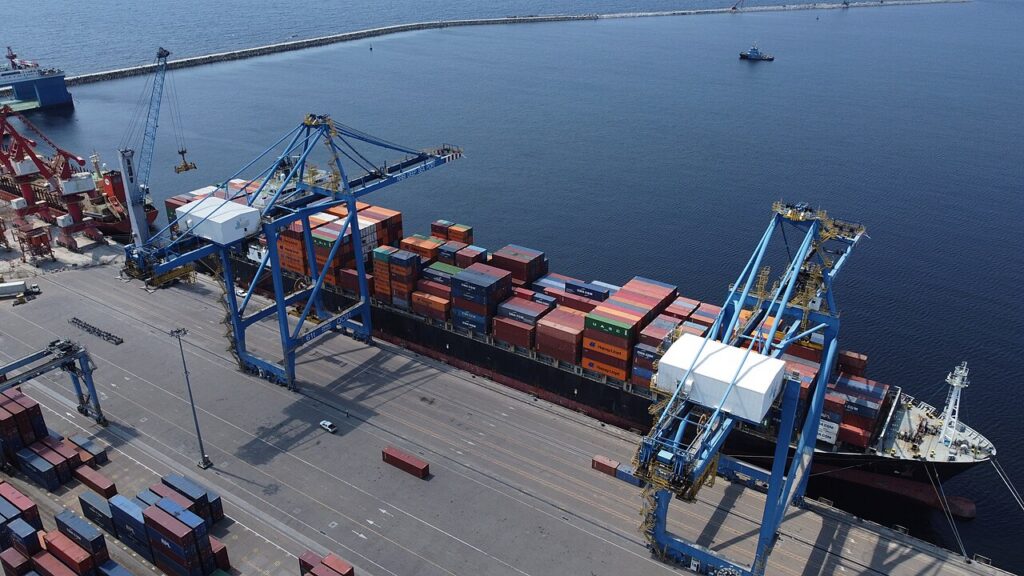
Fifteen years ago, Mboro near Kribi in southern Cameroon was a sleepy fishing hamlet with barely a paved road in sight. Today, this stretch of coastline hosts one of central Africa’s most advanced deep-water ports, and the surrounding area is undergoing a rapid industrial and logistical boom that is reshaping lives across the region.
For decades, Cameroon had sought to build a deep-water port to complement the shallow-water port of Douala, the country’s main maritime gateway. This long-held vision finally became reality with the completion of Kribi’s deep-water port’s first two phases, marking a decisive turning point in the nation’s economic trajectory.
Workers’ stories: building a future on the frontlines
Gu Gaobai was among the first Chinese engineers to arrive in 2011 with China Harbour Engineering Company (CHEC), tasked with constructing the deep-water port. “When we ventured to the project site, we crawled along narrow dirt tracks. All we could see was a stretch of sand and a scattering of reefs. Back then, those reefs were the only landmarks pointing to where the port would rise,” he recalled. Today, he serves as CHEC’s country projects director in Cameroon.
Local resident Jean-Kalvin Assembe, 50, has witnessed the transformation firsthand. “I feel happy and fulfilled living in this city now,” he said. The once-isolated area now boasts new roads, public buildings, and thriving businesses. “Even small corner shops have steady customers. The changes are truly positive,” he added.
Highway to prosperity: connecting Kribi to the nation
Longtime truck driver Yaya Aboubakar, 68, who has crisscrossed Central Africa, said the port has transformed his work. “Kribi has made things easier for us,” he noted. “Service is fast, and we’ve discovered opportunities in this region.”
Industrial surge: jobs, investment, and regional trade
Patrick Mpila Ayissi, infrastructure chief for the Kribi port industrial zone, reports a surge in activity since operations began in 2018. “Industrial operators have invested nearly 700 million dollars, with 93 occupation permits granted and 18 businesses already active,” he said.
The zone’s ambitions have expanded from an initial 455-hectare logistics hub to a sprawling 4,000-hectare integrated industrial park. Ayissi projects investments of nearly 900 million dollars over the next 15 years, potentially creating up to 150,000 direct and indirect jobs.
Container traffic has quadrupled since 2018, exceeding 555,000 TEUs in 2025, while total cargo volume surpassed 12.7 million tons in 2024. Cargo now flows from Kribi to neighboring countries including Gabon, the Central African Republic, Chad, the Republic of the Congo, and Equatorial Guinea, supported by major shipping lines like MSC.
Skills that lift communities: empowerment through training
Ngatugirius Ndenya left his welding job in Yaoundé in 2013 to join CHEC in Kribi. “The early days were tough,” said the 53-year-old. “But the company paired us with experienced Chinese colleagues, giving us hands-on training before we took on key roles.”
“Before coming here, I was just a basic welder. Now I can handle the full range of welding tasks. Young workers who arrived untrained now have valuable skills,” he explained.
For some, the port has been life-changing. Armand Guehoada, now a CHEC commercial affairs manager, recalled arriving with nothing. “I could barely afford life on 100,000 CFA francs a month,” he said. “After a while, I bought a car. Now I own my third and can easily support my family.”
Looking ahead: a legacy of partnership and opportunity
This year also marks 55 years of diplomatic ties between China and Cameroon, with Kribi’s deep-water port celebrating 15 years since construction began. “Kribi stands as a visible symbol of lasting Cameroon-China cooperation, built on concessional financing and long-term partnership,” said Ayissi.
Patrice Melom, CEO of the Kribi Port Authority, sees a bright future ahead. “The port has opened new horizons for the city and the nation. We must now harness this momentum to drive sustainable growth and regional integration,” he stated.