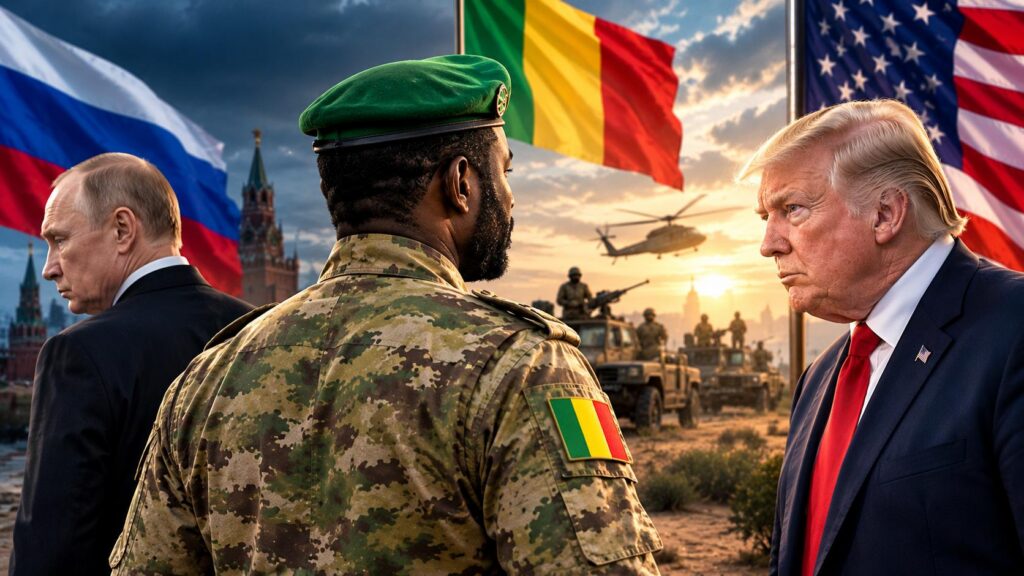
The narrative that once defined Mali’s foreign policy has begun to fracture. After years of deepening ties with Russia—first through Wagner’s fighters and later via Moscow’s Africa Corps—Bamako now appears to be recalibrating its approach. While no official break with Russia has been declared, the signs of a quiet rapprochement with the United States are impossible to ignore.
Washington’s silent comeback in Bamako
At the heart of this shift lies a resurgence of security cooperation with Washington. By early 2026, Mali had already begun re-engaging with the United States, lifting sanctions on key military figures and reopening channels for intelligence sharing. The most striking development occurred in March 2026, when reports emerged of an impending agreement allowing U.S. surveillance flights over Malian airspace—a critical move to monitor jihadist movements, particularly those linked to the Group for the Support of Islam and Muslims (JNIM).
This cooperation isn’t entirely new. Earlier intelligence exchanges had already contributed to a successful Malian operation targeting JNIM leaders. What’s changing now is the intent to formalize and expand this partnership, signaling a pragmatic shift in Bamako’s strategy.
Russia’s flawed security record in Mali
The pivot toward Washington is not without reason. Despite Moscow’s promises of security and sovereignty, the reality on the ground tells a different story. The departure of Western forces in 2022 did little to curb the rising tide of violence. Instead, 2022 and 2023 became the deadliest years in Mali’s modern history, with terror-related fatalities reaching unprecedented levels.
While Wagner’s replacement by the Africa Corps marked a structural change in Russia’s approach, the results have been equally disappointing. In April 2026, a coordinated offensive by JNIM and Tuareg fighters dealt a severe blow to Malian and Russian forces. The death of Defense Minister Sadio Camara—trained in Russia—alongside the withdrawal of Africa Corps troops from Kidal, a strategically vital northern city, underscored Moscow’s limitations.
Analysts, including Héni Nsaibia of ACLED, have described these setbacks as clear indicators of Russia’s failure to stabilize Mali. The persistent jihadist threat, combined with the inability to secure supply routes, has eroded confidence in Moscow’s ability to deliver on its security promises.
Civilian casualties and jihadist resilience
The human cost of Mali’s security crisis further complicates the situation. Data from 2025 revealed a stark imbalance: Malian forces and their Russian allies accounted for 918 civilian deaths, compared to 232 attributed to jihadist groups. These figures, while contested, highlight the brutal toll of the conflict and the growing accusations against government-aligned forces.
Meanwhile, jihadist factions have continued to expand their influence, disrupting supply lines and tightening their grip on parts of the country. In a symbolic move in March 2026, Malian authorities released 200 detainees with alleged jihadist ties in exchange for a halt to fuel convoy attacks—a desperate attempt to mitigate the crisis.
Mali’s new calculus: beyond Moscow-Washington rivalry
Moscow retains significant economic interests in Mali, particularly in mining and energy sectors like gold, lithium, and infrastructure projects. Yet the military setbacks and the evolving threat landscape have forced Bamako to reconsider its options. The pragmatic approach now appears to be diversification: no longer relying solely on one partner.
The United States offers capabilities Russia cannot—or will not—provide under the same terms: advanced aerial and satellite intelligence, cutting-edge technology, and deep-rooted expertise in counterterrorism networks. This calculus suggests that Mali’s warming ties with Washington are less an ideological shift and more a strategic necessity born out of frustration.
From anti-Western rhetoric to pragmatic partnerships
The journey from denouncing Western presence to quietly re-engaging with Washington marks a pivotal moment in Mali’s foreign policy. The Russia-Mali alliance, once touted as a sovereign alternative, has failed to deliver the security promised. In contrast, the U.S. appears to be offering a lifeline—one that Bamako seems increasingly willing to grasp.
This isn’t a rejection of Russia but a recognition of its limitations. Mali is not abandoning Moscow; instead, it is embracing a multi-pronged strategy that leverages competition between global powers to secure its own interests. The days of relying on a single security partner may be over, and Washington’s return is a testament to this new reality.
One thing is certain: the monopolistic hold Russia once had on Mali’s security partnerships is fading. The question now is how far Bamako will go in redefining its alliances—and whether this pragmatic shift will translate into tangible stability for its people.