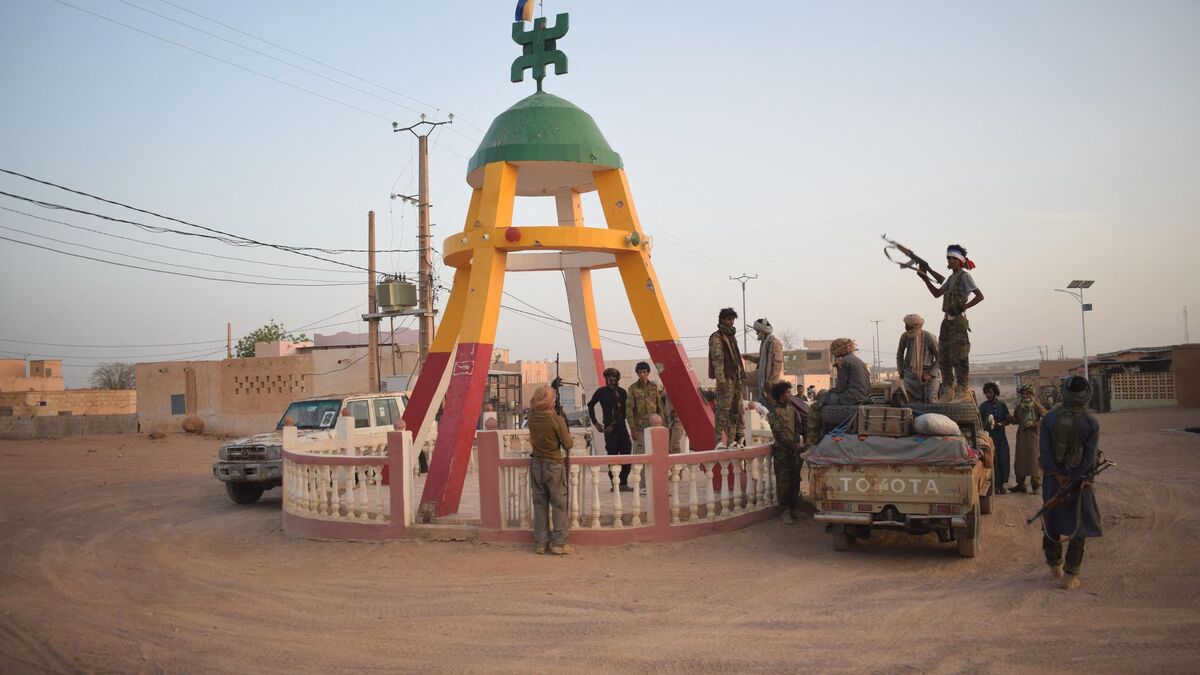
The strategic landscape of Mali has shifted dramatically over the past few days, as rebel forces—backed by jihadist factions—launched coordinated assaults on key juncture points held by the military junta. Among the targets was the residence of Sadio Camara, Mali‘s Defense Minister, who was killed in the attack near Bamako. Meanwhile, in the eastern reaches of the country, a long-standing stronghold of the junta fell into rebel hands for the first time in years.
Kidal, a city of immense strategic value, had been under the iron grip of Africa Corps, a shadowy Russian paramilitary unit, since its deployment in 2023. After intense clashes and protracted negotiations, the group withdrew its forces from the area. Yet despite this setback, Africa Corps continues to play a pivotal role in Moscow’s broader ambitions across the Sahel region and beyond.
Russia’s covert military arm in Africa
Africa Corps, often described as one of Russia’s most clandestine overseas military branches, emerged in late 2023. Its formation was first hinted at in a November 2023 Telegram post by the military blogger *Deux Majors*, who cited comments from Igor Korotchenko, a former Russian colonel and Kremlin-aligned journalist. The organization is reportedly overseen by Younous-bek Evkourov, Russia’s Deputy Minister of Defense.
The timing of its creation coincided with the decline of Wagner Group, the infamous Russian paramilitary force that had operated across Africa since 2014. The deaths of Evgeny Prigozhin and Dmitri Utkin, Wagner’s founders, in a suspicious plane crash in August 2023, left a leadership vacuum. Africa Corps was positioned to absorb Wagner’s assets, personnel, and influence across the continent.
A name steeped in historical irony
Much like Wagner, which drew its name from the composer favored by Adolf Hitler, Africa Corps carries a moniker with heavy historical baggage. The term echoes the *Afrikakorps*, the Nazi-era German expeditionary force deployed in North Africa during World War II. While the parallels may be unintentional, the naming choice has not gone unnoticed, particularly in regions where memories of colonial and wartime aggression remain raw.
Clear objectives, rigid control
Africa Corps has been vocal about its mission: to conduct large-scale military operations across Africa, helping allied governments break free from perceived neocolonial dependence, expel Western influence, and assert full sovereignty. According to Igor Korotchenko, the group’s stated goal is to strengthen Russia’s foothold on the continent by offering security support and military resources to sympathetic regimes.
Unlike Wagner—widely condemned for human rights abuses and brutal tactics—Africa Corps presents itself as a more disciplined and centralized force. Its strategy focuses less on direct combat and more on consolidating alliances with African governments through training, equipment, and logistical support. The group has expanded its presence from Burkina Faso and Libya to Sudan, the Central African Republic, and Niger.
A strategic anchor in Mali
Since 2024, Africa Corps has replaced Wagner as the dominant Russian military presence in Mali, deploying hundreds—if not thousands—of fighters. Many former Wagner commanders and soldiers have reportedly joined its ranks, bringing with them combat experience and local knowledge.
The group has played a critical role in propping up the Bamako junta, particularly in countering Tuareg rebel offensives. For Moscow, this involvement serves multiple purposes: reinforcing its influence in a former French sphere of influence, gaining leverage over migration routes, and securing access to valuable mineral resources in a region rich with gold, uranium, and oil.
As Western powers, including France, scale back their military and political engagement in the Sahel, Russia has seized the opportunity to fill the void. Africa Corps, though less publicly visible than Wagner, has become a key instrument in this geopolitical chess game, balancing military support with strategic resource extraction.
International scrutiny and sanctions
Despite its lower profile, Africa Corps has not escaped international condemnation. In 2024, the United Kingdom imposed sanctions, accusing the group of widespread human rights violations across Africa and exploiting natural resources for financial gain. The sanctions underscore growing concerns over Moscow’s expanding military footprint on the continent, particularly as Africa Corps continues to deepen its ties with fragile governments in exchange for access to strategic sectors.