Deadly assaults expose fragility of Niger’s defense amid escalating violence
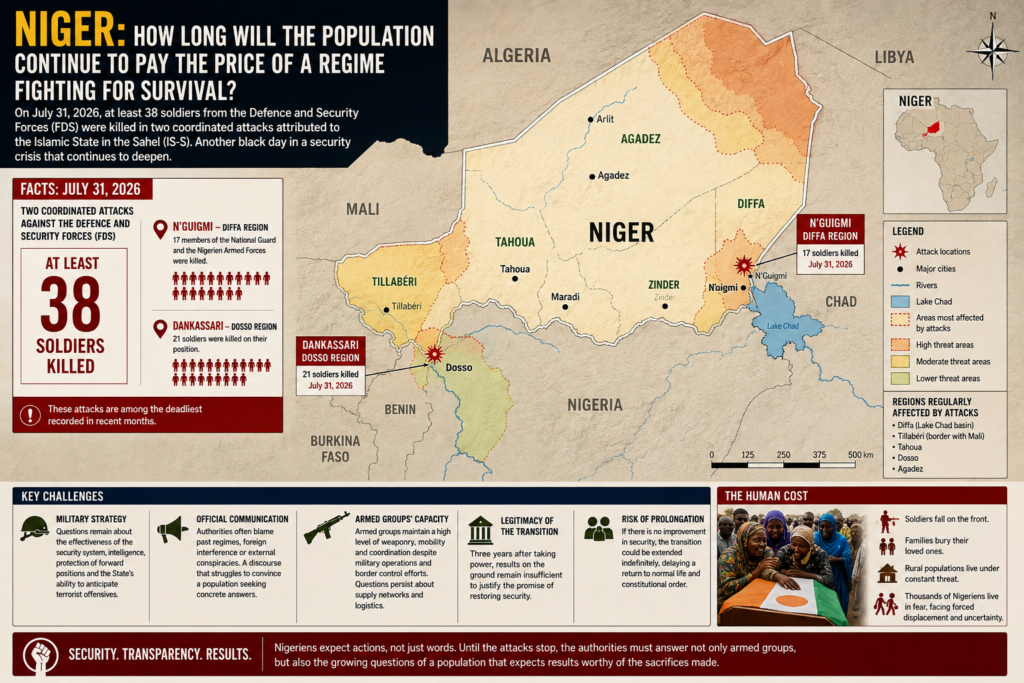
The final day of July 2026 marked another tragic chapter in Niger’s worsening security crisis. At least 38 members of the Forces de défense et de sécurité (FDS) were killed in two coordinated assaults attributed to the Islamic State in the Sahel (EI-S).
In N’Guigmi, situated in the Diffa region, 17 soldiers from the National Guard and Nigerien Armed Forces perished in the initial strike. Hours later, 21 more military personnel lost their lives at their outpost in Dankassari, Dosso region. These attacks rank among the deadliest in recent months, underscoring a disturbing trend: terrorism continues its relentless advance, while human casualties mount.
Beyond the immediate tragedy lies a pressing political question: how much longer will Nigeriens bear the burden of a security crisis that shows no signs of abating?
Broken promises and unmet expectations
When General Abdourahamane Tiani assumed leadership, the military junta justified its takeover by vowing to restore security, reclaim lost territory, and shield civilians from spiraling violence. The narrative was clear: only a military-led transition could reverse the country’s downward spiral.
Yet three years into the transition, the reality paints a starkly different picture. Attacks persist across critical zones, from the Lake Chad basin to the regions of Tillabéri, Tahoua, and Dosso. Armed factions continue to execute sophisticated, well-coordinated offensives on military positions, despite repeated pledges of structural reforms within defense forces.
This pattern raises a critical question: are the stated objectives of the current leadership translating into tangible improvements on the ground?
Military strategy under scrutiny
Each deadly strike now transcends its human toll, exposing deeper systemic flaws. The effectiveness of defense strategies, intelligence gathering, and the protection of remote outposts are increasingly called into question. As assaults multiply, skepticism grows over whether political consolidation is diverting resources and attention from the urgent demands of the battlefield.
A transition that stakes its legitimacy on security cannot afford to sidestep accountability for its performance in this domain. The public demands more than explanations—it seeks concrete measures to prevent future tragedies.
Official narratives fail to silence growing doubts
Following each attack, authorities frequently cite the failures of previous administrations, foreign interference, or geopolitical complexities to justify the escalating violence. While these factors may contribute to instability, they do little to address the immediate concerns of affected families.
Bereaved relatives seek answers about operational shortcomings, corrective actions, and tangible steps to avert future losses. Without visible progress, official statements risk losing credibility, eroding public trust in institutions already strained by prolonged crisis.
A conflict mired in uncertainty
The resilience of armed groups—evident in their sustained access to advanced weaponry, mobility, and coordination—has become a growing concern. Despite intensified military operations and border control efforts, these organizations continue to execute large-scale attacks with alarming regularity.
This persistent threat fuels speculation about the effectiveness of counter-arms trafficking measures, terrorist logistics networks, and intelligence operations. A lack of transparent communication has allowed misinformation to thrive, further deepening the divide between citizens and state institutions.
Transition at a crossroads
The military’s legitimacy hinges on its ability to deliver security. Yet, as violence persists, that credibility erodes. Each new attack delays the prospect of a return to constitutional order, destabilizes local communities, and prolongs the uncertainty gripping the nation.
In this climate, observers warn that the absence of security gains could indefinitely extend the transition. The path forward demands transparency, measurable results, and a credible roadmap for resolving the crisis.
The human cost of prolonged instability
Amidst political debates, one truth remains undeniable: it is soldiers who pay the ultimate price, families who bury their loved ones, and rural communities who endure the constant threat of violence. Thousands of Nigeriens face daily displacement, fear, and uncertainty as their future hangs in the balance.
Security was the cornerstone of the military’s promise. Today, it remains its greatest test. Until attacks subside, authorities must answer not only to armed factions but to a population that has sacrificed much—and now demands results commensurate with their suffering.