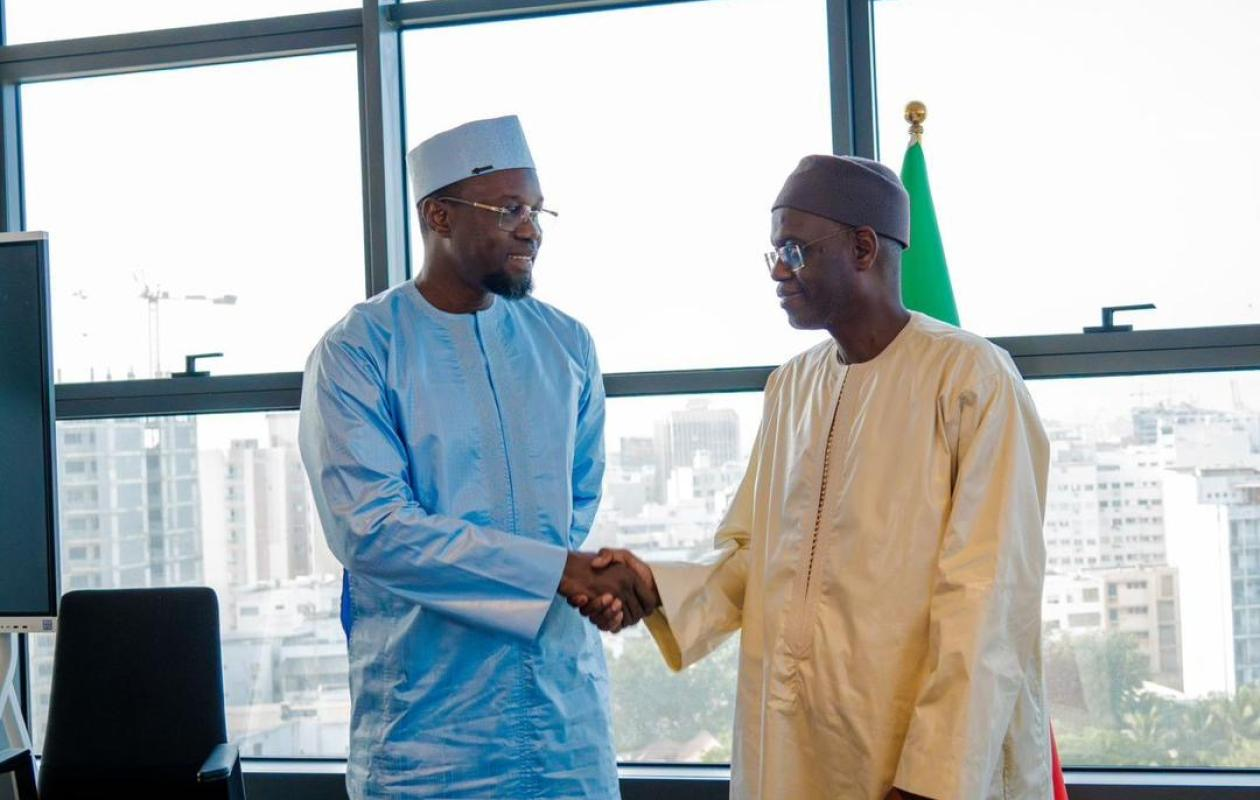
Senegal’s governmental landscape has undergone a fresh transformation following a reshuffle at the helm of the Prime Minister’s office in mid-2026. The transition marked the end of Ousmane Sonko’s tenure as Prime Minister, which began in late 2025, and the ascension of Al Aminou Lô to the position. This shift has triggered a strategic realignment of key state institutions and services.
The restructuring aligns with decree n°2025-1431, which outlines the distribution of state services and oversight of public establishments, national companies, and government-invested firms among the Presidency, Prime Minister’s office, and various ministries.
Ousmane Sonko’s structural innovations
During his brief but impactful time as Prime Minister, Ousmane Sonko spearheaded significant internal reforms within the Prime Minister’s office. A landmark decree, n°2025-1929, signed on November 27, 2025, introduced several new entities designed to streamline government operations. These included:
- A Reform Guidance and Monitoring Unit, tasked with overseeing policy implementation
- An Inspection service to evaluate administrative performance
- A Committee for Tracking Asset Valorization and Recycling Initiatives
- A dedicated Procurement Commission to manage government acquisitions
The General Secretariat of the Government also saw the creation of new divisions, such as a Ministerial Council Preparation and Institutional Follow-up Unit and a National Information Access Commission. These changes aimed to enhance transparency and efficiency in government proceedings.
Al Aminou Lô’s administrative overhaul
With Al Aminou Lô at the helm, the Prime Minister’s office has experienced further adjustments. His cabinet now includes the Technical Secretariat of the National Committee for Local Content Monitoring, previously under the Ministry of Petroleum and Mines. This integration underscores a focus on economic localization strategies.
Conversely, certain departments have transitioned out of the Prime Minister’s purview. The National Directorate of Civic Service and Volunteering, for instance, has been placed under the Ministry of Youth and Sports, reflecting a shift in youth engagement policies.
A major administrative shift involved the transfer of the Government Information and Communication Bureau (BIC-Gouv) to the Ministry of Communication and Institutional Relations. The bureau, previously led by journalist Mame Gor Ngom, was a central hub for government communications. Additionally, the National Observatory of Places of Deprivation of Liberty has moved to the Ministry of Justice, enhancing its oversight capabilities.
The latest reorganization also signals the end of the position of Secretary of State to the Prime Minister, in charge of Institutional Relations and Government Spokesperson. Instead, these responsibilities now fall under a full-fledged ministerial portfolio, specifically the Ministry of Communication and Institutional Relations, which now holds the dual role of government spokesperson.
These strategic adjustments reflect a broader effort to streamline administrative responsibilities, clarify inter-ministerial roles, and optimize the government’s operational framework.