As tensions in the Western Pacific escalate, the geopolitical chessboard around Taiwan is shifting at an unprecedented pace. In early November 2026, Beijing orchestrated one of its largest naval demonstrations in years, deploying over 100 Chinese warships and coast guard vessels in a sweeping military exercise near the island. Days later, the appearance of a specialized U.S. Air Force aircraft—equipped to detect nuclear activity—sent shockwaves through the region, raising critical questions about Washington’s next moves and the evolving power dynamics between the world’s two largest economies.
China’s massive naval show of force rattles observers
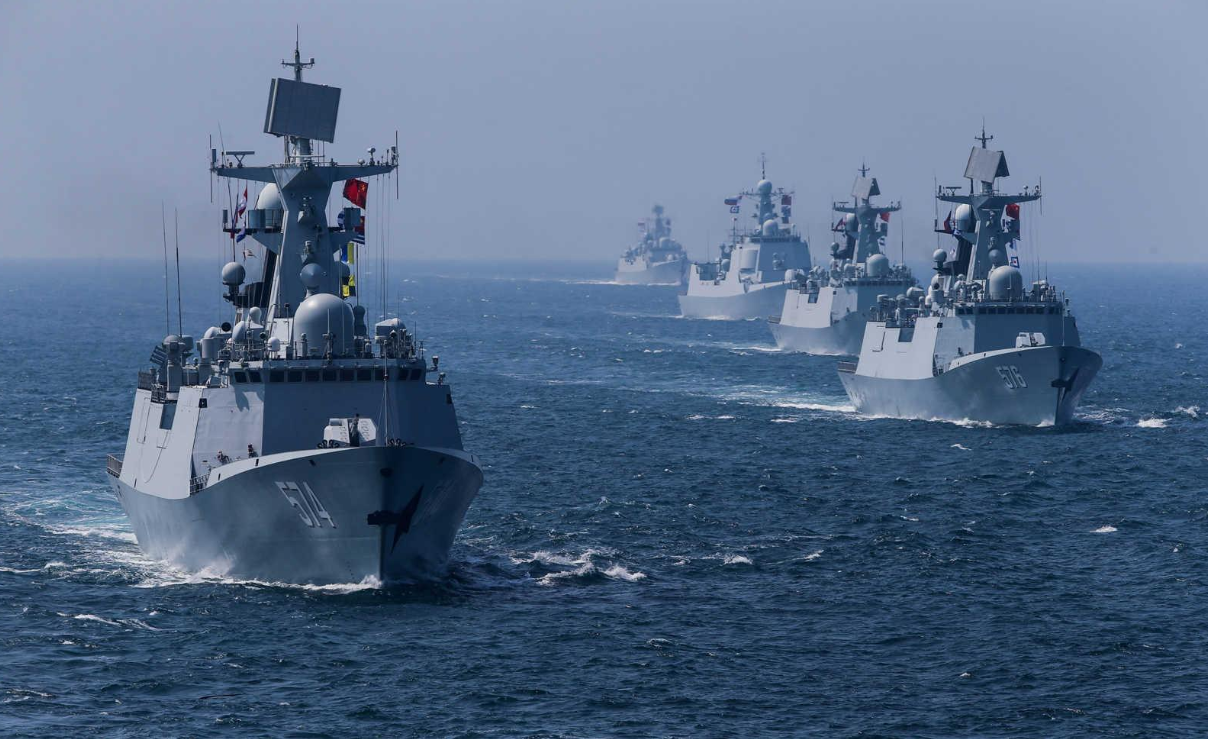
The scale of China’s military buildup this month stunned regional analysts. According to Taiwanese defense officials, over 100 vessels—including warships and coast guard ships—were deployed in coordinated maneuvers across the Western Pacific, stretching far beyond the Taiwan Strait. This silent yet unmistakable display of force involved fleets from all three of China’s naval commands: the Eastern, Northern, and Southern theaters.
The exercises were not limited to routine drills. Taiwanese sources reported simulations of attacks on military installations and urban centers, signaling preparedness for high-stakes scenarios. On November 13, approximately 70 ships remained active near the First Island Chain, a critical maritime boundary, underscoring the operation’s persistent nature.
Taiwan braces for military isolation as China tests new strategies
For Taipei, the implications are far from trivial. Analysts warn that Beijing is refining tactics to encircle Taiwan, a strategy that could enable it to block maritime and air access, disrupt supply chains, and deter foreign intervention without launching a full-scale invasion. Such a “denial and access” approach could exert immense economic and political pressure, leaving Taiwan vulnerable even before any direct military confrontation.
Institutions like the Institute for the Study of War have highlighted these exercises as potential rehearsals for precisely this kind of blockade scenario. The stakes extend beyond Taiwan’s shores: Washington’s role as its key ally and Tokyo’s strategic proximity make this a regional concern with global ramifications.
US nuclear-detection aircraft enters the fray amid escalating uncertainty
Amid this already volatile backdrop, reports emerged of a WC-135R Constant Phoenix—a U.S. Air Force aircraft nicknamed the “Nuclear Sniffer”—operating in Taiwanese airspace. Described as a specialized atmospheric sampling plane, its mission is to detect traces of radioactive particles, a capability critical to monitoring nuclear tests and radiological events.
The aircraft reportedly took off from Okinawa, Japan, before flying south of Taiwan and toward the southwestern approaches of the Taiwan Strait. Its presence in such a tense environment immediately fueled speculation: Was this a routine mission, or a deliberate signal to Beijing?
No official confirmation has been provided regarding the flight’s exact purpose, leaving analysts to consider multiple possibilities. While the WC-135R’s sensors are designed to pick up nuclear traces, its deployment does not necessarily indicate an imminent threat or detected activity. Yet, in the context of China’s recent naval buildup, the timing is impossible to ignore.
Washington’s surveillance: a calculated move or a response to rising threats?
The juxtaposition of China’s naval exercises and the U.S. aircraft’s appearance raises a pressing question: Is Washington intensifying intelligence-gathering efforts in the region? With Kadena Air Base in Okinawa serving as a pivotal hub for U.S. operations in East Asia, the deployment of advanced surveillance assets suggests a broader strategy to monitor Chinese military activity.
However, without explicit disclosures from U.S. authorities, any direct link between the WC-135R’s mission and China’s maneuvers remains speculative. The ambiguity underscores the delicate balance of power in the Taiwan Strait, where missteps could have unforeseen consequences.
What’s next for the Taiwan Strait?
The Taiwan Strait has long been a powder keg in global politics. A military confrontation here would send shockwaves worldwide, disrupting critical supply chains—particularly for advanced semiconductor manufacturing—and straining international trade. The stakes could not be higher for tech industries reliant on Taiwanese chip production, as well as for nations invested in regional stability.
While no immediate signs point to an imminent invasion, the combination of China’s naval maneuvers, the U.S. surveillance response, and the lack of transparency on both sides paints a picture of a region on edge. One thing is clear: the Western Pacific is no longer just a zone of maritime traffic—it is a critical battleground for influence, where every movement is now dissected for hidden meanings.
The question on everyone’s mind remains: How will Washington and Beijing navigate this high-stakes standoff, and what will Taiwan’s fate be in the crossfire?