The question hanging over this war is no longer whether Ukraine can reach deep inside Russia — it plainly can. It is whether striking Moscow’s oil infrastructure will push the Kremlin to rethink its strategy, or whether it will simply feed an escalation spiral that neither side can control. That is the real dilemma exposed by the overnight operation against the Moscow region.
What unfolded over the Moscow region
During the night of 19 to 20 September, the Moscow region absorbed one of the heaviest waves of Ukrainian drones and other long-range weapons since the start of the full-scale war. Russian officials claimed their air defences brought down more than 1,600 drones nationwide, with around 450 of them heading towards the capital. Targets were hit regardless: the Moscow oil refinery, located in the Kapotnia district, was among the sites damaged. Russian authorities reported several deaths and dozens of injuries.
Why the Kapotnia refinery carries so much weight
The refinery is not a minor installation. It ranks among the backbone facilities of the Russian fuel sector, with a processing capacity of roughly 12 million tonnes of crude per year. Geolocated footage circulating after the attack showed large fires burning across the site, a visual reminder of just how exposed this kind of infrastructure has become.
Kyiv claims the operation — and lists its weapons
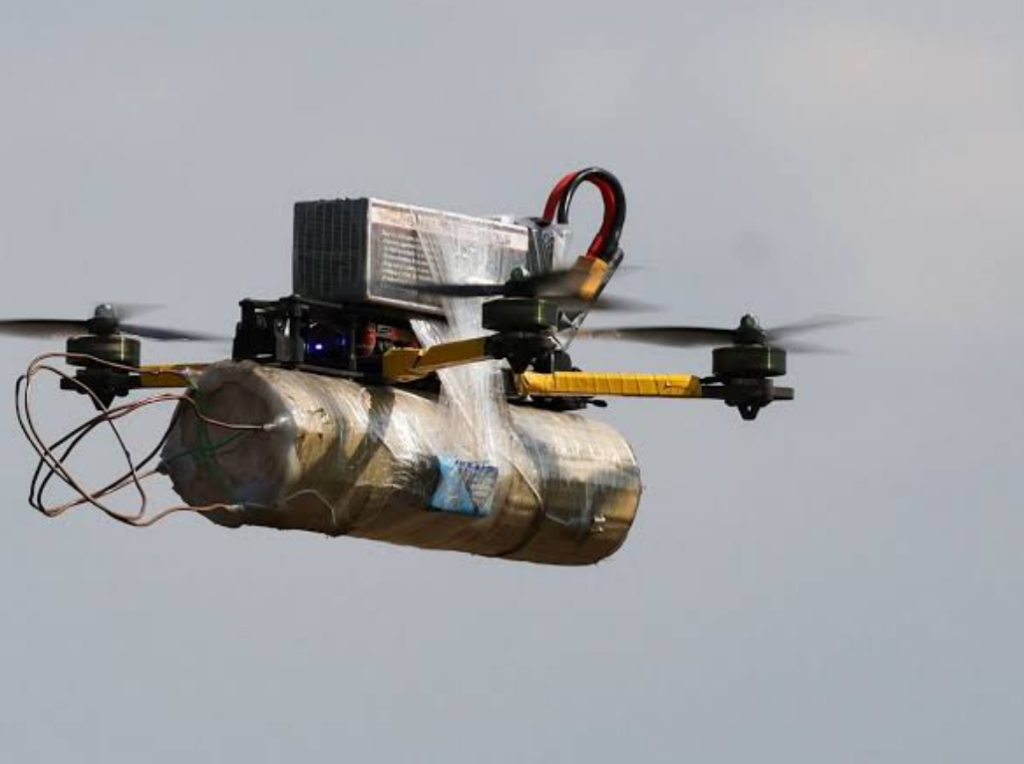
President Volodymyr Zelensky took responsibility for the strike, saying it had hit “one of the key facilities” of Russia’s oil industry as well as a logistics hub. He named a long series of Ukrainian systems used in the operation: FP-1, RZ-100, MICH-2000, Palianytsia, Vendetta, Liutyi, Bars, Flamingo, Sichen and Pelican. Independent analysts have partly corroborated this account, pointing to substantial damage at the refinery and at a logistics complex near Sofyino.
The reasoning in Kyiv: cut the money that fuels the war
For Ukraine’s leadership, the calculation is straightforward. This conflict is no longer confined to the front line. It also runs through the economic assets that allow Moscow to fund and supply its military machine. Energy infrastructure therefore becomes an obvious strategic target — not a symbolic one, but a lever aimed directly at Russia’s capacity to keep fighting.
How long-range exchanges became the new normal
None of this happened in a vacuum. Since the large-scale invasion of Ukraine in February 2022, Russia has repeatedly fired missiles and drones at Ukrainian cities and power networks. The growing number of Ukrainian attacks on Russian soil is, in part, an answer to that long-range campaign. More than anything, it shows how artificial the divide between “front” and “rear” has become.
Responsibility: putting the outbreak of this war back in context
The political starting point cannot be blurred. It was Russia that launched the full-scale invasion of Ukraine in 2022 and has continued its military operations ever since, despite enormous human, economic and diplomatic costs. Russian strikes on Ukraine have in turn caused mass destruction and civilian casualties. On 20 September, even as Russia itself was being hit, Ukrainian authorities were still reporting civilians killed in the Kyiv region after Russian attacks.
A strike that landed on the last day of Russia’s parliamentary vote
The timing was politically charged. The attack came on the final day of Russia’s legislative elections. Moscow’s mayor, Sergei Sobyanin, accused Ukraine of trying to disrupt the ballot — a framing Kyiv did not adopt. What the available facts establish is that the two events coincided. They do not, on their own, prove the precise political intention behind the operation.
Two narratives competing for one battlefield
That distinction matters. In a propaganda war this intense, each side frames events to suit its own story.
- Moscow’s line: it highlights civilian victims and an alleged Ukrainian desire to sabotage the elections.
- Kyiv’s line: it stresses the infrastructure that sustains Russia’s war effort.
The two readings can coexist. A strategically valuable installation can be a legitimate military objective while civilians living nearby are exposed to serious danger.
Ukraine’s steadily expanding long-range arsenal
Technology is another part of the story. Ukraine now fields a widening family of weapons able to reach targets far beyond its own borders, and the Flamingo missile featured among the systems Zelensky cited.
The Flamingo missile
Its inclusion in the list signals how quickly Kyiv’s deep-strike toolkit has matured over the course of the war.
The uncertain case of the Pelican
The “Pelican” remains harder to pin down. Analysts note that available information does not allow a precise identification of the system, and that several contradictory hypotheses are circulating.
Russia’s geographic shield is cracking
This deep-strike capability poses a direct challenge to Moscow. For a long time, sheer distance shielded a portion of Russia’s critical infrastructure. That relative protection is now eroding. A war the Kremlin wanted to confine largely to Ukrainian territory is producing effects in the central regions of the Russian Federation itself.
The spiral no one is steering
The most troubling prospect remains the risk of a tit-for-tat escalation. Moscow has already signalled its intention to intensify strikes on Kyiv following the September attacks. Each new operation can become the pretext for a new response, and every response the trigger for another round.
The contradiction the Kremlin cannot escape
Russia is therefore caught in a fundamental paradox. By trying to impose a military solution on the Ukrainian question, the Kremlin helped turn a war initially concentrated on Ukrainian soil into a far broader confrontation. The strikes on Moscow do not mean the war is over, and they will not by themselves rewrite Russian strategy. But they do demonstrate one thing clearly: the invasion has not delivered the security that was promised to the Russian people.
A burning refinery outside Moscow is more than a military episode. It symbolises the return of the war to the heart of the country that started it — and it recalls a truth that is hard to ignore. When a state chooses to prolong a war of aggression, it never fully controls the consequences it sets in motion.