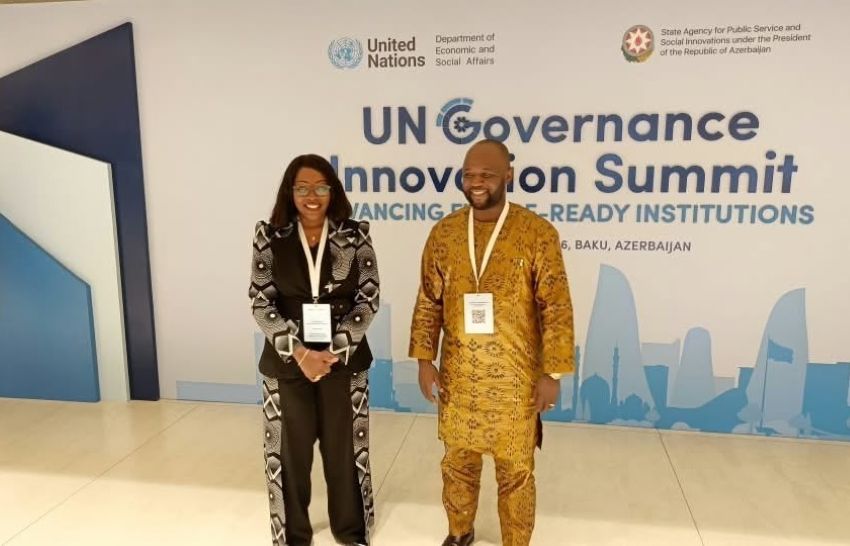
Baku, Azerbaijan — The push for modernizing Africa’s public administrations is gaining momentum, and Gabon and Guinea are leading the charge. On November 5, 2026, top officials from both countries met on the sidelines of the United Nations Summit on Governance Innovation to explore how digital reform, skill-building, and institutional restructuring can drive tangible change. This behind-the-scenes collaboration reveals deeper patterns in West-Central African governance reform, where leaders are quietly rethinking how state institutions engage with citizens.
What’s driving this shift? For decades, public administrations in Gabon and Guinea have grappled with overlapping challenges: inefficient bureaucracies, outdated human resource systems, and slow, opaque service delivery. But now, both countries are turning these constraints into catalysts for reform. According to officials present at the meeting, the goal isn’t just incremental improvement—it’s a full-scale transformation of how government operates, from internal workflows to end-user experiences.
Cross-border collaboration: the strategic logic behind the dialogue
The choice of Baku as the venue for these discussions wasn’t accidental. The UN Summit on Governance Innovation provides a neutral platform for countries like Gabon and Guinea to compare notes on systemic challenges and test solutions at an international scale. For both nations, the stakes are high: improving public trust, attracting investors, and positioning their administrations as models of efficiency in a region where governance quality is increasingly linked to economic credibility.
The meeting between Laurence Ndong, Gabon’s Minister of Public Service and Capacity Building, and François Bourouno Faya, Guinea’s Minister of Public Administration Modernization and Public Service, wasn’t just symbolic—it was strategic. As the two ministers discussed piloting new organizational models, the conversations revealed a shared frustration with traditional public sector inertia. The reforms they’re pursuing aren’t just about technology—they’re about shifting mindsets from process compliance to citizen-centric outcomes.
Digital transformation as the backbone of reform
The conversation quickly centered on digitalization—more than a buzzword, it’s the infrastructure powering Gabon’s Integrated Human Resources Management System (SIGRH) and Guinea’s upcoming e-governance platforms. Both systems aim to replace paper-heavy workflows with streamlined, data-driven decision-making. For citizens in Libreville and Conakry alike, this could mean shorter wait times, clearer procedures, and fewer bureaucratic bottlenecks when accessing essential services.
From paper trails to performance tracking
The Gabonese delegation showcased a revamped civil service framework designed to eliminate redundancy and improve workforce accountability. By integrating digital record-keeping and automated career-path tracking, the country is moving toward a system where promotions and postings are based on verifiable merit—not political favor or outdated geopolitical quotas. Guinea, meanwhile, is piloting its own version of “single-window” service delivery, consolidating previously fragmented departments into one-stop shops for permits and licenses.
These changes aren’t just technical upgrades. They reflect a growing recognition that public sector reform in both countries is less about new laws and more about changing the culture of public service. Agencies that once operated in silos are being pushed to share data, align processes, and measure performance against measurable citizen outcomes.
Why now? The convergence of global and local pressures
The timing of this collaboration is no coincidence. Both Gabon and Guinea have recently undergone political transitions, creating windows for policy experimentation. With demand for efficiency rising across Africa, governments are under pressure to demonstrate tangible improvements in public service delivery. At the same time, digital tools have matured enough to make automation—and real-time governance—feasible for mid-income countries.
Challenges and risks on the path to reform
Of course, the road ahead isn’t without obstacles. Resistance to change remains a persistent challenge, particularly among entrenched civil servants accustomed to analog workflows. There are also concerns about data privacy and cybersecurity as administrations digitize sensitive records. Yet, according to participants, the most significant hurdle may be political will—ensuring that reform initiatives survive leadership transitions and budget fluctuations.
To mitigate these risks, Gabon and Guinea are leaning on each other’s experiences. Officials plan reciprocal study visits, allowing civil servants to observe working models firsthand. The idea is to foster a culture of continuous learning where successes—and failures—are openly discussed and scaled across borders.
From dialogue to delivery: what success looks like
The true test of this partnership will be in the services citizens see on the ground. When a business owner in Port-Gentil applies for a permit and receives it within days instead of weeks, or when a retiree in Conakry checks pension status online from home, these are the signs that the reforms are working. Both ministers emphasized that the goal isn’t just administrative efficiency—it’s about restoring public confidence in government institutions.
As the two nations move from pledge to practice, the broader lesson for Africa is clear: sustainable public sector reform requires both structural changes and cultural shifts. Gabon and Guinea are betting on each other as much as on technology. Their journey offers a blueprint—not perfect, not final, but rooted in realism and mutual accountability.