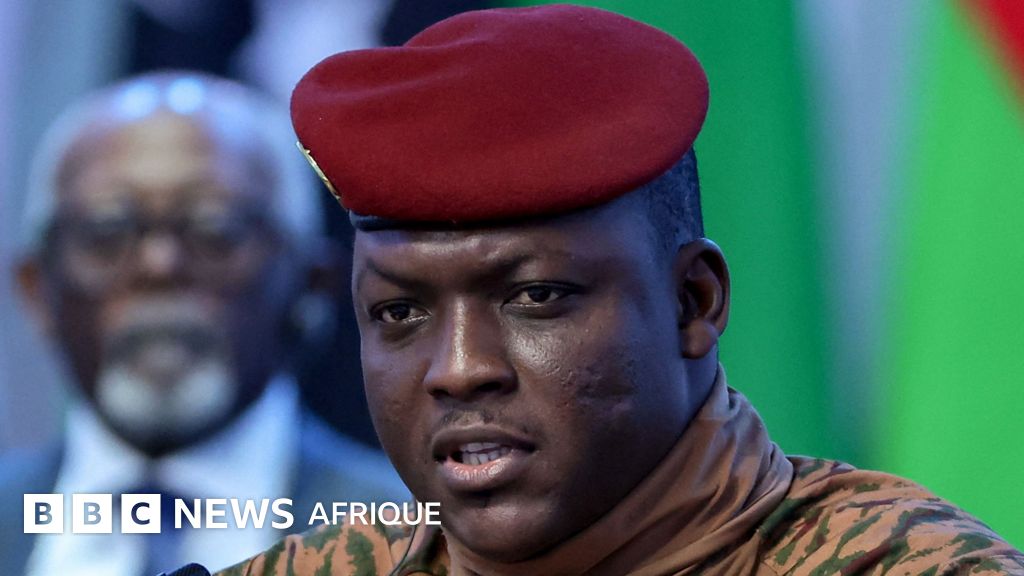
The military leader of Burkina Faso has declared that the nation must abandon its pursuit of democracy, calling the system “a killer” that has no place in the country. Speaking in a televised interview, Captain Ibrahim Traoré, who seized power three years ago, argued that most Africans do not want Western-style democracy and that Burkina Faso must forge its own path.

From democratic promises to authoritarian rule
Traoré initially pledged to restore democracy in Burkina Faso by July 2024. Yet, just two months before the deadline, the military junta announced a five-year extension of its rule, effectively sidelining democratic processes. In January, the government dissolved all political parties as part of a broader strategy to “rebuild the state”, seizing their assets and transferring them to state control.
During the interview, Traoré bluntly stated: “People must forget about democracy. Democracy is not for us.” He went on to warn that Western-backed democratic interventions elsewhere have led to chaos, citing the case of Libya as an example. The North African nation, once under the autocratic rule of Colonel Muammar Gaddafi, collapsed into a prolonged civil war following his ousting in 2011, with no stable government since.
A radical break with traditional politics
The 38-year-old leader, who presents himself as a revolutionary figure fighting against Western imperialism, criticized local politicians, describing them as “liars, flatterers, and charlatans.” He argued that Burkina Faso’s new system would prioritize sovereignty, patriotism, and revolutionary mobilization, with traditional leaders and grassroots structures playing a central role.
Traoré also emphasized the need for economic and military self-reliance, dismissing the idea of standard workdays. “Six or eight-hour workdays won’t help Burkina Faso catch up with wealthier nations,” he declared. His administration has cracked down on dissent, targeting opposition figures, independent media, and civil society groups. Critics have accused the government of silencing opponents by deploying them to frontline combat zones in the fight against Islamist militants.
Controversial support amid regional instability
Despite his authoritarian approach, Traoré has gained significant support across Africa for his anti-Western rhetoric and panafricanist stance. Burkina Faso, along with neighboring juntas in Mali and Niger, has severed ties with Western partners—particularly France—in its battle against Islamist insurgencies that have plagued the Sahel for over a decade.
Instead, these countries have turned to Russia for military assistance. However, violence continues unabated. Recent reports indicate that over 1,800 civilians have been killed in Burkina Faso since Traoré’s rise to power in 2023, with human rights groups attributing two-thirds of these deaths to state forces and allied militias.
No clear path forward
The junta’s rejection of democracy and its aggressive policies have left many questions unanswered. Without a viable alternative model, Burkina Faso remains trapped in a cycle of instability, with no end in sight to the conflict or the humanitarian crisis it has spawned.