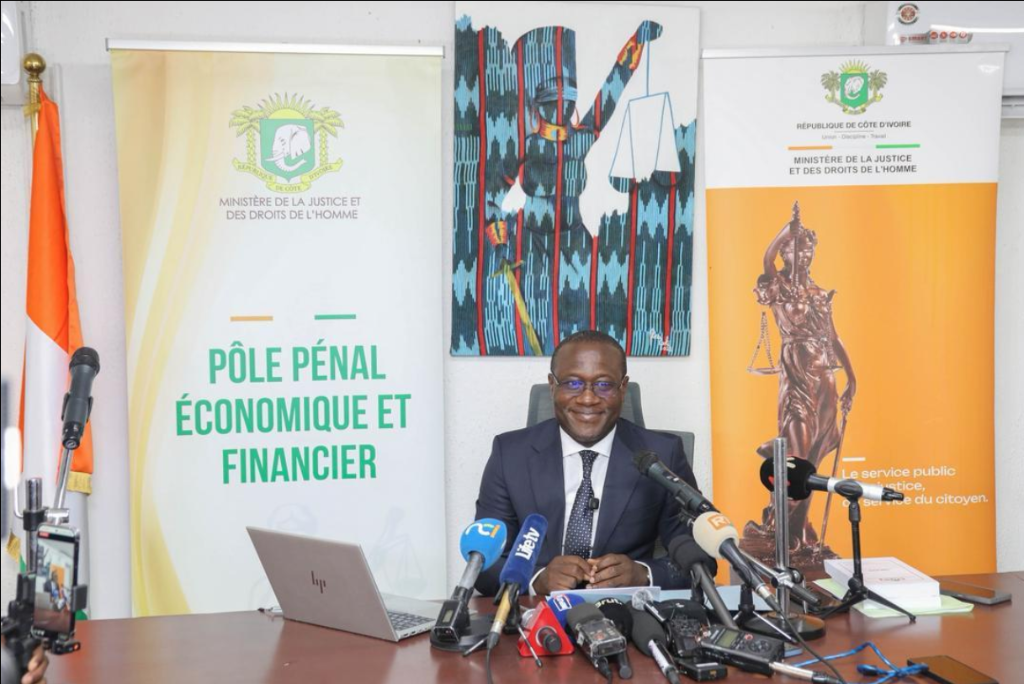
The surprise deployment of Federal Bureau of Investigation (FBI) agents to Côte d’Ivoire’s Economic and Financial Crimes Unit (PPEF) in Abidjan has ignited a fierce public debate. While some speculate about shadowy corruption allegations within the specialized court, Justice Minister Jean Sansan Kambilé has stepped forward to clarify the controversial presence of American investigators, asserting their role is strictly limited to combating transnational cybercrimes targeting victims in the United States.
The FBI’s mission: fighting sextortion networks operating from Côte d’Ivoire
Minister Kambilé confirmed that the FBI’s involvement stems from a surge in sextortion cases where American victims have been systematically exploited by criminal networks based in Côte d’Ivoire. These operations typically begin with deceptive social media interactions, where criminals build false relationships with targets before obtaining compromising material. The suspects then leverage the threat of public exposure to extort substantial sums from victims, with some cases tragically resulting in self-harm.
The minister revealed that the American authorities reached out to their Ivorian counterparts after identifying a disturbing pattern: « American citizens have repeatedly fallen victim to sextortion schemes orchestrated from Ivorian soil. To date, our joint efforts have led to the apprehension and prosecution of nearly a dozen suspects, with several still awaiting trial. »
The framework: a joint task force to dismantle cybercrime rings
The cooperation takes shape through a specialized working group, dubbed the « Joint Task Force, » comprising Ivorian financial crime investigators, prosecutors from both nations, and FBI agents. This coordinated approach targets not only sextortion but also money laundering networks that often intersect with cybercriminal enterprises. According to the Justice Ministry, the initiative has already yielded tangible results, including asset seizures and the dismantling of key operatives.
Under the task force’s structure, American agents operate within the PPEF under strict guidelines that preserve Ivorian judicial sovereignty. Their participation is limited to technical support, evidence sharing, and joint investigations, with all arrests and prosecutions conducted by local authorities under Ivorian law.
Addressing corruption allegations: justice ministry pushes back
The announcement follows media reports suggesting potential corruption within the PPEF, including claims of foreign-linked bank accounts and influence peddling. The Justice Ministry swiftly dismissed these allegations as baseless, emphasizing that no foreign entity has ever lodged corruption complaints against Ivorian officials. The ministry stated: « The FBI’s role is strictly confined to cybercrime enforcement, with no involvement in domestic investigations. »
These clarifications aim to quell public skepticism while reinforcing Côte d’Ivoire’s commitment to international judicial cooperation. Officials highlight the broader strategic benefits, noting that the PPEF’s enhanced capabilities contributed to the country’s recent removal from the Financial Action Task Force (FATF) grey list—a milestone demonstrating progress in combating financial crime.
Sovereignty concerns: how much authority do FBI agents wield in Abidjan?
Despite the official narrative, the debate persists over the extent of American investigators’ powers within Ivorian judicial premises. Critics question whether the collaboration risks undermining local autonomy, particularly when foreign agents operate within national institutions. Legal experts emphasize the need for clear regulatory boundaries to prevent any perception of foreign interference in domestic affairs.
Proponents of the partnership argue that robust international cooperation is essential to tackle crimes that transcend borders. They point to the task force’s successes—such as the extradition of key suspects and the recovery of illicit funds—as proof of the initiative’s effectiveness. Yet, for many Ivorians, the presence of FBI agents raises uneasy parallels with historical patterns of external influence in African governance.
What’s next? The future of Ivorian-U.S. judicial cooperation
As the dust settles on the controversy, the government faces a dual challenge: maintaining public trust while expanding partnerships to address evolving threats. With cybercrime and financial fraud proliferating across West Africa, the task force model may serve as a blueprint for future collaborations—provided transparency and accountability remain central to the approach.
The Justice Ministry has signaled its intention to publish periodic updates on the task force’s operations, though critics demand stricter oversight mechanisms. For now, the FBI’s presence in Abidjan remains a flashpoint, encapsulating the broader tensions between security imperatives and national sovereignty in an era of globalized crime.