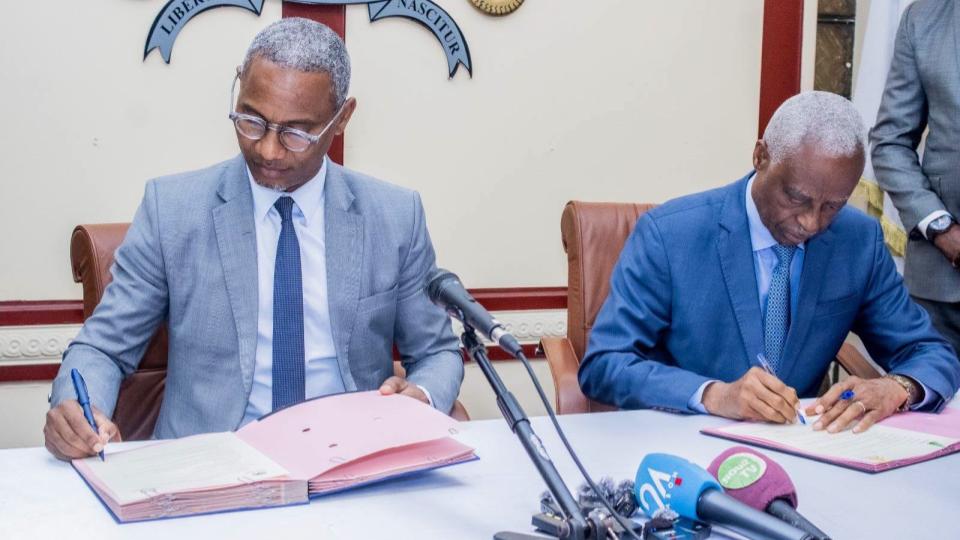
In a significant move towards enhanced local governance, Paul Kessany, Gabon’s Minister of Youth, Sports, Cultural Radiance, and Arts, formalized a framework agreement for the transfer of competencies with the Libreville Commune on Thursday, July 30, 2026. This action marks a pivotal step in realizing the decentralization policy championed by the President of the Republic, Head of State, and Head of Government, Brice Clotaire Oligui Nguema. The ambitious reform aims to bring public policies closer to citizens by granting greater responsibilities to local authorities across Gabon.
The decentralization agenda, established as a top priority by President Brice Clotaire Oligui Nguema, continues its tangible implementation. Following a series of institutional reforms designed to strengthen the role of territorial communities, the Ministry of Youth, Sports, Cultural Radiance, and Arts is now initiating the gradual transfer of its responsibilities to the Libreville Commune.
Through the signing of this landmark framework agreement, Paul Kessany emerges as one of the first government members to concretely translate the Head of State’s vision within his ministerial department. This vision seeks to build an administration that is more accessible to citizens and more responsive to local realities across the nation.
A reform driven by the head of state’s vision
The agreement forged between the ministry and the Libreville municipality outlines the progressive devolution of competencies in critical areas including youth affairs, sports development, leisure activities, cultural promotion, artistic endeavors, and the support of associative life.
This proactive approach directly addresses President Brice Clotaire Oligui Nguema’s ambition to transform local authorities into genuine catalysts for territorial development. By decentralizing decision-making centers and bringing them closer to the populace, the overarching objective is to enhance the quality of public services while simultaneously granting greater autonomy to communes in managing local policies.
For Minister Paul Kessany, this new era of governance is expected to facilitate better maintenance of sports infrastructure, invigorate cultural activities, foster artistic talent, and strengthen support for local community associations, ultimately benefiting Gabonese citizens.
Paul Kessany inaugurates a new phase of decentralization
Beyond the symbolic significance of this signing, the minister is now committing his department to a profound reform poised to permanently reshape the governance of the sectors under his purview.
However, the Mayor of Libreville prudently emphasized that this decentralization initiative can only achieve its full potential if it is accompanied by an effective transfer of human, technical, material, and financial resources. Furthermore, sustained technical support from the State will be crucial throughout the transitional period.
This vital requirement aligns perfectly with the fundamental principle advocated by the Head of State: truly effective decentralization extends beyond mere administrative transfers; it must also empower local communities with the necessary means to fully exercise their newly acquired responsibilities.
The festival of cultures, first symbol of this new governance
The momentum generated by this agreement will swiftly manifest on the ground. As early as next week, the ministry led by Paul Kessany and the Libreville Commune will collaboratively host the Festival of Cultures, marking the inaugural joint initiative stemming from this innovative partnership.
Beyond its inherent cultural dimension, this event will serve as a powerful illustration of the government’s commitment to leveraging decentralization as a concrete mechanism for serving citizens, faithfully adhering to the vision articulated by President Brice Clotaire Oligui Nguema.
With this framework agreement, Paul Kessany’s actions directly translate presidential pledges into operational realities for decentralization in Gabon. The paramount challenge now lies in demonstrating that this transfer of competencies will genuinely enable local authorities to achieve greater efficiency, autonomy, and capacity to act, ultimately benefiting the populations they serve.