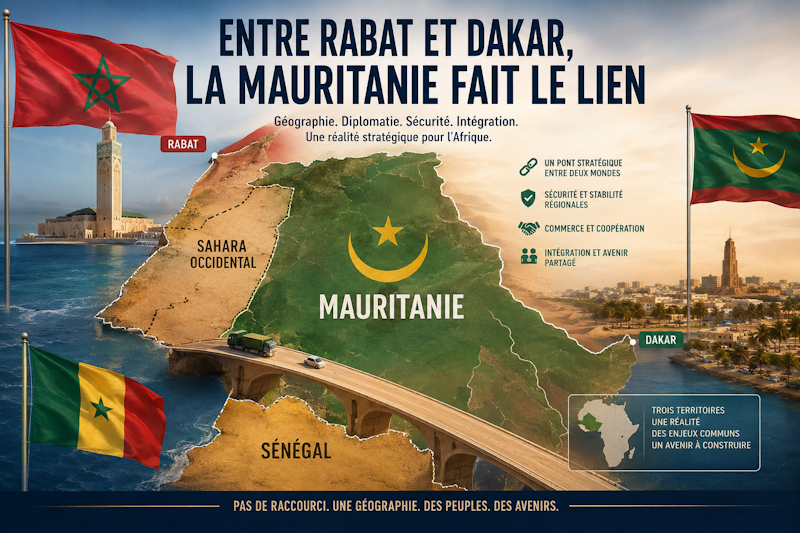

When examining the relationship between Morocco and Senegal, one cannot overlook the pivotal role of Mauritania, as highlighted by Mauritanian journalist Ahmed Ould Bettar.
The vast stretch of land separating Rabat from Dakar is not merely an empty space—it is a region shaped by history, sovereignty, and strategic interests. At its core lies the Western Sahara, a territory whose status remains internationally contested. Yet, equally indispensable to this equation is the Islamic Republic of Mauritania, whose geographical and political significance is often underestimated.
Mauritania: The missing link in Maghreb-West Africa ties
Geography does not lend itself to shortcuts, nor does diplomacy tolerate oversimplifications. The idea that there exists a direct path between Morocco and Senegal ignores a fundamental reality: the land in between is not a void but a sovereign nation—Mauritania. This oversight distorts the true dynamics of North-South relations in Africa.
More than just a corridor or a stretch of desert, Mauritania stands as a fully recognized state and a key diplomatic player. Its influence extends across security, trade, and regional integration, making it an indispensable bridge between the Maghreb and West Africa.
The dangers of overlooking Mauritania’s strategic importance
Reducing Mauritania to a mere transit zone or an afterthought in regional discussions undermines the complexity of its role. As conflicts, economic ties, and security challenges evolve, the country’s position becomes ever more critical. Ignoring its presence—whether intentionally or not—risks oversimplifying a geopolitical landscape that is anything but simple.
The Western Sahara dispute, while significant, is not the sole factor shaping relations between these nations. Mauritania’s own national interests, its alliances, and its historical ties to both Morocco and Senegal demand careful consideration. To dismiss its relevance is to disregard the very fabric of regional stability.
Why precision matters in African geopolitics
Words carry weight, especially when spoken by those who claim deep knowledge of African affairs. The call for clarity is not academic—it is essential. In a continent where borders define identities and sovereignty, reducing geography to theoretical lines on a map is not only inaccurate but potentially perilous.
Between Rabat and Dakar, more than just distance separates two capitals. There are people, histories, and competing visions for the future. Mauritania is not a detour; it is a destination in itself—a nation whose voice must be heard in any serious discussion of Maghreb-West Africa relations.
The lesson is clear: in geopolitics, as in diplomacy, shortcuts lead to dead ends. Mauritania’s role is not optional; it is indispensable.